

Trying to lose fat but unsure whether to choose whey isolate or concentrate? You’re not alone.
Here’s the truth: the wrong pick can slow your progress—bloating, extra calories, and less muscle retention. The right pick helps you burn fat, stay lean, and feel better.
After years of coaching fat loss transformations, I’ve seen the difference firsthand.
🔥 Below are 7 reasons why whey isolate beats concentrate for fat loss.
- Fewer calories per scoop – Saves 10–30 calories, adds up over weeks.
- Less carbs and fat – Pure protein, nothing extra to store.
- Almost no lactose – No bloating, no gas, no stomach issues.
- Faster absorption – Quicker muscle recovery without heaviness.
- More protein per gram – 90%+ vs 70–80% – better value for your macros.
- Easier to digest in a deficit – Less gut stress when calories are low.
- Leaner body composition results – Helps retain muscle while shedding fat.
Now let’s cut through the confusion. Below I’ll answer the most common questions I get from clients — starting with the quick answer you’re really looking for.
Table of contents
- Quick Answer: Isolate or Concentrate for Fat Loss?
- What’s the Difference Between Whey Isolate and Concentrate?
- Isolate vs Concentrate: Which Has Fewer Carbs and Fat?
- Calorie Comparison: Which Has Fewer Calories?
- Digestion and Absorption: Which Supports Leaner Goals?
- Training and Fat Loss: Does Type of Whey Matter?
- Budget vs Goal: Isolate Worth the Extra Cost?
- Real-Life Tips from a Fitness Coach
- FAQ
- Final Verdict: Best Whey for Weight Loss Goals
Quick Answer: Isolate or Concentrate for Fat Loss?
✅ Whey isolate is the better choice for fat loss.

It has fewer calories, less carbs and fat, and absorbs faster – three advantages that directly support a calorie deficit.
That said, concentrate can still work. If you’re not lactose-sensitive and you track your total intake closely, it’s a solid budget-friendly option.
When I cut weight or help clients shred fat, I choose isolate every time – unless budget is tight or bloating isn’t an issue.
Isolate for precision. Concentrate for value. Pick what fits your body and budget.
Want to see how other proteins compare? Check EAAs vs BCAAs vs Protein.
What’s the Difference Between Whey Isolate and Concentrate?

Feature | Whey Isolate | Whey Concentrate |
|---|---|---|
Protein per scoop | 25g (90%+) | 20-22g (70-80%) |
Calories per scoop | ~100-110 | ~120-140 |
Carbs | Less than 1g | 2-4g |
Fat | Less than 0.5g | 1-2g |
Lactose | Almost zero | Low to moderate |
Best for | Fat loss, low-calorie diets, sensitive stomach | Budget, bulking, general fitness |
Both come from milk, but processing changes everything.
- Concentrate is less filtered. It stays closer to the original whey – about 70-80% protein, with some lactose, carbs, and fat left behind.
- Isolate goes through extra filtration. It delivers 90%+ pure protein with almost everything else removed. That means less bloat, fewer calories, and faster digestion.
Real example: During one of my own cutting phases, I started with concentrate. After a few weeks, I felt bloated and sluggish. Switching to isolate fixed it overnight – smoother digestion, lighter after meals, better energy.
👉 Want to know if whey is safe for daily use?
Read: Is Whey Protein Safe for Daily Use?
Isolate vs Concentrate: Which Has Fewer Carbs and Fat?
Isolate wins — by a lot.
Whey isolate undergoes extra filtration, which strips away almost all carbs and fat. Concentrate is less processed, so more of those extras remain.
Here’s a typical per-scoop breakdown:
Nutrient | Whey Isolate | Whey Concentrate |
|---|---|---|
Carbs | <1g | 3–5g |
Fat | <0.5g | 1–2g |
Protein | 25g | 20–22g |
Why this matters for fat loss:
When you’re in a calorie deficit, every gram counts. Those extra carbs and fat from concentrate may not seem like much — but over 30 days of daily shakes, concentrate adds 90–150g of extra carbs and 30–60g of extra fat compared to isolate.
That’s roughly 500–1,000 extra calories per month from concentrate — just from your protein powder.
If you’re tracking macros strictly, isolate gives you more control and more room for whole foods.
Calorie Comparison: Which Has Fewer Calories?
Isolate wins — by 10–30 calories per scoop.
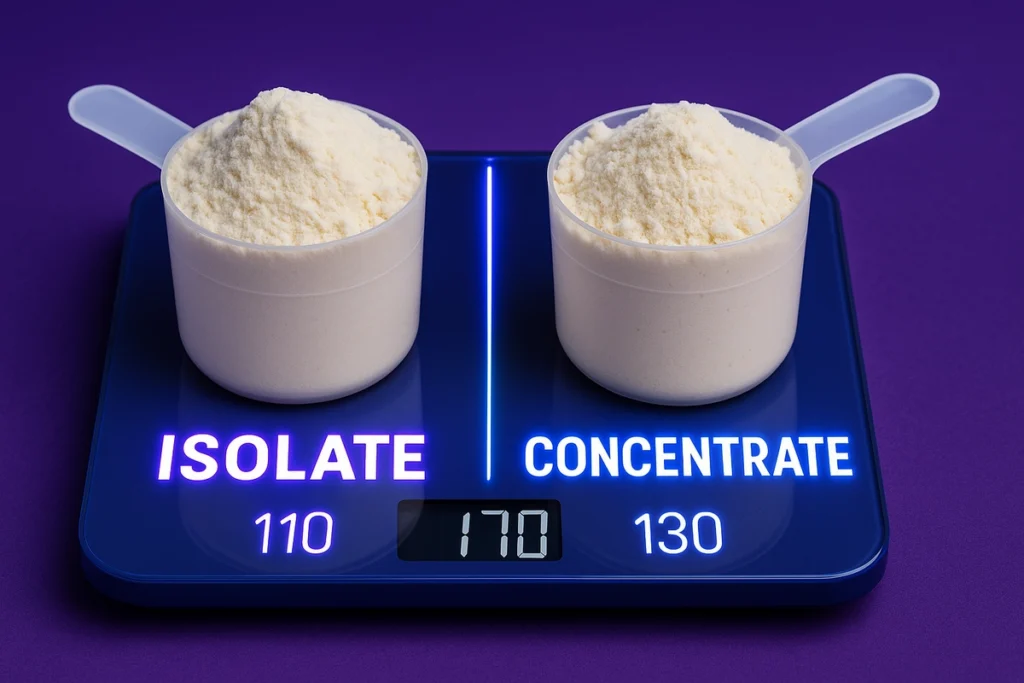
That doesn’t sound like much. But let’s do the math.
Nutrient | Whey Isolate | Whey Concentrate |
|---|---|---|
Calories (per scoop) | ~100–110 | ~120–140 |
Weekly calories | ~700–770 | ~840–980 |
Monthly calories | ~3,000–3,300 | ~3,600–4,200 |
In a strict calorie deficit, every bit counts. Those saved calories can be the difference between a plateau and progress.
Real client example:
James was prepping for a photoshoot and stuck at a plateau. He switched from concentrate to isolate — same diet, same training. That small swap saved him about 210 calories per week. Within two weeks, he pushed past the plateau without changing a single meal.
Isolate gives you more calorie freedom while hitting your protein target.
Skinny guy trying to build better body composition? Best Whey Protein for Skinny Guys
Digestion and Absorption: Which Supports Leaner Goals?
Isolate absorbs faster and digests easier.

Here’s why that matters for fat loss:
Factor | Whey Isolate | Whey Concentrate |
|---|---|---|
Absorption speed | Fast (30–45 min) | Moderate (1–2 hours) |
Lactose content | <0.1g (nearly zero) | 1–3g |
Bloating risk | Very low | Low to moderate |
Best for | Post-workout, sensitive stomachs | Any time, if tolerated |
Why faster absorption helps:
A quicker recovery means less muscle soreness and better training consistency. When you feel lighter after a shake, you’re more likely to stick to your next workout — and your diet.
Real client example:
Lena from Sweden had constant stomach discomfort after her shakes — bloating, gas, and that heavy feeling that made her want to skip meals. We switched her from concentrate to isolate. Within three days, the discomfort was gone. She stuck to her plan consistently and dropped 8 lbs over the next 8 weeks.

Take this 2-minute assessment & get a science-backed training, nutrition & supplement roadmap built for YOUR body.
🔬 12,000+ personalized roadmaps generated
If your stomach fights you, you won’t stay consistent. Isolate removes that barrier.
Worried about long-term side effects? You might want to read this: Does Whey Protein Harm the Kidneys?
Training and Fat Loss: Does Type of Whey Matter?
It does—especially when you’re trying to retain muscle while losing fat.
Both isolate and concentrate help with muscle recovery and protein synthesis,
but isolate gives you more pure protein per scoop with fewer distractions (like carbs or fats).
When Carlos from Brazil hit a fat loss wall before a beach trip, I suggested switching from concentrate to isolate.
With that and tighter macro tracking, he dropped from 14% to 12.2% body fat in just 2.5 weeks.
Get the most out of your training with protein timing tips here:
Whey Protein Before or After Workout?
Budget vs Goal: Isolate Worth the Extra Cost?
Isolate is more expensive, no doubt. But if your gut is sensitive or you’re really focused on every macro, it’s worth it.
That said, I’ve had clients like Jake, a college student, do just fine on concentrate— as long as their overall diet is clean.
For many people, a quality concentrate with good protein content is enough.
I always say: if it fits your macros and doesn’t upset your stomach, go with what you can afford.
But if you’re going all in on fat loss, isolate gives you more control.
New to using protein and wondering how much to take?
Check this: Daily Whey Protein Intake for Muscle Growth
Real-Life Tips from a Fitness Coach
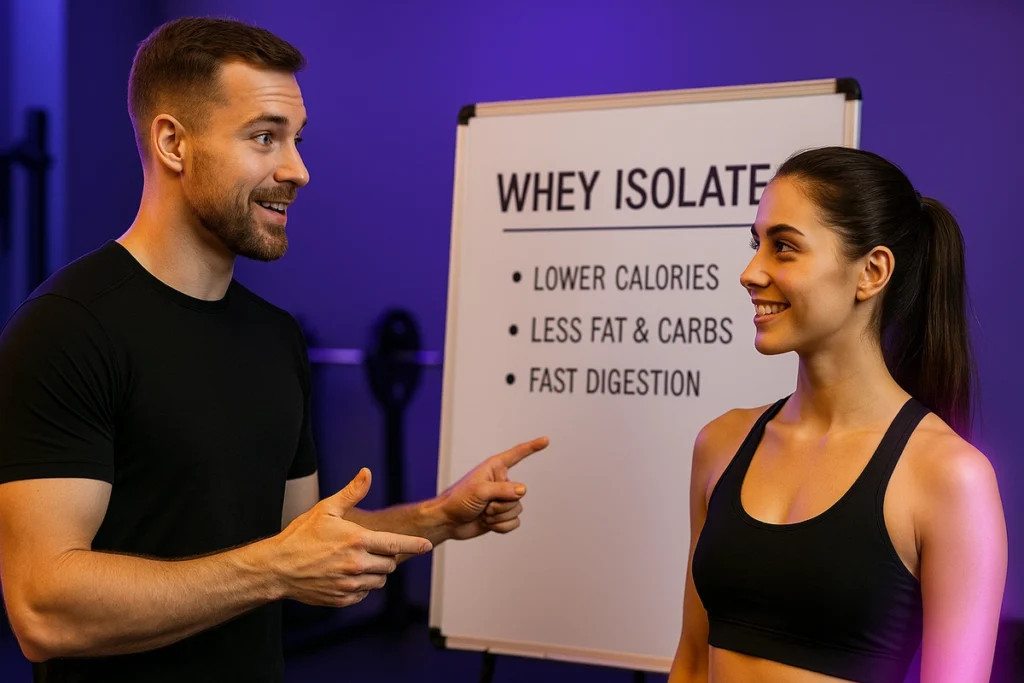
I’ve coached all kinds of clients, and I’ve made my own mistakes too. Here’s what I’ve learned:
- Don’t overdo the shakes. Jake was taking 3 scoops a day, thinking it would melt the fat.
We cut it to one post-workout shake and focused on whole foods—his results doubled. - Add fiber or healthy fats to make shakes more filling.
I often blend my isolate with flaxseed or half an avocado when I’m in a rush. - Use timing smartly. Emma, one of my clients from Australia, felt fuller and more energized after shifting her shake to post-workout instead of late night.
Also wondering if whey helps even without workouts?
Here’s the full breakdown: Whey Protein Without Working Out
FAQ
Yes. It’s low in calories, carbs, and fat, and high in pure protein. That helps you feel full while staying in a calorie deficit.
Usually yes. Isolate has fewer calories and less lactose. It also digests faster and causes less bloating, which makes sticking to your diet easier.
No, not directly. No protein burns fat on its own. But it helps preserve muscle while you lose fat, and it supports a high-protein diet that keeps you full.
Isolate. It goes through more filtration, so most of the carbs and fat are removed. Concentrate still contains small amounts of both.
Yes, if it fits your daily calories and doesn’t upset your stomach. Many people lose fat successfully with concentrate, especially on a budget.
About 10 to 30 calories per scoop. Over a week, that can add up to 150–200 calories – a small but helpful bonus when you’re cutting.
If you are sensitive to lactose, easily bloated, or tracking every macro strictly, yes. Otherwise, a good quality concentrate works fine.
After workout is best. It helps with muscle recovery without adding many calories. But timing matters less than your total daily intake.
No single food or supplement targets belly fat. But replacing a higher‑calorie meal or snack with a whey isolate shake can help you create the calorie deficit needed to lose fat everywhere, including your belly.
One to two scoops is enough for most people. Don’t overdo shakes – focus on whole foods. Use whey as a tool, not a meal replacement for every meal.
Final Verdict: Best Whey for Weight Loss Goals
If you’re cutting, chasing definition, or sensitive to digestion, whey isolate is the winner.
It’s leaner, faster-absorbing, and easier on the gut—perfect for staying sharp in a calorie deficit.
But don’t rule out whey concentrate.
If you’re not lactose-sensitive and want a cost-effective solution, a high-quality concentrate still delivers great results—
as long as your overall plan is on point.
At the end of the day, your consistency matters more than your scoop.
Just make sure you’re using whey protein as a tool, not a shortcut.
If your goal shifts toward muscle building or bulking, compare your options here: Mass Gainer vs Whey Protein: Which Builds Better Bulk?

 Claim Your Free Assessment
Leave a Reply