
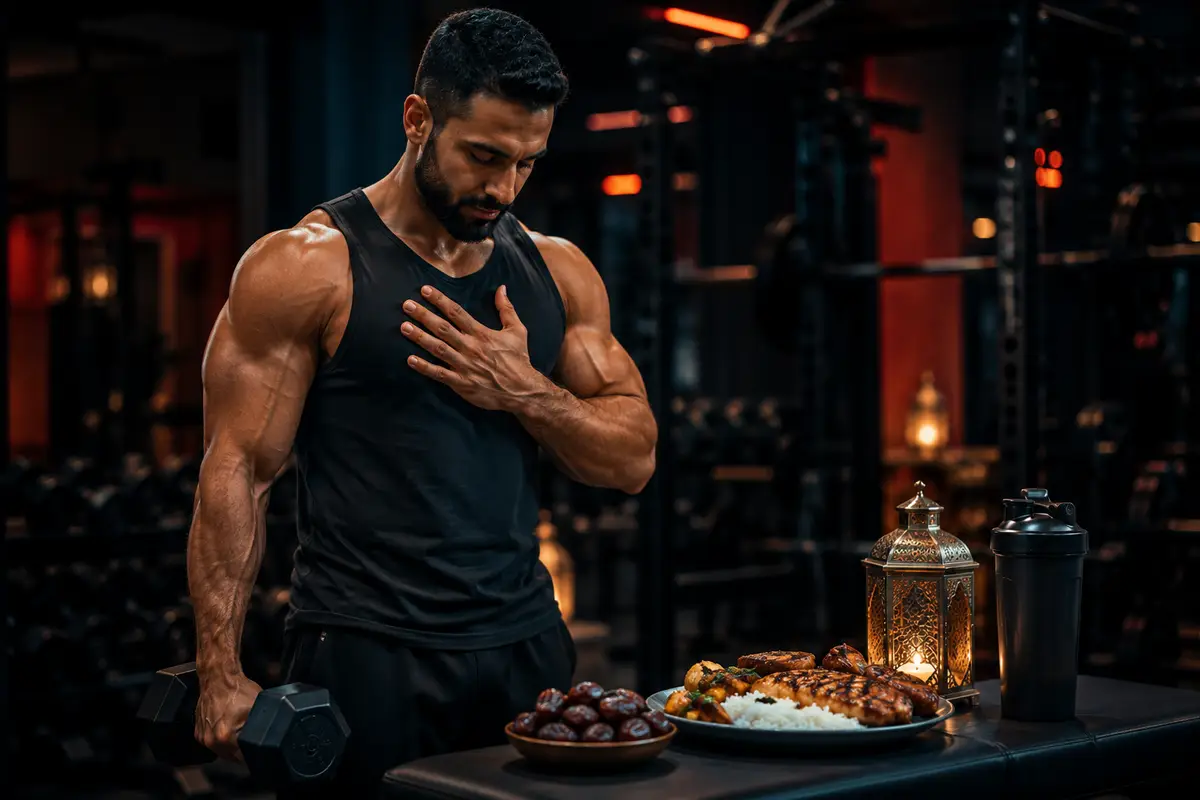

I’m Hossein Mardali, and I’ve spent over seven years in coaching clients through every imaginable challenge. But nothing tests a lifter’s discipline quite like Ramadan.
You’re fasting for 14 to 16 hours, your sleep schedule flips upside down, and somehow you’re supposed to hold onto muscle and performance.
I’ve lived this personally and guided countless clients through it. Let me walk you through exactly what works.
Table of contents
Can You Build Muscle While Fasting? (The Direct Answer)
Let’s cut through the noise immediately. Yes, you can maintain muscle during Ramadan. In fact, I’ve watched clients like Marcus—a 42-year-old accountant who trained with me last year—not just maintain but actually add 5kg to his back squat by the end of the month.
Is that typical? No. Building significant new muscle while fasting requires everything to line up perfectly. But retention? Absolutely achievable. The key sits in three words: nutrient timing matters.
You cannot out-train a poorly timed meal plan during Ramadan. Your window shrinks dramatically, so every bite needs purpose. Hit your maintenance calories, protect your protein intake at 1.6 to 2.2 grams per kilogram of bodyweight, and preserve the strength stimulus.
Do those things, and you emerge from the month intact. Skip them, and I’ve seen lifters lose months of progress in four weeks.
The Non-Negotiable Rules of Ramadan Nutrition
Suhoor (Pre-Dawn Meal): The Engine Room
Here’s where experienced lifters sabotage themselves most. I cannot count how many athletes I’ve seen treat Suhoor like an afterthought—a bowl of cereal, a glass of water, back to sleep. That single mistake destroys performance. I know because I made it myself.
Early in my competitive career, I slept through Suhoor completely during a heavy deadlift phase. I woke up, realized what happened, and stubbornly decided to train pre-Iftar anyway. By the third warm-up set, my grip had vanished. I felt dizzy loading 60% of my usual working weight. I nearly blacked out.
I packed my gym bag and went home humbled. I have never missed Suhoor since—even if it means choking down oats and a shake at 3 a.m.
Your Suhoor must include three components:
- Slow-digesting protein anchors the meal. Casein-rich foods like Greek yogurt, cottage cheese, eggs, or lean beef release amino acids gradually across your fasting hours. Think of this as your muscle preservation insurance policy.
- High-fiber, low-glycemic carbohydrates provide sustained energy. Steel-cut oats, whole-grain bread, quinoa, and sweet potatoes prevent the mid-day energy crash. Fiber slows digestion, keeping you fuller longer.
- Healthy fats support hormonal function during a month when testosterone and other anabolic hormones face stress. Avocado, nuts, seeds, or olive oil belong on your Suhoor plate. Don’t fear fats here—you need them.
Hydration begins at Suhoor, not after Iftar. Aim for a minimum of one liter of water with electrolytes before dawn. Sodium, potassium, and magnesium prevent the cramps and headaches that derail training sessions.
Suhoor Component | Examples | Why It Matters |
|---|---|---|
Slow-Digesting Protein | Eggs, Greek yogurt, cottage cheese, casein shake | Gradual amino acid release across fasting hours |
Low-GI Carbohydrates | Steel-cut oats, whole-grain bread, quinoa, sweet potato | Sustained energy, prevents blood sugar crashes |
Healthy Fats | Avocado, almonds, chia seeds, olive oil | Hormonal support and satiety |
Hydration | 1L water + electrolyte powder or pinch of salt | Performance preservation and cramp prevention |
Iftar (Breaking the Fast): The Recovery Window
The Hossein Rule: protein before anything sweet. Always.
I break my fast with dates and water, pause for Maghrib prayer, then immediately consume 40 to 50 grams of fast-digesting protein. Only after that do I consider the main meal. That single discipline has protected my body composition through every Ramadan for over a decade. It’s completely non-negotiable.
Your Iftar unfolds in three strategic steps:
Step one involves dates, water, and ideally bone broth. Dates rapidly restore blood glucose after 14-plus hours without food. The broth replenishes minerals and prepares your digestive system for solid food. Don’t skip this transitional moment.
Step two delivers fast-acting protein immediately. Whey isolate absorbs fastest, but lean poultry or white fish work if you prefer whole foods. You’ve just spent an entire day in a catabolic state. Flipping that switch to anabolic requires speed.
Many clients ask me, “Can you take whey protein during intermittent fasting?” and the answer is a firm yes—during your feeding window, fast-digesting protein is exactly what your body needs.
Step three brings high-glycemic carbohydrates to replenish glycogen stores. White rice, potatoes, white bread, and fruits like bananas and dates excel here. Your muscles scream for glycogen after fasting, and the post-Iftar window offers prime replenishment timing.
The Hydration Window: Sip, Don’t Chug
Between Iftar and Suhoor, target 40 milliliters of water per kilogram of bodyweight. For an 80-kilogram lifter, that’s roughly 3.2 liters spread across the eating window. Chugging two liters at once overwhelms your system and sends you running to the bathroom. Sip consistently instead.
Excess caffeine and sugary syrups sabotage hydration. Traditional Ramadan drinks often pack enormous sugar loads. Enjoy them mindfully, but don’t count them toward your fluid goals.
If you rely on caffeine for training focus, you’ll want to understand how caffeine and fasting interact so you can boost energy without compromising your hydration strategy.
The Optimal Ramadan Training Blueprint
When Is the Best Time to Train? (3 Options Ranked)
I’ve experimented with every training time across my 10-plus years in this sport. Here’s how they stack up:
- Post-Iftar (Gold Standard): You’re fueled, hydrated, and neurologically ready. Train 45 to 60 minutes after that initial protein and small meal, then eat your largest dinner afterward. Every client who set a Ramadan PR—including Marcus with his squat—trained in this window. Performance stays highest here.
- Pre-Iftar (Time Efficient): Train 45 to 60 minutes before Maghrib. Volume must stay low to moderate because you’re depleted. The psychological advantage? You break your fast immediately post-workout, which feels rewarding. I use this window when my schedule demands it, but I never push intensity here.
- Post-Suhoor (Fasted Training): Only consider this if you can sleep afterward. Dehydration risk climbs throughout the day, and I’ve seen too many lifters crash before noon. I rarely recommend this to clients.
Training Window | Best For | Key Consideration |
|---|---|---|
Post-Iftar | Maximal performance and strength | Train after small meal, feast afterward |
Pre-Iftar | Time efficiency and convenience | Keep volume low; food comes immediately after |
Post-Suhoor | Early risers who can nap later | High dehydration risk; not recommended for most |
How to Adjust Volume and Intensity
Ramadan is not the month to chase one-rep maxes. I tell every client this on day one. Your central nervous system faces fatigue from disrupted sleep and dehydration. Testing limits here invites injury.
Reduce training volume by 30 to 40 percent during week one. Let your body adapt to the new rhythm before pushing harder. Focus on maintenance ranges: 3 to 6 reps for strength preservation, 8 to 12 reps for hypertrophy with slightly lighter loads than usual. You’re signaling your body to hold tissue, not break records.
Cardio needs restraint. Limit conditioning to 30 minutes of low-intensity steady state work—walking primarily. Aim for 8,000 to 10,000 steps daily. Save high-intensity interval training for post-Iftar sessions when fully fueled, or eliminate it entirely for the month. I made the mistake of HIIT while fasted once. I won’t do it again.
Supplement Stack Strategy for Fasting Athletes
Your feeding window shrinks, so supplement timing becomes surgical. These four supplements form my Ramadan foundation:
- Whey Isolate: Fast absorption matters when you have limited hours to hit protein targets. Take it immediately upon breaking your fast, before the main Iftar meal.
- Electrolyte Powder: Sodium, potassium, and magnesium prevent cramps, headaches, and performance drops. Sip throughout the eating window, not just at Suhoor.
- Creatine Monohydrate: It saturates tissues over time—not an acute booster. Take it during your feeding window without worry. Despite persistent myths, creatine does not cause dehydration during dry fasting. Take it post-workout with your shake.
- Vitamin D3: Most fasting athletes train indoors or during evening hours, limiting sun exposure. Take this fat-soluble vitamin with your largest Iftar meal for optimal absorption.
Supplement | Timing | Purpose |
|---|---|---|
Whey Isolate | Immediately at Iftar | Rapid amino acid delivery to reverse catabolism |
Electrolytes | Throughout eating window | Hydration support and cramp prevention |
Creatine Monohydrate | Post-workout with shake | Tissue saturation for strength preservation |
Vitamin D3 | With largest Iftar meal | Hormonal and immune support |
When clients ask me about amino acid supplementation, I point them toward my detailed breakdown of BCAAs during intermittent fasting so they understand the full science before spending money.
Similarly, the question of whether EAAs break a fast comes up constantly, and understanding that distinction matters for your supplement strategy.
If you’re specifically worried about muscle preservation during Ramadan, I’ve written an entire guide on BCAA during Ramadan that walks through the protocol I recommend to my fasting athletes.

Take this 2-minute assessment & get a science-backed training, nutrition & supplement roadmap built for YOUR body.
🔬 12,000+ personalized roadmaps generated
For a broader understanding of what’s safe to take during your eating window, my intermittent fasting supplements guide covers everything from vitamins to performance enhancers.
The Mindset Trap Nobody Talks About
Let me tell you about Aisha. She came to me after three weeks of Ramadan, frustrated and confused. She’d gained four kilograms of fat despite fasting 16 hours daily. When I asked about her Iftar, she described eating an entire tray of fried samosas and baklava every single night. Her reasoning? “I earned it after fasting all day.”
This represents the single most destructive psychological trap during Ramadan: treating the fast as punishment you reward with food. Fasting is not a deprivation you must compensate for. It’s a discipline you honor with nourishment. That mental shift changes everything.
Aisha and I rebuilt her approach. She started breaking her fast with protein first—my rule, which she adopted as her own. We tracked her intake for the first week to create awareness. The fried foods didn’t disappear, but they became a mindful choice once or twice weekly rather than a nightly habit. She finished the month leaner than she started, and her energy levels transformed.
The flip side of this trap is the “I’m too depleted to train” fear. Many clients assume fasting equals fragility. It doesn’t. Your body adapts remarkably well when you respect the new rhythm. Training maintains the muscle you’ve built. Removing the stimulus guarantees loss. Show up, adjust expectations, and trust the process.
If you’re trying to actually gain size during Ramadan, the approach shifts significantly—my mass gainers during Ramadan guide explains exactly how to structure a bulking strategy when your feeding window is compressed to a few hours.
FAQ
Not if you hit maintenance calories, consume 1.6 to 2.2 grams of protein per kilogram of bodyweight daily, and maintain a consistent strength stimulus. I’ve guided dozens of clients through Ramadan without muscle loss. The ones who lose tissue invariably undereat protein or stop training entirely.
Yes, but only low-intensity steady state work. Aim for 8,000 to 10,000 steps daily. Avoid high-intensity interval training unless you train post-Iftar and immediately replace fluids. I’ve learned this lesson the hard way—fasted HIIT leads to dehydration and performance crashes.
Break your fast with protein and a fat source first, not sugary desserts. Traditional sweets hold cultural importance, and I’m not suggesting you eliminate them. But when cravings hit, reach for fruit—dates, watermelon, or berries satisfy the sweet tooth without triggering the blood sugar roller coaster that drives more cravings.
Yes. Creatine saturates tissues gradually and does not act as an acute performance booster. Take it during your feeding window. It will not cause dehydration during fasting hours. This myth persists despite zero evidence, and I’ve personally used creatine through every Ramadan without issue.
Tradition-induced overeating explains nearly every case I see. Deep-fried iftar foods, heavy rice dishes, and sugary drinks create a significant caloric surplus despite the fasting period. Track your intake for the first week. Awareness alone often solves the problem—it certainly did for Aisha.

 Find Which Supplements You Need
Leave a Reply