
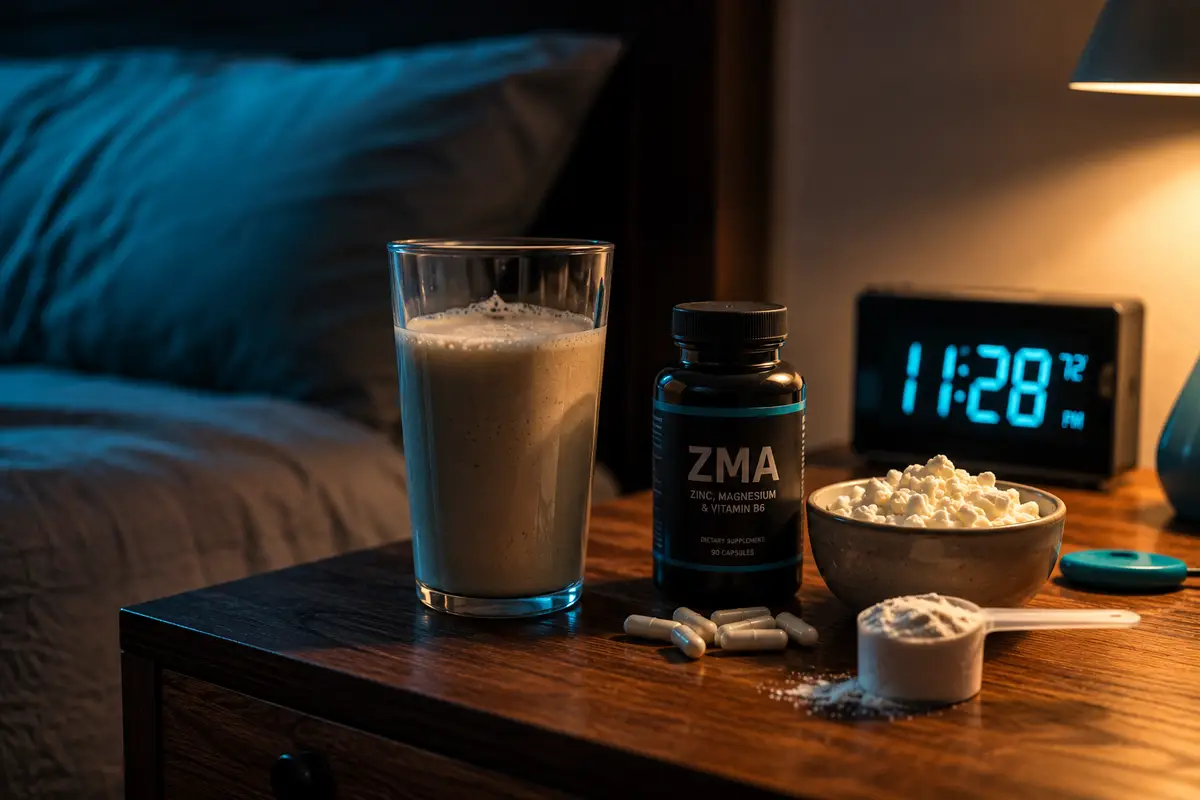

You crush your workouts. You hit your macros. Then you go to sleep and leave 6-8 hours of recovery on the table. That’s a mistake I used to make, too.
Let me walk you through exactly what works, what doesn’t, and how to wake up feeling like you actually recovered.
Table of contents
What Is the Best Pre-Sleep Nutrition for Muscle Growth?
Here’s the straightforward answer you came for:
Slow-digesting protein + sleep-supporting minerals.
That’s the formula. You need a steady drip of amino acids to stop muscle breakdown while you fast for 6-8 hours, and you need your nervous system to actually shut down into deep, restorative sleep.
Train hard but skip this window? You’re leaving gains on the table.
The overnight fast is the longest period your body goes without nutrients. Your muscle tissue is hungry. Cortisol creeps up. Without intervention, catabolism wins.
The right pre-sleep protocol flips that switch. It turns your bed into an anabolic environment.
Casein Before Bed: The Nighttime Muscle Protector
What Casein Actually Is
Casein isn’t some fancy supplement gimmick. It’s simply the dominant protein in milk, making up about 80% of dairy protein.
The magic is in how it behaves. Unlike whey, which hits your bloodstream fast and clears out in 90 minutes, casein clots in your stomach acid. It forms a gel-like mass that releases amino acids slowly over 6-8 hours.
Think of whey as a sprinter. Casein is a marathon runner. For a complete breakdown of its benefits and science, check out my casein protein ultimate guide.
How It Differs From Whey
Feature | Whey Protein | Casein Protein |
|---|---|---|
Digestion Speed | Fast (60-90 minutes) | Slow (6-8 hours) |
Best Timing | Post-workout, morning | Before bed, long gaps without food |
Amino Acid Spike | Sharp, rapid rise | Gradual, sustained release |
Muscle Protein Synthesis | High immediate boost | Moderate, prolonged elevation |
Anti-Catabolic Effect | Lower | Superior |
This slow-release nature makes casein your body’s overnight bodyguard. It tamps down muscle protein breakdown while you sleep.
Studies back this up, showing micellar casein before bed boosts overnight muscle protein synthesis and improves net protein balance. In fact, research shows that casein protein can meaningfully improve sleep quality and recovery.
The Anti-Catabolic Effect I’ve Witnessed
I’ll tell you about Marcus. He’s a 42-year-old accountant who trains at 5 AM before his kids wake up. Solid guy, disciplined.
But when he came to me, he was flat. Strength plateaued. Energy tanked by Wednesday. He’d sleep 7 hours and wake up feeling like he’d pulled an all-nighter.
I didn’t overhaul his entire program. I added one thing: 200g of low-fat cottage cheese 30 minutes before bed.
Within two weeks, he texted me: “I feel like a different person.” His morning sessions had power again. He leaned down without the constant fatigue.
That’s not magic. That’s stopping the overnight muscle breakdown that was draining him dry.
My Recommended Dosage
Based on 7 years of client feedback, here’s what consistently works:
- Men: 35-40g micellar casein, 30-60 minutes before sleep
- Women: 25-30g micellar casein, same timing window
- Whole food alternative: 200g low-fat cottage cheese or 250g Greek yogurt
Mix your powder with just water. Too much liquid right before bed? You’ll wake up to pee, and that ruins the entire point.
Best Casein Sources at a Glance
- Micellar casein powder (pure, slowest-digesting form)
- Low-fat cottage cheese (cheap, effective, real food)
- Greek yogurt (thick, high-protein, gut-friendly)
- Milk protein isolate (blend of casein and whey, decent compromise)
A client named Elena couldn’t stomach protein powders. They bloated her, left her uncomfortable.
I switched her to 200g of full-fat Greek yogurt with a small handful of almonds. The fat slowed digestion even more. She got the same sustained-release effect without the GI distress.
Listen to your body and adapt. If you’re torn between whole food and powder, I’ve broken down the pros and cons of cottage cheese versus casein powder for sleep and muscle growth.
ZMA Before Sleep: The Recovery Amplifier
What ZMA Actually Is
ZMA isn’t a single ingredient. It’s a specific combination of three nutrients:
- Zinc Monomethionine: 30mg
- Magnesium Aspartate: 450mg
- Vitamin B6: 10.5mg
This formula was designed to be taken on an empty stomach, right before bed. The minerals work synergistically.
Zinc supports testosterone production and immune function. Magnesium calms the nervous system. B6 helps your body utilize both minerals and supports neurotransmitter production.
Deep Sleep Enhancement and Natural GH Support
Zinc and magnesium deficiencies are shockingly common in athletes. You lose both through sweat. Training depletes them. When you’re low, sleep quality tanks and recovery suffers.
The research shows ZMA can improve deep sleep stages and support natural growth hormone release during the first sleep cycles.
You don’t get supraphysiological results like injecting GH. That’s not the claim. What you get is a restoration of what intense training drains away.
Dosage and Timing That Works
- Standard dose: One serving of ZMA (30mg Zinc, 450mg Magnesium, 10.5mg B6)
- Timing: 30-60 minutes before bed, on a completely empty stomach
- Cycling protocol: 3 weeks on, 1 week off to maintain sensitivity
This cycling piece matters. Your body adapts to everything.

Take this 2-minute assessment & get a science-backed training, nutrition & supplement roadmap built for YOUR body.
🔬 12,000+ personalized roadmaps generated
I learned this the hard way. Used ZMA nightly for six months straight and felt the effects fade. Now I cycle it, and every “on” phase hits like the first time.
Who Benefits Most
- Athletes in a caloric deficit
- Heavy trainers doing high volume
- Anyone with excessive sweating during workouts
- Clients struggling to reach deep sleep
- Those with low dietary zinc intake
Magnesium for Sleep Quality: The Missing Link
Glycinate vs. Citrate for Sleep
This is where I see clients mess up constantly. Not all magnesium is created equal. Here’s the breakdown:
Magnesium Type | Best For | Absorption | Sleep Effect |
|---|---|---|---|
Glycinate | Sleep, anxiety, relaxation | Excellent | Superior |
Citrate | Constipation, digestion | Good | Mild |
Oxide | Nothing really | Terrible | None (waste of money) |
Aspartate (in ZMA) | Recovery, deep sleep | Good | Moderate |
Magnesium glycinate is hands-down the winner for sleep. Glycine itself is a calming neurotransmitter. Bound to magnesium, you get a double effect.
It lowers cortisol, relaxes the central nervous system, and helps you fall asleep faster.
Citrate works for some people but often causes digestive urgency. The last thing you need before bed is a bathroom sprint.
How Magnesium Calms Your System
Magnesium acts as a natural GABA agonist. GABA is your brain’s primary inhibitory neurotransmitter. It tells neurons to slow down.
When magnesium levels are adequate, your nervous system can properly shift from sympathetic fight-or-flight to parasympathetic rest-and-digest mode.
It also regulates melatonin production and binds to excess glutamate, the excitatory neurotransmitter that keeps your mind racing at 11 PM.
Signs You’re Deficient
- Can’t shut your brain off at night
- Muscle twitches or cramps while lying still
- Anxiety spikes in the evening
- Waking up at 3 AM unable to fall back asleep
- Eyelid twitching during the day
- Poor recovery despite adequate calories and protein
I’d estimate 60% of my new clients show at least three of these signs.
A woman named Priya came to me convinced she had chronic insomnia. She’d been mixing her ZMA with milk, blocking the zinc entirely, and her magnesium intake was nonexistent.
We fixed the timing, added glycinate, and three nights later she messaged me about “the most vivid, restful sleep I’ve had in years.”
How to Stack Casein, ZMA, and Magnesium Correctly
This is the protocol I’ve refined over a decade of personal use and thousands of client nights.
The Perfect Pre-Bed Protocol
Time Before Sleep | Action | Details |
|---|---|---|
60 minutes | Take ZMA | On empty stomach, with water only |
45 minutes | Take magnesium glycinate (optional add-on) | 200-400mg, if using ZMA stick to 200mg extra |
30 minutes | Consume casein | 30-40g micellar casein with water, or cottage cheese |
15 minutes | Final bathroom trip | Minimize sleep disruption |
Lights out | Sleep in cool, dark room | No screens for 30+ minutes prior |
The Critical Timing Note
You cannot take ZMA with your casein shake. I don’t care how convenient it feels.
Priya, the client I mentioned earlier, complained ZMA did nothing for her sleep. She’d been downing it with a glass of milk. Calcium competes with zinc for absorption and wins. Her expensive ZMA was passing through her system completely unabsorbed.
The fix was simple: ZMA right before brushing her teeth, casein 20 minutes later in bed.
Three days. That’s all it took. Three days and she reported deep sleep and wild, vivid dreams.
What to Avoid Pairing With Your Stack
- Calcium-rich foods or drinks: Blocks zinc absorption. Separate from ZMA by at least 45 minutes.
- Large volumes of liquid: Interrupts sleep with bathroom trips.
- Caffeine within 6 hours of bed: Blocks adenosine receptors, overrides magnesium’s calming effect.
- High-fat meals right before casein: Slows gastric emptying beyond what’s useful, causing discomfort.
- Phone screens: Blue light kills melatonin production regardless of your supplement stack.
My Current Personal Stack
After 10+ years of experimenting, I’ve stripped it down to what actually moves the needle:
- 400mg magnesium glycinate
- 35g micellar casein mixed with water
- ZMA cycled 3 weeks on, 1 week off
In my early 20s, I had seven different supplements on my nightstand. Powders, pills, potions. I thought more meant better.
Now at 31, I know simplicity wins. The glycinate is non-negotiable for me. Without it, I feel the difference within two days. The ZMA cycles keep my body responsive. The casein keeps my muscles fed.
That’s it. That’s the stack. If you’re curious about adding another research-backed element, here’s the science on taking creatine before bed for overnight recovery.
Common Mistakes That Ruin Your Pre-Sleep Nutrition
I’ve made every one of these. So have my clients. Let me save you the wasted time.
1. Taking ZMA With Your Casein Shake
I’ve said it twice already. I’ll say it again because it’s that common.
Calcium blocks zinc. Keep them separate. The 45-minute gap between ZMA and casein isn’t a suggestion. It’s the entire game.
2. Using the Wrong Form of Magnesium
Walk into any drugstore and grab a “magnesium” supplement. Chances are it’s oxide. Magnesium oxide has a bioavailability of roughly 4%. You’re paying for expensive urine.
Always, always choose glycinate for sleep. Yes, it costs more. It also actually works.
3. Drinking Too Much Liquid Before Bed
You mix your casein with 500ml of milk. Add a glass of water with your ZMA. Then wonder why you’re up at 2 AM.
Use just enough water to mix your casein into a pudding consistency. Handle bathroom needs before your head hits the pillow.
4. Ignoring Sleep Hygiene Entirely
A supplement stack won’t outrun terrible sleep habits. You need a cool, dark room. No phones 30 minutes before bed. Consistent sleep and wake times.
Supplements amplify good habits. They don’t replace them. If you train late and struggle to wind down, I put together a list of the best caffeine alternatives for night workouts and sleep.
5. Skipping the Cycling Protocol
Take ZMA every night for months and your body adjusts. The effects fade.
Cycle it. Three weeks on, one week off. This keeps your system responsive. During the off week, you can increase magnesium glycinate slightly if needed.
6. Assuming Women Respond Identically to Men
They don’t. Women often respond more powerfully to magnesium glycinate alone, especially around their menstrual cycle when magnesium demand skyrockets.
I had a client named Sarah who saw minimal results from ZMA. We dropped it, increased her glycinate dose, and kept the casein. Her sleep latency, the time it takes to fall asleep, literally halved.
Men typically feel ZMA’s effects more aggressively. Let gender inform your approach, not dictate it. Test and adjust.
Real-World Results Worth Noting
Daniel, a shift worker I coached, fought 3 AM junk food raids for years. He’d wake up, raid the kitchen, and destroy his progress.
We added 35g of casein before his irregular bedtime. The midnight cravings stopped cold. Why? Stable blood sugar and a steady amino acid drip kept hunger hormones in check.
Speaking of amino acid drips, if you’ve ever wondered how BCAAs compare to casein for overnight muscle preservation, I covered that here.
Marcus, my 5 AM accountant, didn’t just keep his muscle on casein. He built more. In a slight deficit. At 42.
That’s not supposed to happen, but when you stop overnight catabolism dead in its tracks, your body can do things the textbooks say it shouldn’t.
What you eat the night before a brutal session matters enormously. For a full breakdown, see my guide on the best foods to eat the night before a heavy leg day for recovery and sleep quality.
FAQ Section
No. ZMA requires an empty stomach for proper absorption. The calcium in dairy blocks zinc uptake almost completely. Separate them by at least 45-60 minutes. ZMA first, casein later.
No. This myth needs to die. Studies show casein before bed increases next-morning metabolic rate and does not impair fat oxidation. Total daily calorie balance determines fat loss or gain. The timing of those calories, when structured like this, actually tilts things in your favor.
They serve different purposes. ZMA supports deep sleep phases and replenishes training-depleted minerals. Magnesium glycinate excels at sleep onset and anxiety reduction. You can use both. I do. Just reduce the extra glycinate slightly on ZMA nights to avoid overdoing magnesium.
30-60 minutes. Glycinate absorbs with or without food, so you have flexibility. I take mine alongside my ZMA timing, then casein 20 minutes later.
Yes. The goal isn’t casein specifically. The goal is a sustained amino acid release. A blend of pea and rice protein digests slowly. Add a small amount of almond butter for healthy fats, and you’ll mimic the slow-release effect nicely.
Absolutely not. Anyone who trains hard, struggles with sleep quality, or wants better recovery benefits from this protocol. Shift workers, busy parents, stressed professionals, aging athletes. If you stress your body during the day and want it to repair at night, this is for you.
It can. Vivid dreams are a common side effect, usually from the B6 boosting neurotransmitter activity and the deeper REM sleep ZMA facilitates. For most people, this fades within the first week. Enjoy the ride while it lasts.
No. Casein is just food. You don’t cycle steak or chicken. Use it consistently. Cycle the ZMA.

 Reveal What's Holding Me Back
Leave a Reply