
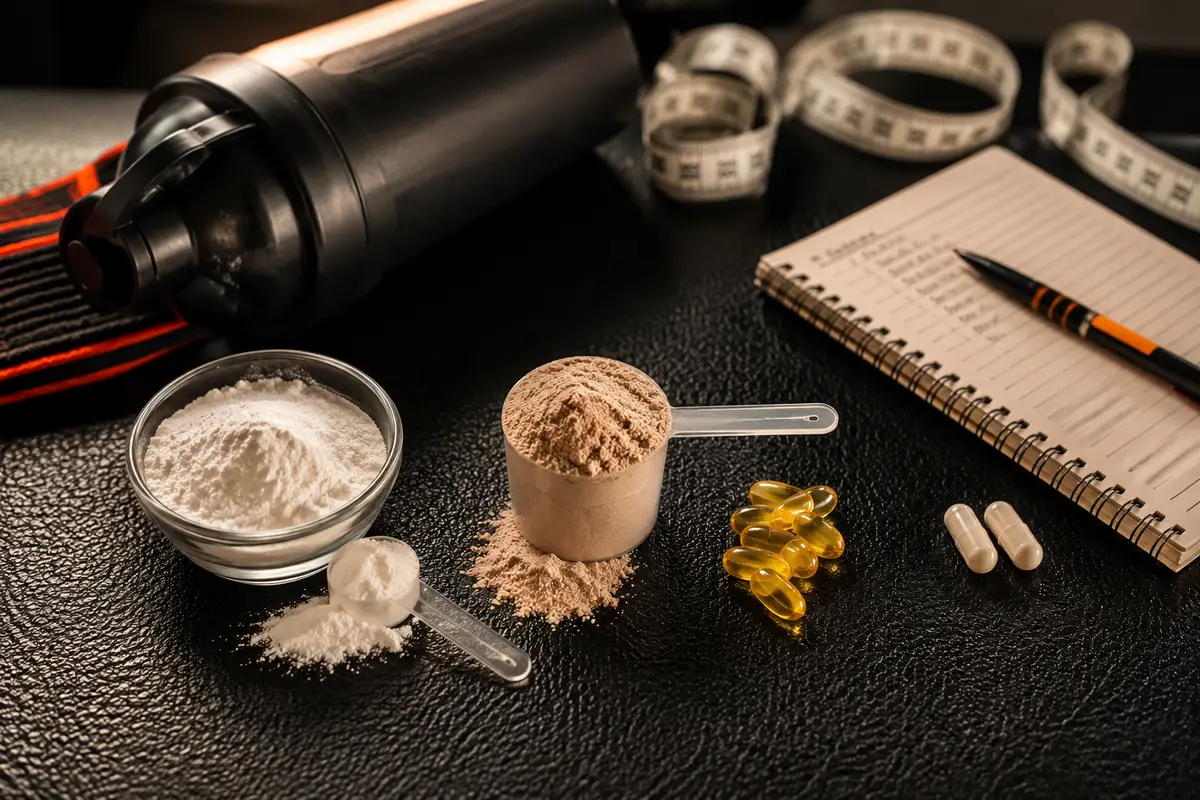

I’ve seen clients waste thousands on worthless pills, and I’ve seen others build stage-ready physiques on shockingly simple supplement stacks. This article exists to draw a clear line between the two.
My philosophy is simple: build your foundation on food, training, and sleep. Supplements only fill the cracks; they don’t pour the concrete.
If you’re a natural lifter, every dollar you spend on supplements must buy real, measurable progress—not marketing fairy tales. Let’s build your supplement hierarchy from the ground up.
Table of contents
- The Short Answer: Your Supplement Priority List
- Why Natural Lifters Need a Different Supplement Strategy
- Tier 1: The Proven Essentials (Buy First)
- Tier 2: The Support Crew (Buy Second)
- Tier 3: The Situational Add-Ons
- Tier 4: The “Never Buy” List
- How to Assess a Supplement Label Like a Pro
- The Natural Lifter’s Monthly Supplement Budget
- Frequently Asked Questions
The Short Answer: Your Supplement Priority List
You came here for clarity, so I’m giving it to you straight. Here is exactly what your supplement priority list should look like as a natural lifter.
Tier 1 — Buy First (Proven Essentials)
- Creatine Monohydrate
- Whey Protein (when whole food isn’t practical)
- Vitamin D3
Tier 2 — Buy Second (Support Crew)
- Magnesium Glycinate
- Omega-3 Fatty Acids
- Caffeine or a Basic Pre-Workout
Tier 3 — Buy Situationally (Context-Dependent Add-Ons)
- Citrulline Malate
- Beta-Alanine
- Electrolytes
Tier 4 — Never Buy (Money Traps)
- BCAAs
- Testosterone Boosters
- Fat Burners
- Glutamine
This isn’t a theory I pulled from a textbook. This is the exact framework I use with every single client who walks through my door.
If you want a complete step-by-step plan, check out my 4-week natural muscle gain supplement blueprint.
Taking Supplements? Don’t Let Bad Timing or Wrong Dosage Kill Your Progress.
I’ll map out exactly when and how much supplements you need — personalized to your full stack.
Stop Guessing — Show Me the Plan →Why Natural Lifters Need a Different Supplement Strategy
As a natural lifter, you operate without pharmaceutical shortcuts. Your body builds muscle slowly, repair depends entirely on sleep and nutrition, and your hormonal profile stays within normal human ranges. That reality demands a different supplement strategy from what you see in magazines or on sponsored YouTube videos.
Every dollar you spend must buy a proven, research-backed result. There are no miracle pills that raise your testosterone meaningfully or melt fat while you sleep.
I’ve learned this the hard way—spending my own money on garbage at 19 so you don’t have to. The core principle I teach every client: fix your diet first, supplement second. A creatine scoop won’t rescue a bad training program, and no protein powder outweighs poor sleep.
Tier 1: The Proven Essentials (Buy First)
These three supplements cover your performance, convenience, and health bases. Start here and you’ve already covered 95% of what supplementation can realistically do for you.
Creatine Monohydrate
I’ve taken creatine monohydrate for over 10 years. The first thing I noticed wasn’t just the strength increase—it was the sharper mental clarity and that fuller, rounder look my muscles held, even during aggressive cuts.
For a deep dive into everything this supplement can do, read my creatine ultimate guide covering benefits, dosage, and results. It’s the most researched sports supplement on earth, and the data is unanimous: it works.
I had a client named Marco, a 34-year-old engineer and a hard skeptic. He told me plainly, “I don’t believe in powders.” I asked him for 30 days on 5 grams daily. That’s it. Nothing else changed.
On day 28, he messaged me: “My logbook looks like someone else wrote it. I added two reps to every working set.” He hasn’t stopped since.
How I recommend it: 5 grams of plain creatine monohydrate every single day. No loading phase, no cycling off, no fancy blends. Just buy the unflavored monohydrate powder and take it.
Your muscles and your brain will thank you. If you train in hot conditions or sweat heavily, I’ve also written about the best creatine for heavy sweaters with no cramps and zero clumps.
Whey Protein
I set all my natural clients at 1.6 to 2.2 grams of protein per kilogram of body weight. Can you hit that with whole food alone? Absolutely. But I’ve coached enough busy humans to know that life often gets in the way.
Whey becomes necessary when convenience is the obstacle. I had a client named Anna, a nurse pulling 12-hour hospital shifts. Sitting down for a fourth solid meal between rounds was impossible. Two scoops of whey kept her on track. She added 3 kilos of lean mass that year—not because whey is magic, but because it helped her stay consistent.
That’s the real benefit. It’s a tool of convenience, and a damn good one. For a complete breakdown of how to use it for muscle gain, fat loss, and recovery, I recommend my whey protein guide.
Vitamin D3
I tested my own levels three years ago. I was sitting at 18 ng/mL—clinically deficient—despite living in a sunny region. My energy was flat, my mood tanked every winter, and I caught every cold that passed through the gym.
I started supplementing 4000 IU daily and retested at 54 ng/mL. The difference was night and day.
Now I make D3 testing mandatory for my clients. Seven out of ten come back deficient. The ones who correct it consistently report better mood, deeper sleep, and fewer missed sessions due to illness.
It’s a cheap capsule that impacts your testosterone production, immune function, and bone health. For the price, nothing competes.
Tier 2: The Support Crew (Buy Second)
Once your essentials are locked in, these three supplements fill the remaining gaps in recovery, inflammation control, and training intensity.
Magnesium Glycinate
Sleep is the most underrated performance drug available to a natural lifter. Magnesium glycinate is the key that opens that door for many people.
I had a client named Daniel, a 28-year-old teacher and competitive powerlifter. He slept seven hours a night but woke up wrecked. Night-time calf cramps pulled him awake three times a week.
We added 400mg of magnesium glycinate before bed. Within two weeks, the cramps disappeared entirely, and his sleep tracker showed an extra 45 minutes of deep sleep per night. His deadlift moved up 10 kilos the following month. Magnesium didn’t pull the bar for him—better recovery did.
How I recommend it: 300-400mg of magnesium glycinate 30 minutes before bed. Avoid magnesium oxide; the absorption is poor, and it’ll send you running to the bathroom.
Omega-3 Fatty Acids
I’ll be honest with you—I don’t “feel” Omega-3 the way I feel caffeine or even creatine. I recommend it purely on the strength of the cardiovascular and anti-inflammatory research. But the real-world results still show up.
I had a 46-year-old client named Tomas with nagging knee pain and a family history of heart trouble. He started 3 grams of combined EPA/DHA daily.
His joint pain didn’t vanish, but it dulled noticeably within six weeks, and his blood markers improved at his next physical. For older lifters or anyone with inflammatory issues, I consider Omega-3 non-negotiable.
Caffeine / Pre-Workout
I prefer black coffee. It’s cheap, predictable, and doesn’t make my skin crawl with questionable stimulant blends. Most commercial pre-workouts under-dose the active ingredients and over-dose the caffeine and beta-alanine, relying on the tingles to convince you the product is working.
Does a solid pre-workout have a place? Sure. I’ll grab one occasionally when I’m traveling and need the convenience.
But I tell my clients: drink a strong coffee, and if you want a skin-splitting pump, add a scoop of pure citrulline malate separately. You’ll save money and actually control what goes into your body.
Tier 3: The Situational Add-Ons
These supplements work, but only in specific contexts. For the average lifter running a basic strength program, they won’t move the needle. Use them deliberately or skip them entirely.
Citrulline Malate
I recommended citrulline malate to a client named Javier, a physique competitor who wanted to look fuller on stage and improve vascularity for his photo shoots. We added 8 grams pre-training during peak week.
The visual effect was real—denser, grainy muscle bellies and roadmap veins. But I told him plainly: this is cosmetic, not structural. You’re buying a temporary look, not permanent muscle tissue.
For a photoshoot or stage appearance, it’s a useful tool. For everyday training, it’s a luxury.
Beta-Alanine
I reserve beta-alanine for clients doing high-volume, lactic-heavy work—CrossFit-style sessions, 20-rep squat programs, or extended hypertrophy blocks.
A client named Lena complained her shoulders burned out too fast during high-rep accessory work. We added 3.2 grams daily. After three weeks, she could push an extra two to three reps in the tank before the burn forced her to stop.
It works beautifully in that specific context. For the 5×5 lifter grinding heavy triples, it’s useless.
Electrolytes
I only recommend targeted electrolyte supplementation during cuts, low-carb phases, or for athletes training in extreme heat.
If you’re sweating buckets and your diet has stripped out carb-heavy foods that normally hold water and minerals, electrolytes prevent cramping, headaches, and performance drops. The average lifter eating maintenance calories doesn’t need them.
Tier 4: The “Never Buy” List
These are the supplements I see wasting the most money in the natural lifting community. I’ve fallen for them myself, and I’ve watched countless clients make the same mistakes.
BCAAs
If I could remove one product from every supplement store on earth, it would be BCAAs. You sip neon-colored powder during your workout, believing you’re protecting your hard-earned muscle. Then you eat a chicken breast an hour later that contains triple the BCAAs for a tenth of the price.
Here’s the truth: whey protein and whole protein sources already contain all the BCAAs you need in larger quantities. Isolated BCAAs provide leucine, isoleucine, and valine without the other essential amino acids required for actual muscle protein synthesis.
You are literally throwing money away. Stop paying for flavored water.
Testosterone Boosters
At 19 years old, I bought a fancy testosterone booster with Tribulus, D-Aspartic Acid, and a label that promised to transform me. I paid around $60 for a month’s supply. I took it religiously and felt absolutely nothing. No strength jump, no libido spike, no blood work change. It was an expensive lesson in marketing versus reality.
I keep that empty bottle in my garage now as a reminder. I tell every young client the same thing: if an over-the-counter supplement genuinely raised testosterone to a meaningful degree, it wouldn’t sit on a vitamin store shelf. It would be a controlled substance. Zero clinical evidence supports these products for healthy natural men.
Fat Burners
Fat burners are overpriced caffeine pills dressed up with green tea extract, raspberry ketones, and clever marketing stories. They don’t burn fat. A calorie deficit burns fat.
If the caffeine dose suppresses your appetite, you might eat less, but you could achieve the same thing with a $0.10 coffee. Save your money and track your calories instead.
Glutamine
Glutamine was debunked for muscle-building purposes years ago. Your body produces plenty on its own, and dietary protein provides more than enough.
The old studies showing benefits used intravenous administration in burn victims, not oral glutamine in healthy lifters. It’s a waste of a scoop.
How to Assess a Supplement Label Like a Pro
After a decade in this game, I’ve developed a simple filter for evaluating any supplement. Use these rules before you open your wallet.
I’ve written an entire dedicated guide on how to read a supplement label like a coach with the 7 red flags I check first, but here’s the quick version.
- Check clinical dosing versus proprietary blends. If a label hides behind a “proprietary blend” without disclosing individual ingredient amounts, assume it’s under-dosed and walk away.
- Ignore influencer hype; demand human studies. An athlete holding a shiny tub on Instagram tells you nothing. Search for peer-reviewed research on actual humans.
- Single-ingredient products beat useless stacks. I’d rather you buy pure creatine monohydrate and pure citrulline malate separately than some pre-mixed “anabolic pump matrix” with mystery dosages.
- If it sounds too good to be true for $39.99, it is. Real results come from training hard, eating properly, sleeping well, and using a few proven supplements. No pill rewrites that equation.
The Natural Lifter’s Monthly Supplement Budget
Here’s what a sensible supplement budget actually looks like. I cap most of my clients between $50 and $70 per month. Anything beyond $100 demands serious justification tied to a specific goal.
The $50 Essentials-Only Plan
Supplement | Approximate Monthly Cost |
|---|---|
Creatine Monohydrate (1kg bulk) | $5 – $8 |
Whey Protein (5lb tub, partial use) | $20 – $25 |
Vitamin D3 (generic, 2000-5000 IU) | $5 – $7 |
Total | $30 – $40 |
The $70 Optimized Plan
Supplement | Approximate Monthly Cost |
|---|---|
Creatine Monohydrate | $5 – $8 |
Whey Protein | $20 – $25 |
Vitamin D3 | $5 – $7 |
Magnesium Glycinate | $8 – $12 |
Omega-3 | $10 – $15 |
Total | $48 – $67 |
The money you save skipping Tier 4 garbage? I’d rather you spend it on better steak, fresher vegetables, and a gym membership upgrade. I’ve watched clients build incredible physiques on $30 monthly stacks. The difference was never their supplement cabinet—it was their consistency.
A client named Omar came to me at 22, skinny-fat, 68 kilos, and completely overwhelmed by supplement marketing. He was about to drop $300 on a stack some influencer promoted. I stopped him.
We spent $45 that month: creatine, whey, and Vitamin D. We funneled his extra budget into a modest calorie surplus and higher-quality whole food.
Two years later, he stepped on stage at his first natural bodybuilding show at 74 kilos, shredded, with no exotic supplements in sight. He told me afterward, “You saved me years of distraction.”
That’s exactly the point. If Omar had been trying to force-feed himself extra calories, he might have considered a mass gainer for lean muscle growth, but solid food and consistency did the job better.
Frequently Asked Questions
What is the single most effective supplement for a natural lifter?
Creatine monohydrate. Decades of data stand behind it. You get measurable strength and muscle gains with zero hormonal effect. It simply works, and I’ve seen it transform skeptics into lifelong users inside a single month.
And it’s not just for men—I’ve written a complete guide on creatine for women covering benefits, dosage, and common myths.
Do natural lifters actually need whey protein?
Not if you consistently hit your daily protein goal from whole food sources. Whey is a tool of convenience, not a biological requirement. But if your schedule makes four solid meals impossible, whey bridges the gap beautifully. Use it strategically, not mindlessly.
Why are BCAAs useless if I eat enough protein?
Because whey and whole protein sources already contain BCAAs in larger amounts. Isolated BCAAs provide leucine, isoleucine, and valine without the other essential amino acids required to trigger actual muscle protein synthesis. You’re sipping an incomplete protein and calling it protection. It’s not.
Can a natural lifter benefit from pre-workout supplements?
Yes, but only for acute performance improvement. Caffeine reliably improves focus and strength output during your session. Expensive pump formulas with proprietary blends are optional luxuries, not necessities. Coffee does the job for pennies.
What supplement do most natural lifters waste money on?
Testosterone boosters. I wasted $60 on one at 19 years old and felt absolutely nothing. No over-the-counter supplement has ever been proven to meaningfully raise testosterone in healthy men with normal levels. I keep the empty bottle in my garage as a permanent warning.
How much should a natural lifter realistically spend on supplements monthly?
$40 to $70 covers all your essentials beautifully. If you’re spending beyond $100 per month, you’d better have a clear, justifiable reason tied to a specific performance or health goal. Most lifters overspend on things that don’t work.
Is vitamin D really that important for natural lifters?
Yes. I tested clinically deficient at 18 ng/mL despite living in a sunny region. Correcting my levels transformed my energy, mood, and immune resilience. Deficiency is widespread among athletes, and optimal levels support testosterone production, bone health, and overall well-being. It’s cheap, high-impact, and criminally overlooked.
Your supplement stack should support your hard work, not replace it.
Stick to the hierarchy I’ve laid out, ignore the flashy labels making impossible promises, and put your real energy into the things that actually build a natural physique: progressive training, adequate protein, quality sleep, and relentless consistency. Everything else is just noise.
 Maximize Results
Leave a Reply