


Want to hold onto your hard‑earned muscle while cutting fat? Your nighttime shake might be the missing piece.
Casein is one of the most effective – and overlooked – tools for muscle preservation. Unlike fast‑digesting whey, casein fuels your muscles for hours, especially when your body is most vulnerable to breakdown: during sleep.
Quick answer (no fluff):
Take 25–30 grams of micellar casein about 30 minutes before bed. That’s roughly one scoop. For precise dosing, use 0.3–0.4g per kg of bodyweight.
In this article, you’ll learn exactly how much casein you need, when to take it, and why the science backs it up – whether you’re an athlete, bodybuilder, or just trying to stay lean and strong.
Table of contents
- How Much Casein You Need, Based on Your Bodyweight
- Why Casein Is So Effective for Preserving Muscle
- Best Times to Take Casein for Muscle Preservation
- Casein vs. Whey: Which One Prevents Muscle Loss Better?
- Real‑Life Results from a Coach (Client Examples)
- FAQ: Casein Protein for Muscle Preservation
- Final Verdict: A Simple Plan to Keep More Muscle with Casein
How Much Casein You Need, Based on Your Bodyweight
25–30g is the sweet spot for most people. But if you want to get precise, dose it by bodyweight.

Simple formula: 0.3–0.4 grams of casein per kg of bodyweight.
Example: A 75 kg person → 23–30g is ideal.
A quick word on mindset:
More isn’t better. Consistency wins. Taking the right amount every night beats slamming 50g once and skipping the next three days. I remind my clients of this constantly.
Dosage by Bodyweight (Quick Table)
Use this table to find your ideal nightly dose. Take it 30 minutes before bed.
Bodyweight (kg) | Bodyweight (lbs) | Recommended Casein Dose |
|---|---|---|
50 – 65 kg | 110 – 145 lbs | 20 grams |
65 – 70 kg | 145 – 155 lbs | 22 grams |
70 – 85 kg | 155 – 190 lbs | 25 grams |
85 – 90 kg | 190 – 200 lbs | 27 grams |
90 – 105 kg | 200 – 230 lbs | 30 grams |
105+ kg | 230+ lbs | 30–35 grams (max) |
Formula used: 0.3–0.4g casein per kg bodyweight. Example: 75 kg × 0.35 = 26g → rounded to 25g for simplicity.
Dosage by Goal: Cutting, Maintenance, or Bulking
Goal | Recommended Dose (before bed) | Why This Dose |
|---|---|---|
Muscle preservation during a cut (calorie deficit) | 25–30g | Your body is more likely to break down muscle for energy. Casein provides steady amino acids to protect muscle overnight. |
Maintenance / light training (eating at maintenance calories) | 20–25g | You don’t need as much protection. This dose keeps muscle without adding extra calories. |
Bulking / mass gain (calorie surplus) | 30–35g (max) | You’re trying to build muscle. A slightly higher dose supports overnight recovery, especially after heavy training days. |
Intermittent fasting (long daily fasts) | 25–30g | Casein helps bridge the long gap between your last meal and your first meal the next day. |
When to Adjust Your Dose
Situation | Adjustment |
|---|---|
You weigh less than 60 kg (130 lbs) | Reduce by 5g |
You weigh more than 100 kg (220 lbs) | Increase by 5g |
You trained very hard that day | Add 5g |
You had a rest day | Stick to baseline or reduce 5g |
You’re over 50 years old | Stick to 25–30g (older adults need more protein to trigger muscle synthesis) |
Taking Protein? Don’t Let Bad Timing or Wrong Dosage Kill Your Progress.
I’ll map out exactly when and how much protein you need — personalized to YOUR body and YOUR goal.
Teach Me the Right Protein Timing & Dosage →Why Casein Is So Effective for Preserving Muscle
What makes casein truly different? Digestion speed.

Whey hits your system like a spike – amino levels rise fast, then drop within hours. Casein does the opposite. It clots in your stomach, releasing a slow, steady “drip‑feed” of amino acids into your bloodstream for 6–8 hours.
Why does that matter for muscle preservation?
Because when you sleep (or go long hours without food), your body naturally breaks down muscle for energy. A slow casein stream helps maintain a positive nitrogen balance – the #1 condition for keeping lean mass.
Research confirms it: casein before bed significantly reduces overnight muscle protein breakdown.
I’ve seen it in my own training too. During a calorie deficit, adding casein to my evening routine keeps my muscles fuller and my strength more stable – compared to nights without it.
📌 Slow digestion = overnight protection.
Best Times to Take Casein for Muscle Preservation
Casein is flexible. You’re not locked into just one schedule. But some times work much better than others.

Below is the optimal timing guide based on your daily routine and goals.
Casein Timing at a Glance (Table)
Time of Day | Best For | Dose | Why It Works |
|---|---|---|---|
30 minutes before bed | Most people (cutting, maintaining, or bulking) | 25–30g | Covers your longest fasting window (sleep). Reduces overnight muscle breakdown. |
Before a long meal gap (4+ hours without food) | Intermittent fasting, busy schedules | 20–25g | Slows digestion. Keeps amino acids flowing during the gap. |
Mid‑evening (night shift workers) | Shift workers, late trainers | 25–30g | Prevents catabolism during awake hours when meals are skipped. |
Between lunch and dinner (if dinner is very late) | People with irregular eating patterns | 20g | Stops muscle breakdown during long afternoon fasts. |
Real‑Life Example: Night Shift Nurse
One of my clients, Lucia, works night shifts as a nurse. She takes 25g of casein around 7 PM, right before her shift starts.
It keeps her energy stable and her body in an anti‑catabolic state until her first break 5 hours later.
Simple Weekly Schedule for Most Lifters
If you want zero guesswork, follow this:
- Every night: 25–30g casein, 30 min before bed.
- Optional extra dose: On days with 2+ training sessions or very large calorie deficit, add 20g casein before a long afternoon gap (e.g., 3 PM if lunch was at 12 PM and dinner is at 8 PM).
What If You Train in the Morning?
If you train first thing in the morning:
- Take casein before bed the night before.
- In the morning, use whey or fast‑digesting protein post‑workout.
Casein before sleep primes your muscles, but it’s too slow for post‑morning workout recovery.
When to Skip Casein
- Immediately after a workout – use whey instead (faster absorption).
- Right before a meal if you struggle with appetite – casein is satiating and may reduce meal size.
- If you’re already over your daily calorie limit – unnecessary extra calories (though casein alone won’t cause fat gain).
Casein vs. Whey: Which One Prevents Muscle Loss Better?
Both have their place. Neither is “better” overall — it depends on your goal and timing.
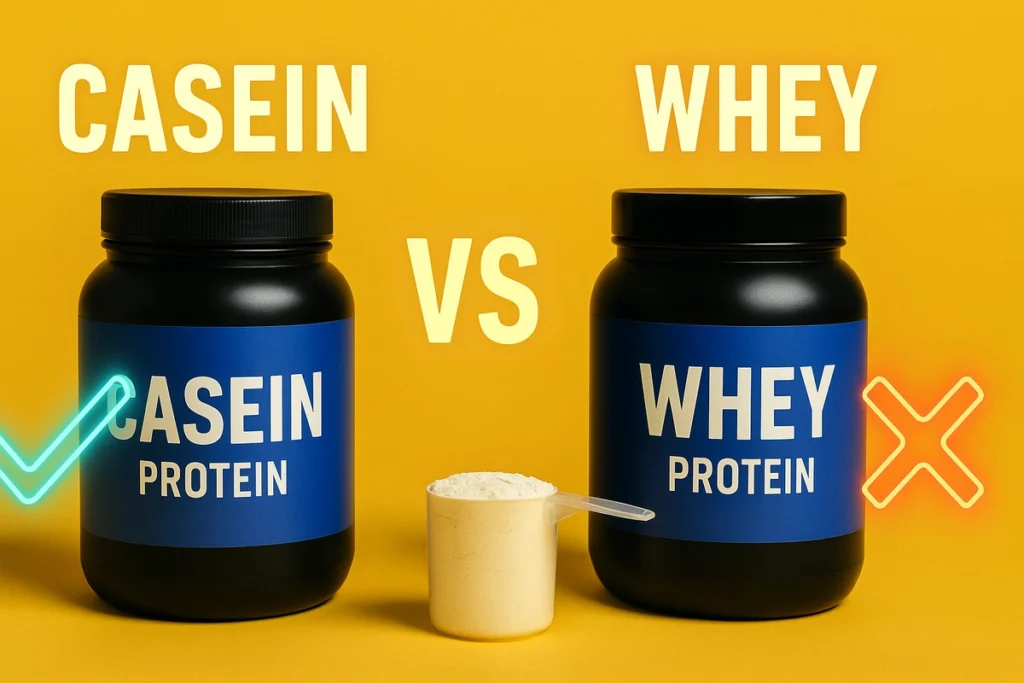
- Whey is best for quick post-workout recovery.
- Casein is superior for long-term muscle preservation, especially overnight or during calorie deficits.
Think of whey as a sprinter — fast, explosive, and done quickly.
Casein is the marathon runner — slow, steady, and reliable for hours.
Side‑by‑Side Comparison Table
Feature | Whey Protein | Casein Protein |
|---|---|---|
Digestion speed | Fast (30–60 minutes) | Slow (6–8 hours) |
Amino acid release | Rapid spike, then drop | Slow, steady drip-feed |
Best time to take | Immediately after workout | Before bed or long fasts |
Muscle preservation during cut | Good | Excellent |
Muscle protein synthesis trigger | Strong but short-lived | Moderate but prolonged |
Best for | Post-workout recovery | Overnight protection, fasting |
Fullness / hunger effect | Low to moderate | High (keeps you full longer) |
When Whey Is the Better Choice
- Right after training (especially within 1 hour)
- When you need fast amino acids to start repair
- If you struggle to eat solid food post-workout
- As part of a morning shake on training days
📌 Example: 25–30g of whey within 60 minutes after lifting.
When Casein Shines
- Before bed (30 minutes prior)
- During a cutting phase to preserve muscle overnight
- When you have long gaps between meals (4+ hours)
- If you feel hungry at night or during fasts
📌 Example: 25–30g of micellar casein before sleep.
How to Use Both for Best Results
You don’t have to pick one. Most advanced lifters and coaches use both:
- Whey post-workout for fast recovery
- Casein before bed for overnight protection
During one of my own mini-cuts, I ran a 4-week test with whey only, then another 4 weeks with whey + casein at night. I lost the same amount of weight, but the casein phase preserved noticeably more muscle fullness and strength.
One Simple Rule to Remember
Goal | Whey | Casein |
|---|---|---|
Build muscle after workout | Best | Too slow |
Preserve muscle during cut | Good | Best |
Prevent overnight breakdown | No | Best |
Stay full during fasting | No | Best |
Don’t compare them as rivals. They work as teammates.
- Whey = post-workout sprinter
- Casein = overnight marathoner
Use whey after training. Use casein before bed. Your muscles will thank you.
Real‑Life Results from a Coach (Client Examples)
Theory is great, but here’s what actually happens when real people add casein before bed.

Markus, 34 – cutting for summer
He added 30g of casein before bed for 6 weeks, training five days a week on low calories.
Compared to his last cut (no casein), his muscle retention was noticeably better – plus he woke up feeling less sore.
Jared – struggled with late‑night cravings
We swapped his bedtime snack for a casein shake. It curbed his hunger and improved his morning recovery.
My own experience
During fat‑loss phases, I’ve consistently lost less strength simply by sticking to bedtime casein.
No magic. Just consistency.
FAQ: Casein Protein for Muscle Preservation
Take 25 to 30 grams of micellar casein about 30 minutes before bed. If you want to be more precise, use 0.3 to 0.4 grams per kilogram of bodyweight. For a 75 kg person, that’s 23–30 grams.
Yes, for most people between 70–85 kg (155–190 lbs) , 25 grams is enough. Lighter individuals can take 20 grams. Heavier individuals may need 30 grams.
Yes. Casein helps preserve muscle even if you don’t train, as long as you eat enough total protein. However, it works best when combined with resistance training.
Right before bed is the best time. That’s when your body goes through the longest fast. Casein also helps during long meal gaps or intermittent fasting.
Casein is better for long-term muscle preservation (like overnight or during a cut). Whey is better for quick recovery after a workout. Use both: whey post-workout, casein before bed.
Not necessarily. If you already eat enough total protein (around 1.6–2.2g per kg of bodyweight), casein is optional. But it’s a convenient and effective way to protect muscle overnight.
Yes. The dosage is based on bodyweight, not gender. A 65 kg woman should take around 20–25 grams, just like a 65 kg man.
No. Casein is just protein. It will not make you gain fat as long as you stay within your daily calorie needs. In fact, it helps preserve muscle during fat loss.
Micellar casein is the best. It digests slowly and provides a steady release of amino acids for 6–8 hours. Avoid casein hydrolysate for overnight use — it digests too fast.
Most people with mild lactose intolerance tolerate micellar casein well because it’s very low in lactose. If you’re highly sensitive, try a lactose-free casein or plant-based alternative.
Final Verdict: A Simple Plan to Keep More Muscle with Casein
Here’s the truth: You don’t need a complicated supplement stack to preserve muscle while cutting.

Just do this every night:
- Take 25–30g of micellar casein about 30 minutes before bed
- Pick a clean brand – minimal fillers, no junk
- Be consistent – daily, not just “when you remember” (especially during cuts or maintenance)
That’s it.
Whether you’re an athlete, bodybuilder, or simply trying to lose fat without losing muscle, casein is one of the simplest, most underrated tools available.
In my coaching experience, it’s made a real difference – not just on paper, but in the mirror too.
Now go protect those gains.

 Maximize Results
Leave a Reply