

If you’ve ever stood over your supplement shelf wondering, “Should I take my BCAAs now or after I eat?“—you’re not alone.
It’s one of the most common questions I get as a coach, especially from clients who train fasted, follow intermittent fasting, or are deep in a cutting phase.
❌ The 5 most common BCAA timing mistakes I see athletes make:
- Assuming BCAAs work the same way with or without food
- Taking BCAAs right after a high-protein meal
- Sipping BCAAs all day like a casual drink
- Skipping BCAAs before fasted cardio to “save” them
- Mixing BCAAs into thick smoothies and expecting fast effects
Most lifters get at least two of these wrong. Let’s see where you stand.
Table of contents
- Quick Answer: BCAA on an Empty Stomach or With Food?
- What Are BCAAs? (And Why Timing Matters)
- How Food Affects BCAA Absorption (And What to Do About It)
- Who Benefits Most from BCAAs on an Empty Stomach?
- Best Times to Take BCAAs (Based on Your Goal)
- BCAA Timing for Fat Loss vs. Muscle Gain
- FAQ: BCAAs on Empty Stomach vs. With Food
- Final Verdict: Empty Stomach or With Food?
Quick Answer: BCAA on an Empty Stomach or With Food?
Let’s cut straight to it:
👉 For best results, take BCAAs on an empty stomach—especially before fasted workouts, fasted cardio, or early morning training.
Here’s why: Without food in your system, BCAAs absorb faster. That means quicker energy, better muscle protection during your session, and noticeably less soreness afterward. I’ve seen this consistently—both in my own training and with clients—especially after heavy lifting or HIIT. (Related: BCAA for muscle soreness)
That doesn’t mean BCAAs are useless with food. They still work. But when you take them solo, the effects hit harder and faster—exactly when you need them most.
If you’re training fasted or following intermittent fasting, timing becomes even more critical. I’ve covered that in depth here: BCAAs during intermittent fasting.
🆚 Final Verdict:

Stop buying what influencers sell. Start buying what science supports.
Takes 2 Min | No sign-up needed
- Fasted: faster, sharper results.
- With food: milder, slower effect.
Both have a place. But if you want the most from every scoop, empty stomach wins.
What Are BCAAs? (And Why Timing Matters)
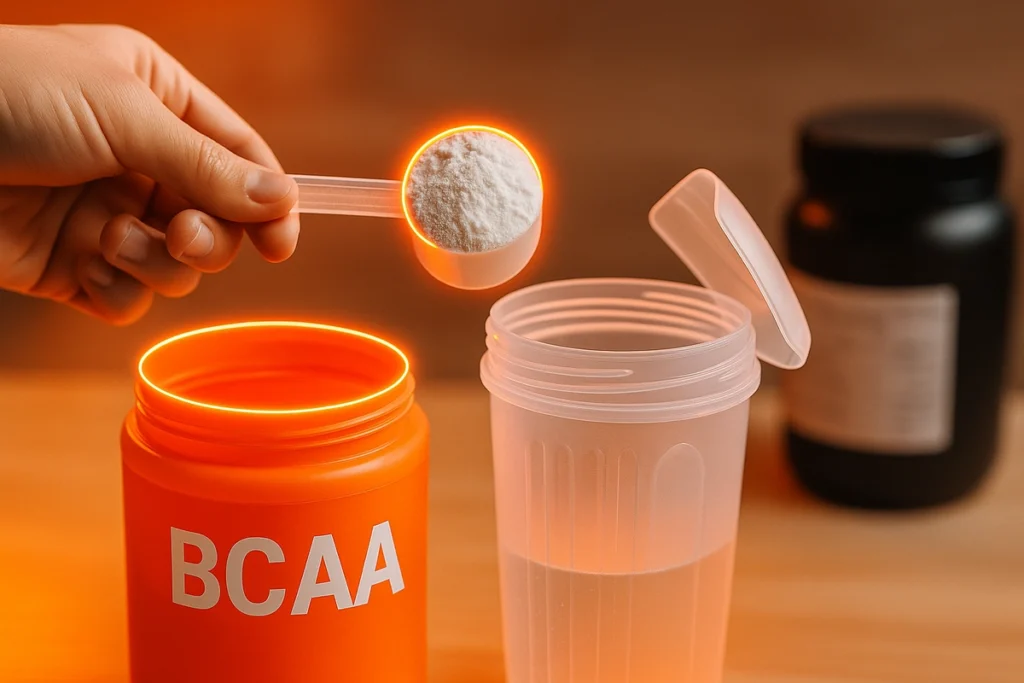
BCAAs—short for branched-chain amino acids—are a trio of essential aminos: leucine, isoleucine, and valine.
Think of them as your muscles’ fast-response team. Unlike whole protein, BCAAs skip digestion and hit your bloodstream almost immediately. That speed is what makes timing so powerful.
✅ Here’s what they do when timed right:
- Shield lean muscle during intense or fasted training
- Reduce post-workout soreness so you bounce back faster
- Fuel energy output when your body needs it most
Now, why does timing matter? Because that rapid absorption is wasted if you take them when your body doesn’t need the quick hit—like right after a protein-heavy meal.
A 2018 study in Nutrition & Metabolism supports this: combining BCAAs with aerobic exercise boosted markers of fat metabolism in muscle cells. In plain terms? BCAAs before fasted training can help your body tap into fat as fuel more efficiently. (Source)
That’s why I treat BCAAs as a strategic tool—not an all-day sipper. Use them in the right window, and they work with your physiology. Use them randomly, and you’re just buying expensive flavored water.
For my female lifters, I’ve written more on how this applies specifically to your training here: BCAAs for women in strength training.
How Food Affects BCAA Absorption (And What to Do About It)
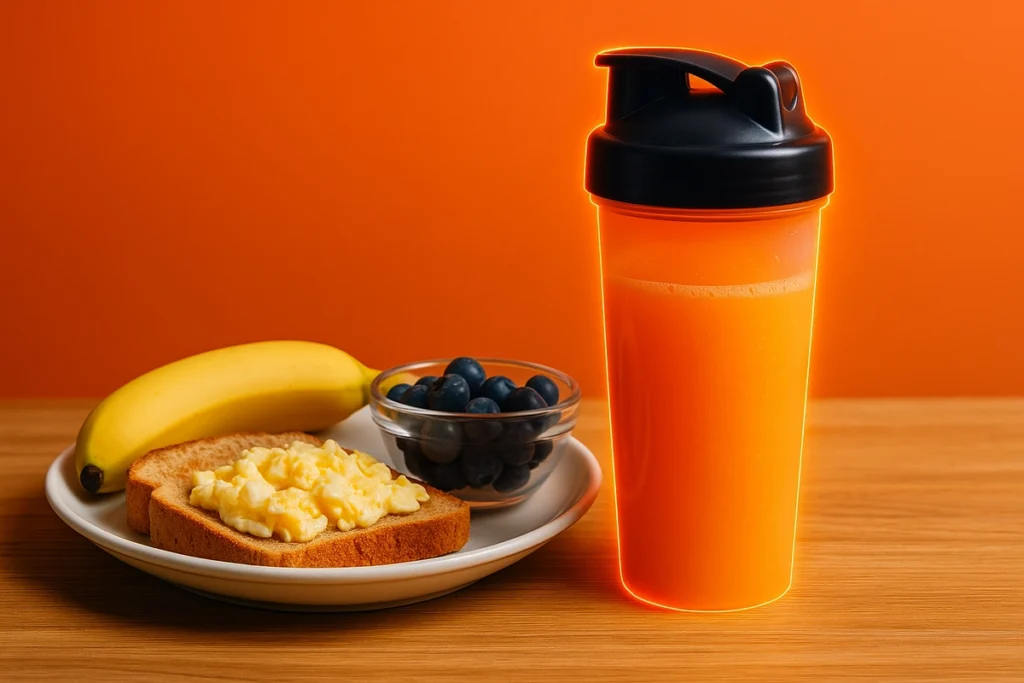
Here’s what happens when you take BCAAs with food—especially a high-protein meal:
Your BCAAs enter a lineup. The other amino acids from your meal compete for the same absorption pathways. The result? Your BCAAs get slowed down, and that fast-acting edge you paid for gets dulled.
Now, if your meal already contains 20–30g of complete protein, you’re getting plenty of leucine, isoleucine, and valine naturally. Adding a BCAA scoop on top isn’t harmful—but it’s redundant. You’re essentially doubling up on something your meal already delivered.
🚀 The smarter move: Save your scoop for windows when your stomach is truly empty. That’s where BCAAs actually earn their keep.
Real story: Emma from the UK
Emma used to blend her BCAAs straight into her morning smoothie—protein, oats, the works.
She figured it was convenient. And honestly? It didn’t hurt her performance. But for months, she also didn’t notice much benefit. No sharper focus, no faster recovery. Just… meh.
When we stripped the BCAAs out of her smoothie and moved them before her fasted sessions instead, the difference showed up within 10 days. Better clarity mid-workout. Less soreness the next morning.
Moral of the story?
- BCAAs + food: slower, milder response.
- BCAAs solo: quicker uptake, noticeable results.
Also worth comparing: EAAs vs BCAAs during workout.
Who Benefits Most from BCAAs on an Empty Stomach?
From my coaching experience, these clients see the biggest difference when they take BCAAs without food:
- Intermittent fasters – protecting muscle during the fasting window is priority number one.
- Early morning lifters – rolling out of bed and training before breakfast leaves your body running on empty.
- Anyone on a calorie deficit – when calories drop, muscle breakdown risk climbs.
- Fasted cardio devotees – your body needs a shield when fuel is low.
❓ Here’s why: in each of these states, your body is more prone to breaking down muscle for energy. BCAAs step in as a fast-acting buffer—giving your muscles a layer of protection when they’re most vulnerable.
For more on cutting-phase strategy: BCAA vs Glutamine for cutting benefits.

Take this 2-minute assessment & get a science-backed training, nutrition & supplement roadmap built for YOUR body.
🔬 12,000+ personalized roadmaps generated
Will BCAAs Break My Intermittent Fast?
Technically, yes. BCAAs contain calories—about 4 per gram—so they break a strict, zero-calorie fast. There’s no getting around that.
But here’s what matters for most lifters: Do BCAAs break a fast in a way that ruins your results? Almost certainly not.
The small insulin bump from 5–7g of BCAAs is modest and short-lived. For fat loss, fasted training performance, and muscle preservation, the trade-off is overwhelmingly worth it. Most intermittent fasters I coach treat fasted BCAAs as an acceptable exception—not a dealbreaker.
If your priority is absolute gut rest or autophagy, skip them. If your priority is maintaining muscle and training hard while fasting, they’re a smart addition.
Real story: Carlos from Spain
Carlos was doing early morning HIIT while following intermittent fasting.
He showed up consistently, but halfway through each session, he’d hit a wall—sluggish, drained, fighting to finish.
We added 7g of BCAAs 20 minutes before his workouts—no food, just BCAAs and water. Within two weeks, his endurance noticeably improved and his post-session recovery smoothed out.
Same fast. Same training. Different fuel window.
Carlos still trains fasted. He just uses BCAAs as his pre-workout bridge. And it made all the difference.
Best Times to Take BCAAs (Based on Your Goal)
Timing isn’t complicated—but it is specific. Here’s exactly when I recommend taking BCAAs based on what you’re trying to achieve:
Your Goal | When to Take BCAAs | With Food? |
|---|---|---|
Fasted morning workout | 15–20 min before training | No (empty stomach) |
Intense strength training (fed) | 15 min before or sip during | No, but a light carb snack won’t hurt |
Fat loss / cutting cardio | Before fasted cardio | No |
Muscle gain (big pre-workout meal) | During or right after training | Optional—often unnecessary if your meal covered protein |
⏩ A quick way to think about it:
- If your stomach is empty and your session is intense → take them before.
- If you’ve already eaten a solid protein meal → you can skip or sip during.
- If you’re chasing fat loss → before fasted cardio, no exceptions.
BCAAs reward precision. The closer you match your timing to your goal, the more you’ll feel the difference.
⌚ More timing deep-dives:
BCAA Timing for Fat Loss vs. Muscle Gain
Your goal changes how you should use BCAAs.

Here’s the breakdown.
For Fat Loss
⌚ Best time: 15–20 minutes before fasted cardio.
When I coach clients through a cut, BCAAs are almost always part of the plan—especially on lower-calorie days.
Why? Because when calories drop, muscle breakdown risk rises. A small BCAA dose before fasted cardio acts like an insurance policy. You’re telling your body, “Burn fat, not muscle.”
No food. Just BCAAs and water. That’s the formula.
Real story: Natalie from Germany
Natalie was on a tight 1,400 kcal plan and doing fasted cardio five days a week. She was committed—but the fatigue was real.
We added 5g of BCAAs before her morning walks. No food. Just BCAAs and water.
The shift was clear. Less fatigue. Better mood. And after 8 weeks of cutting? Zero muscle loss.
That’s exactly what you want from a fat loss phase: fat going down, muscle staying put.
For Muscle Gain
⌚ Best time: During or right after your workout.
When the goal is building size, BCAAs play a supporting role—not the lead. I shift them to the peri-workout window, where they’re most useful.
Sipping BCAAs during or immediately after training keeps amino acids available when your muscles are most receptive, without forcing you to digest a full meal mid-session.
They’re especially valuable for hardgainers who struggle to eat large meals before or after lifting. A quick scoop bridges the gap until your next solid meal lands.
Just remember: if you’ve already had a big pre-workout meal with 30g+ of protein, you can skip the BCAAs entirely. Save them for when your stomach isn’t already doing the work.
Quick Comparison
Goal | Best BCAA Window | Key Benefit |
|---|---|---|
Fat loss | Before fasted cardio | Protects muscle while burning fat |
Muscle gain | Peri-workout (before/during/after) | Supports recovery without heavy digestion |
📌 For a full dosage breakdown: BCAA dosage for athletes.
FAQ: BCAAs on Empty Stomach vs. With Food
Technically, yes. BCAAs contain calories (about 4 kcal per gram), so they break a strict fast. However, for fitness purposes, most intermittent fasters accept 5 to 7 grams before training because the insulin spike is small and the muscle protection is often worth it.
For the fastest results, take them on an empty stomach. Without food, your body absorbs BCAAs quickly, giving you rapid energy and muscle support. With food — especially a high-protein meal — absorption slows down and the extra BCAAs become less necessary.
Yes. Mixing unflavored BCAAs into black coffee is a popular fasted-training trick. Coffee does not interfere with BCAA absorption, and the combination can support both focus and muscle protection before a workout.
The ideal time is 15 to 30 minutes before a workout. If you train fasted, taking them right before the session works best. For fed training, sipping BCAAs during or after the workout can still help with recovery.
They can. Some studies show that BCAA supplementation before or after exercise reduces delayed muscle soreness, especially after heavy or new training. The effect is often modest but noticeable when taken on an empty stomach.
For pure muscle protection, EAAs are technically better because they contain all nine essential amino acids. However, BCAAs are more commonly used during fasted training because they are lower in calories, widely available, and have a longer track record in the intermittent fasting community.
You can, but you probably don’t need to. A standard protein shake or high-protein meal already provides plenty of BCAAs. Adding a separate BCAA supplement on top offers little extra benefit and mainly costs you more money.
Most coaches, including myself, recommend 5 to 7 grams. Take this dose 15 to 20 minutes before fasted cardio or strength training. Start at the lower end if you are smaller or new to supplements, then adjust based on how you feel.
Final Verdict: Empty Stomach or With Food?
Here’s the bottom line after years of coaching this: Take 5–7g of BCAAs on an empty stomach before training. That’s where they shine brightest.
When Empty-Stomach BCAA Use Wins
- You’re doing fasted cardio or fasted training
- You’re in a cutting phase on lower calories
- You train early in the morning before breakfast
- You follow intermittent fasting
In all these scenarios, your body is primed to absorb BCAAs fast—giving you muscle protection exactly when you need it.
When With-Food BCAA Use Is Fine (But Optional)
- You’re in a muscle gain phase and already eating big meals
- You’ve had a protein-rich meal within 90 minutes of training
- You’re using BCAAs as intra-workout support during long sessions
In these cases, BCAAs won’t hurt—but your meal likely already covered your amino acid needs. If you take them, do it strategically, not out of habit.
Quick Decision Cheat Sheet
Situation | Empty Stomach or With Food? |
|---|---|
Fasted cardio / fasted training | ✅ Empty stomach |
Morning workout before breakfast | ✅ Empty stomach |
Cutting / calorie deficit | ✅ Empty stomach |
Big pre-workout meal eaten | ⚠️ With food (optional) |
Intra-workout sip during long session | ⚠️ Either—goal dependent |
Rest days between meals | ✅ Empty stomach |
What About Rest Days?
BCAAs aren’t just a training-day tool. Taking them between meals on rest days can help maintain that muscle-preserving environment—especially during a cut.
🤔 Should You Take BCAAs on Rest Days?
Stacking for Full Recovery
If recovery is your priority, consider pairing BCAAs with glutamine. They cover different bases: BCAAs handle muscle protection, glutamine supports immune function and gut health—both of which take a hit during hard training phases.
Coach’s final word: Don’t overcomplicate it. Empty stomach before training is your default setting. Adjust from there based on your goal. Consistency beats perfection—but smart timing beats random timing every time.

Leave a Reply