
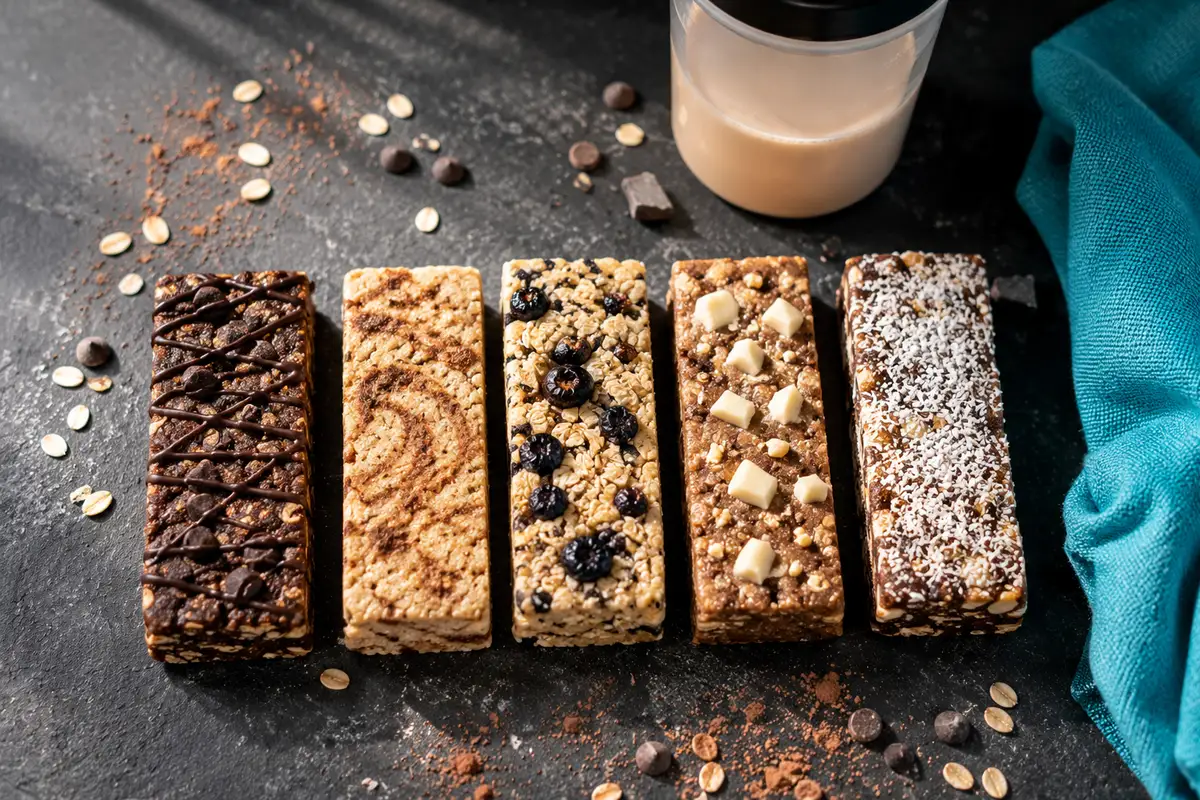

I remember standing in my kitchen five years ago, staring at an empty wrapper from a bar that had just cost me nearly four dollars. My stomach was already churning from whatever sugar alcohol they had packed into that thing.
I was in the middle of a lean-out phase for a photoshoot, and I thought, There has to be a better way.
That moment launched me into experimenting with homemade protein bars, and I have never looked back. Today, I am going to show you exactly how I make them, why my clients swear by them, and how you can tailor every single recipe to your goals.
Table of contents
- Can You Make Protein Bars That Actually Taste Good?
- The 4-Part Formula for Any Homemade Protein Bar
- Essential Tools and Pantry Staples
- Recipe 1: Classic Chocolate Peanut Butter Protein Bars
- Recipe 2: Cookies and Cream No-Bake Bars
- Recipe 3: Blueberry Muffin Breakfast Protein Bars
- Recipe 4: Cinnamon Roll High-Protein Squares
- Recipe 5: Dark Chocolate Coconut Keto-Style Bars
- How to Store Your Bars for Maximum Freshness
- 3 Common Mistakes That Ruin Homemade Protein Bars
- Frequently Asked Questions
Can You Make Protein Bars That Actually Taste Good?
I get this question from new clients constantly. A guy named Marcus, a 34-year-old accountant from London, joined my coaching program two years ago. The first thing he told me was, “I have tried three homemade bar recipes from social media. They all tasted like chalk mixed with regret.”
I laughed because I had been there.
The truth is, most store-bought bars fail us in three ways. First, they cost a fortune. Marcus was spending around $110 a month on branded bars. Second, the ingredient lists read like chemistry exams—soy protein isolate, maltitol, fractionated palm kernel oil. Third, the taste often falls somewhere between cardboard and a failed science experiment.
Homemade bars solve all three problems. You control the ingredients. You control the macros. And yes, you can make bars that genuinely taste like dessert without derailing your progress.
My chocolate peanut butter recipe has converted dozens of skeptics into believers. The answer to this question is a confident yes, and I will prove it to you.
The 4-Part Formula for Any Homemade Protein Bar
Before I hand you recipes, you need to understand the blueprint. I teach every client this formula during their first week. Master it, and you will never need another recipe again. You will just create your own.
Component | Role | Examples |
|---|---|---|
Protein Base | Structure and muscle repair | Whey-casein blend, plant-based protein |
Binding Agent | Holds everything together | Honey, nut butter, brown rice syrup, mashed banana |
Dry Base | Texture and satiety | Rolled oats, almond flour, coconut flour |
Flavor Boosters | Taste and enjoyment | Dark chocolate chips, dried fruit, chopped nuts, sea salt |
Here is the single most important lesson I have learned from watching clients fail: do not use pure whey protein as your only protein source. I made that mistake early on. The bars turn into dry, chalky bricks within hours.

Tell us your goal & discover your perfect stack — backed by science, no BS.
Free. Takes 2 Min | No sign-up needed
I teach what I call the 70-30 rule. Use 70% whey and 30% casein, or replace that 30% with a scoop of peanut butter or almond butter. The fat and the slower-digesting protein lock in moisture and keep the bar soft for days.
For a deeper dive into why this blend matters, I often point clients to my guide on the hybrid protein strategy of combining whey and casein together for 24-hour muscle growth.
Essential Tools and Pantry Staples
You do not need a professional kitchen. I have made these bars in a tiny apartment with minimal equipment. Here is what you need.
Tools:
- Parchment paper (non-negotiable, prevents sticking)
- 8×8 inch square pan (glass or metal, either works)
- Large mixing bowl
- Food processor (helpful but optional, you can mix by hand)
- Rubber spatula
Pantry Staples I Always Keep On Hand:
- 2-3 types of protein powder (chocolate, vanilla, unflavored)
- Rolled oats (not instant, they turn mushy)
- Natural peanut butter or almond butter
- Raw honey or sugar-free maple syrup
- Coconut oil
- Unsweetened cocoa powder
- Unflavored egg white powder (my secret weapon, which I will explain shortly)
Recipe 1: Classic Chocolate Peanut Butter Protein Bars
This is my personal post-workout bar. I eat one within 30 minutes of finishing my session. The fast-digesting carbs from honey replenish glycogen. The whey-casein blend delivers a complete amino acid profile. The sodium from peanut butter helps with rehydration after a heavy sweat.
I have made this bar hundreds of times, and it never gets old.
Macros per bar (makes 8 bars):
- Calories: 235
- Protein: 22g
- Carbohydrates: 18g
- Fat: 9g
Ingredients:
- 2 cups rolled oats, pulsed lightly in a food processor
- 4 scoops chocolate whey-casein blend protein powder
- 1/2 cup natural peanut butter (drippy, not the dry bottom-of-jar stuff)
- 1/3 cup raw honey
- 1/4 cup unsweetened almond milk
- 3 tablespoons dark cocoa powder
- Pinch of sea salt
Method:
- Line your 8×8 pan with parchment paper, leaving overhang on two sides for easy lifting.
- In a large bowl, combine the pulsed oats, protein powder, and cocoa powder. Whisk dry ingredients together.
- Add the peanut butter, honey, and almond milk. Stir until a thick dough forms. If the mixture feels dry and crumbly, add almond milk one tablespoon at a time until it holds when squeezed in your fist.
- Press the dough firmly and evenly into the prepared pan. I use the bottom of a flat glass to really pack it down. This prevents air pockets that cause crumbling later.
- Refrigerate for at least two hours before slicing into eight bars.
Coach’s Protein-Boosting Trick: Add 15 grams of unflavored egg white powder to the dry ingredients. It dissolves completely neutral, adds zero grit, and bumps each bar by roughly 2 grams of protein. No one ever notices it is there.
Recipe 2: Cookies and Cream No-Bake Bars
This recipe was born because a client named Elena, a 28-year-old graphic designer from Barcelona, told me she missed eating cookies and cream chocolate bars during her cut. I developed this as a compromise. It scratches the dessert itch while fitting her macros.
Macros per bar (makes 8 bars):
- Calories: 210
- Protein: 20g
- Carbohydrates: 19g
- Fat: 7g
Ingredients:
- 1 1/2 cups almond flour
- 3 scoops vanilla whey-casein blend protein powder
- 1/4 cup coconut flour
- 1/3 cup cashew butter (its mild flavor lets the cookies and cream shine)
- 1/4 cup sugar-free maple syrup
- 1/4 cup unsweetened almond milk
- 1/3 cup crushed sugar-free chocolate sandwich cookies
- 2 tablespoons white chocolate chips
Method:
- Line your pan with parchment paper.
- Mix almond flour, protein powder, and coconut flour in a large bowl.
- Add cashew butter, syrup, and almond milk. Stir until combined into a thick dough.
- Fold in the crushed cookies and white chocolate chips gently. Do not overmix or the cookies will turn to dust.
- Press firmly into the pan. Chill for three hours, then slice.
Real-World Tip: Elena kept a batch in her office fridge. She told me her coworkers kept stealing them, thinking they were store-bought. That is when you know you have nailed the recipe.
Recipe 3: Blueberry Muffin Breakfast Protein Bars
Dried blueberries are the non-negotiable ingredient here. Fresh blueberries add too much moisture and turn the bars soggy within a day. Dried blueberries concentrate the flavor and keep the texture dense and satisfying.
I use this bar as a breakfast replacement on busy mornings.
Macros per bar (makes 8 bars):
- Calories: 225
- Protein: 18g
- Carbohydrates: 22g
- Fat: 8g
Ingredients:

Take this 2-minute assessment & get a science-backed training, nutrition & supplement roadmap built for YOUR body.
🔬 12,000+ personalized roadmaps generated
- 2 cups rolled oats
- 3 scoops vanilla protein powder
- 1/4 cup coconut flour
- 1/3 cup almond butter
- 1/4 cup honey
- 1/4 cup unsweetened applesauce
- 1/2 cup dried blueberries
- Zest of one lemon (this brightens the entire bar, do not skip it)
Method:
- Pulse oats briefly in a food processor. You want some texture, not flour.
- Combine dry ingredients in a large bowl.
- Add almond butter, honey, and applesauce. Mix until uniform.
- Fold in dried blueberries and lemon zest.
- Press into lined pan, chill for two hours, slice.
Client Story: A client named Daniel, a 41-year-old father of two from Toronto, replaced his gas station breakfast muffins with these bars. Over six weeks, he dropped five pounds without changing anything else in his routine. Small swaps compound.
Recipe 4: Cinnamon Roll High-Protein Squares
The swirl technique makes this bar feel like an indulgence, but the macros stay clean. I developed this for a client during a maintenance phase. She wanted something that felt like a treat without triggering a binge.
The visual appeal matters more than you think. When food looks good, you feel satisfied before you even take a bite.
Macros per bar (makes 8 bars):
- Calories: 240
- Protein: 21g
- Carbohydrates: 20g
- Fat: 10g
Ingredients:
Base:
- 1 1/2 cups almond flour
- 3 scoops vanilla protein powder
- 1/4 cup coconut flour
- 1/3 cup cashew butter
- 1/4 cup brown rice syrup
- 1/4 cup unsweetened almond milk
Cinnamon Swirl:
- 3 tablespoons melted coconut oil
- 2 tablespoons ground cinnamon
- 1 tablespoon coconut sugar or brown sugar substitute
Method:
- Mix all base ingredients into a thick, uniform dough.
- In a separate small bowl, combine the swirl ingredients.
- Press the base dough into your lined pan.
- Drizzle the cinnamon mixture over the top. Use a butter knife to gently swirl it through the surface, creating that classic cinnamon roll pattern. Do not over-swirl or the whole top turns muddy brown.
- Chill for three hours minimum, then slice.
Presentation Note: I served these at a client workshop in Melbourne last year. Six people asked for the recipe before they finished eating. That cinnamon swirl does the heavy lifting on first impressions.
Recipe 5: Dark Chocolate Coconut Keto-Style Bars
Coconut oil is the hardening secret here. Unlike nut butters that soften at room temperature, coconut oil firms up solid when chilled. This gives the bar a satisfying snap and a texture closer to commercial chocolate bars.
I use this recipe for clients on lower-carb protocols. If you are on a ketogenic diet and wondering whether the protein source could interfere with your state, I have a detailed breakdown on using casein on keto and whether it truly breaks ketosis.
Macros per bar (makes 8 bars):
- Calories: 250
- Protein: 19g
- Carbohydrates: 8g (net)
- Fat: 16g
Ingredients:
- 1 1/2 cups unsweetened shredded coconut
- 3 scoops chocolate protein powder
- 1/4 cup coconut flour
- 1/3 cup melted coconut oil
- 1/4 cup sugar-free maple syrup
- 2 tablespoons unsweetened cocoa powder
- 1/3 cup sugar-free dark chocolate chips
Method:
- Combine shredded coconut, protein powder, coconut flour, and cocoa powder.
- Pour in melted coconut oil and syrup. Mix fast because coconut oil starts setting quickly on cold ingredients.
- Fold in dark chocolate chips.
- Press into pan, chill for two hours. These bars are firmer than the others, so slice them straight from the fridge with a sharp knife.
How to Store Your Bars for Maximum Freshness
Proper storage makes the difference between a bar that stays delicious for a week and a bar that dries out in two days. I learned this the hard way during a competition prep when I batch-prepped ten days of bars and stored them incorrectly. Half of them turned into bricks.
Storage Method | Duration | Best Practice |
|---|---|---|
Refrigerator (airtight container) | 7 days | Separate layers with parchment paper |
Freezer (individually wrapped) | Up to 3 months | Wrap each bar in plastic wrap, then place in a freezer bag |
Room temperature (nut-heavy bars only) | 4-6 hours | Perfect for gym bag or office desk |
Pro Tip: When freezing, write the date and macros on each bar with a permanent marker on the plastic wrap. You will thank yourself three weeks later when you cannot remember which recipe is which.
3 Common Mistakes That Ruin Homemade Protein Bars
I have watched clients make these exact errors hundreds of times. Here is how to spot them and fix them fast.
Mistake 1: Dry, Crumbly Texture
The Cause: Too much dry ingredient, not enough binder. Often happens when you pack the measuring cup instead of scooping loosely.
The Fix: Add one tablespoon of milk, melted coconut oil, or nut butter at a time. Mix thoroughly after each addition. The dough should hold its shape when you squeeze a handful. If it crumbles apart, it needs more moisture.
Mistake 2: Too Soft to Hold Shape
The Cause: Overdoing the liquid ingredients or using a protein powder that absorbs moisture poorly. Pure whey is the worst offender here. This is exactly why I recommend reading through my complete whey protein guide covering muscle gain, fat loss, and recovery to understand how your powder behaves.
The Fix: Add more dry base—oats, almond flour, or an extra half-scoop of protein. Chill the bars longer. If they still will not set, you likely skipped the 70-30 whey-to-casein rule I mentioned earlier. For a thorough explanation of why casein behaves so differently, check out my casein protein guide.
Mistake 3: Bitter Protein Aftertaste
The Cause: Low-quality protein powder or artificial sweeteners that leave a chemical finish. I see this constantly with cheap, bulk-bought powders.
The Fix: Use a protein brand you trust and genuinely enjoy drinking plain. Enhance flavor with a pinch of sea salt, a teaspoon of vanilla extract, or an extra tablespoon of cocoa powder. Do not rely on sweeteners to mask bad protein. Start with a base that tastes decent on its own.
If you want transparency on what goes into your powder, I have an in-depth look at how manufacturers create those natural flavors in whey protein. The topic of sweeteners is also critical, and I encourage you to read my full analysis on whether artificial sweeteners in whey protein are safe or not before you buy your next tub.
Frequently Asked Questions
A whey and casein blend gives the best texture. Pure whey makes bars dry and hard. Casein adds a soft, doughy consistency. Plant proteins work too but need extra nut butter or liquid.
Seven days in the fridge. Up to three months in the freezer. Always store them in an airtight container and wrap individually to keep them from drying out.
Yes. Use almond flour or coconut flour instead. If using coconut flour, cut the amount in half because it absorbs much more moisture.
Most do, because they contain no preservatives. Nut-heavy bars can stay firm at room temperature for a few hours, so they work in a gym bag.
Weigh every ingredient on a digital food scale. Add up all the macros, then divide by the number of bars you cut. Never use volume measurements like cups.
You need more binding. Add extra honey, nut butter, brown rice syrup, or mashed banana. If the dough feels dry, add a tablespoon of milk at a time until it holds when squeezed. Press the mixture firmly into the pan.
Most are dessert bars with a scoop of protein added. They often pack 350 calories with only 10 grams of protein. Always check the macros before committing to a recipe.
Recipe 1, Classic Chocolate Peanut Butter. It is my post-workout go-to. The taste never gets old, the macros match my goals, and it keeps me full for hours.
Collagen supports skin and joints but is not a complete protein for muscle repair. Casein provides all essential amino acids and digests slowly, making it ideal for muscle growth and recovery.

Leave a Reply