


Looking for a supplement that helps you crush more reps, last longer, and push past muscle burn?
The answer isn’t caffeine or pre-workout hype. It’s beta-alanine — and it works best when paired with carnosine.
This powerful duo fights the burning sensation that forces you to stop mid-set. Whether you train for weightlifting, CrossFit, or endurance sports, understanding how beta-alanine and carnosine work together gives you a serious edge.
📌 The 5 Essential Tips:
- Beta-alanine boosts muscle carnosine by 40–80% within 4–6 weeks.
- Carnosine buffers acid (H⁺) — delaying muscle burn by 30–40% during high-rep sets.
- Effective dose: 3.2–6.4g daily, split into 2–3 doses to avoid tingling.
- Best for: HIIT, CrossFit, endurance running, and bodybuilding (8–20 rep range).
- No effect on 1RM strength — pair with creatine for power.
In this article, I’ll break down the science, share real coaching experience, and show you exactly how to use beta-alanine and carnosine for better workouts.
Table of contents
- Why This Combination Matters
- How Beta-Alanine Raises Muscle Carnosine
- What Carnosine Does for Your Muscles
- What the Research Shows
- Who Can Benefit Most from Beta-Alanine?
- Recommended Dosage and Best Timing
- Side Effects and How to Manage Them
- Beta-Alanine vs. Creatine: Key Differences
- When to Avoid Beta-Alanine
- Frequently Asked Questions
- Final Verdict: Is Beta-Alanine Worth Taking?
Why This Combination Matters

If you’ve ever pushed through high-rep sets, intense circuits, or endurance sessions, you know the feeling — that burning wall where your muscles scream “enough!”
That burn isn’t actually from lactic acid. It’s from hydrogen ions (H⁺) building up in your muscles, making the environment more acidic. The harder you train, the faster they accumulate.
This is where beta-alanine and carnosine become your muscle-saving tag team.
Beta-alanine raises carnosine levels in your muscles. Carnosine then acts like a built-in buffer — neutralizing those hydrogen ions before they shut you down.
The result? You delay fatigue, push through more reps, and maintain peak performance longer. Whether you’re cutting, bulking, or grinding through leg day, this synergy keeps you moving.
For a deeper look at how to use beta-alanine consistently, check out the Beta-Alanine Daily Use Guide.
How Beta-Alanine Raises Muscle Carnosine
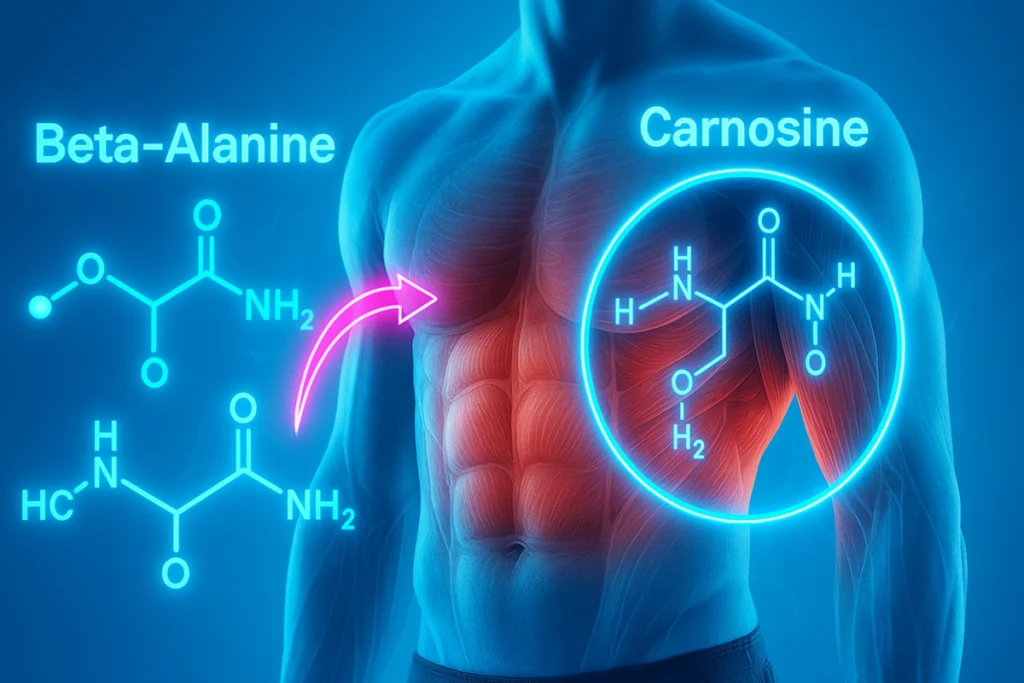
Carnosine is naturally found in your muscle cells — but your body can’t produce it without the right ingredients.
It forms when beta-alanine (a non-essential amino acid) combines with histidine. Here’s the key: histidine is plentiful in your body, but beta-alanine is almost always the limiting factor. That means supplementing with beta-alanine is the most effective way to raise muscle carnosine levels.
My personal experience: Once I started taking beta-alanine consistently, I noticed a real difference. During supersets on push days, I wasn’t gassed by the third round. That shift alone changed how I trained.
Not sure if you need beta-alanine alone or in a pre-workout? See our comparison: Beta-Alanine vs. Pre-Workout.
What Carnosine Does for Your Muscles
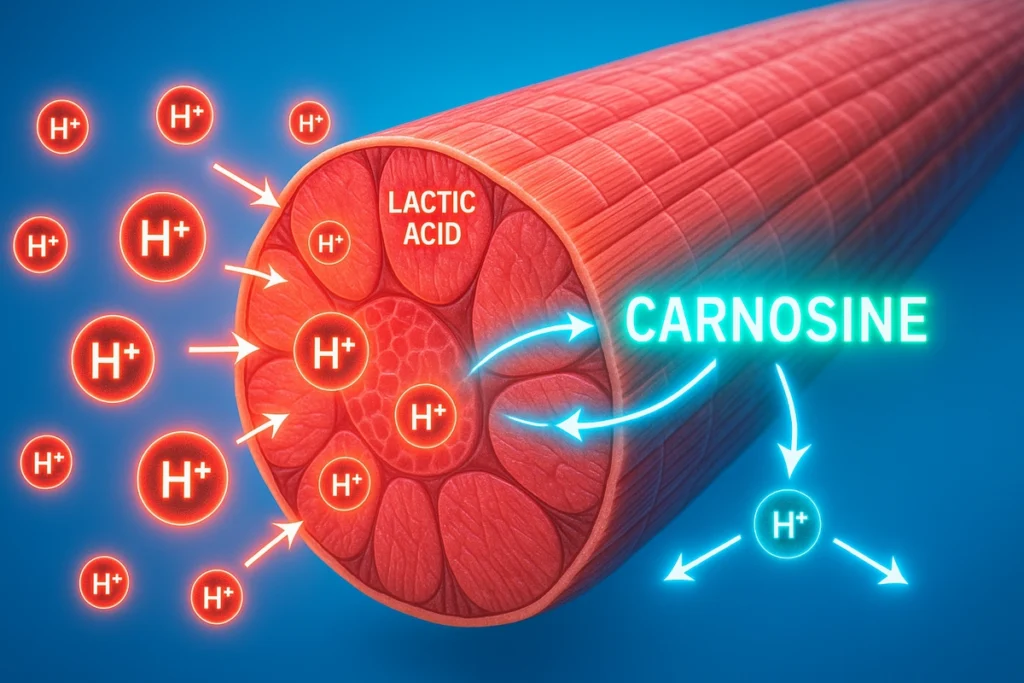
Carnosine works like a built‑in shock absorber for your muscles.
During high‑intensity efforts, hydrogen ions (H⁺) accumulate rapidly. These ions drop your muscle pH, creating that painful burn — and eventually forcing you to stop.
Higher carnosine levels mean your muscles can buffer more H⁺. The result? You stay in the fight longer.
Real‑world example: One of my athletes, James from Canada, started beta‑alanine before prepping for a Spartan Race. After just a few weeks, his uphill sprints felt noticeably more manageable. No magic — just better buffering.
Good to know: Beta‑alanine works even on rest days. Should You Take Beta‑Alanine on Rest Days?
What the Research Shows
The science confirms what I’ve experienced with clients and in my own training.

Multiple studies show that 4–6 weeks of beta-alanine supplementation increases muscle carnosine by up to 80% .
That increase translates directly to:
- Better muscular endurance
- Longer time to exhaustion
- Reduced perceived fatigue
My personal result: Around weeks 3–4, I noticed a real shift. During leg workouts, my walking lunges went from 10 reps to 13 reps — same weight, no change in form. Just better endurance from beta-alanine and carnosine working together.
Running specific? Here’s our full guide: Beta-Alanine for Runners.
Results Timeline
Weeks | What to Expect |
|---|---|
1–2 | Tingling may appear (harmless). No performance change yet. |
3 | ~30% carnosine increase. You may feel less burn on final reps. |
4–6 | 60–80% carnosine saturation. Noticeable endurance boost. |
8+ | Full effect maintained with 3.2g daily. |
Who Can Benefit Most from Beta-Alanine?

You’re a good fit for beta-alanine if your training includes:
- High-rep hypertrophy sets (8–20 reps per set)
- HIIT, CrossFit, or circuit training
- Endurance sports — obstacle races, running, cycling
If that sounds like you, beta-alanine is worth adding.
Client example: Luis from Brazil was deep into a cutting phase. His energy usually dropped by set three. After adding beta-alanine, he maintained workout intensity longer — and preserved more lean mass in the process.
For our female athletes: Beta-alanine works just as well. Beta-Alanine for Women Training.
Recommended Dosage and Best Timing
Choose your goal — then follow the dose schedule below.

Take this 2-minute assessment & get a science-backed training, nutrition & supplement roadmap built for YOUR body.
🔬 12,000+ personalized roadmaps generated
Goal | Daily Dose | Split Schedule | Duration |
|---|---|---|---|
Loading (fast saturation) | 6.4 g | 4 x 1.6 g (every 3–4 hours) | 2–3 weeks |
Maintenance | 3.2 g | 2 x 1.6 g (morning + night) | Ongoing |
Low tingling sensitivity | 2.4 g | 3 x 0.8 g | Ongoing |
Pro tip: Take beta-alanine with meals — this slows absorption and significantly reduces the tingling sensation (paresthesia).
New to beta-alanine? Start with the low‑tingling protocol (2.4g daily) for the first week, then increase if needed.
Side Effects and How to Manage Them
Let’s talk side effects — because they’re real.

The most common one is a tingling sensation on your skin called paresthesia. Why does it happen? Beta-alanine activates certain nerve receptors under your skin. It’s harmless, temporary, and goes away.
How to stop the tingle: Split your daily dose into 3–4 smaller servings, take it with food to slow absorption, or try sustained-release capsules.
I got the tingle too, especially on my face and hands during the first week. It’s harmless but a bit weird at first. Once I started splitting my dose into 2–3 servings, it stopped — and made it easier to stay consistent.
Want a full breakdown of the tingling effect? Here you go: Beta-Alanine Tingling Explained.
Does stacking help? Yeah, I’ve used beta-alanine alongside creatine and citrulline malate. The combo improved my strength and endurance without any crash.
If you’re thinking about that stack, check this out: Beta-Alanine vs Creatine for Strength and Power.
And yeah, people ask about loading a lot. My take? It’s optional but helpful. Here’s the guide if you want to try it: Beta-Alanine Loading Phase Guide.
Beta-Alanine vs. Creatine: Key Differences
Not sure which one you need? Here’s the simple breakdown.
Attribute | Beta-Alanine | Creatine |
|---|---|---|
Primary benefit | Endurance, delays muscle burn | Strength, power, sprint repeats |
Time to feel it | 3–6 weeks | 1–2 weeks (with loading) |
Best for | 60–240 sec efforts (400m run, high-rep squats) | 0–30 sec efforts (1RM, 100m sprint) |
Can you stack them? | Yes — they work together | Yes — synergistic |
The bottom line? Take both. Beta-alanine handles the burn. Creatine handles the bang.
When to Avoid Beta-Alanine
Beta-alanine is safe for most people, but it’s not for everyone. Here’s when to think twice.
- You’re very sensitive to tingling.
Paresthesia (that skin tingle) is harmless, but some people really hate it. If that’s you, try a lower dose first — or just skip it. - You have a history of taurine deficiency.
Beta-alanine and taurine compete for the same transporters in your body. Taking beta-alanine can lower taurine levels over time. If you already run low on taurine, talk to a coach or doctor first. - You’re a pure strength athlete.
If you only care about your 1RM on squats, deadlifts, or bench — beta-alanine won’t help much. It’s built for endurance and high reps, not max power. Stick with creatine instead.
Frequently Asked Questions
It raises carnosine levels in your muscles. Carnosine buffers acid, so you feel less burn and can do more reps or sprint longer before fatigue stops you.
About 3–4 weeks. You’ll notice better endurance in the 4th or 5th week. Full carnosine saturation takes 4–6 weeks.
Take 3.2 to 6.4 grams total per day. Split it into 2–3 smaller doses (e.g., 1.6g twice a day) to reduce tingling.
It triggers certain nerve receptors under your skin. The feeling is harmless, lasts 15–30 minutes, and goes away when you split your doses or take them with food.
Yes. Carnosine levels drop slowly, but consistent daily dosing keeps them high. Take the same amount on rest days.
Loading is optional. A loading phase (6.4g/day for 2–3 weeks) saturates muscles faster. A standard dose (3.2g/day) works too, just slower.
Use both. Beta-alanine helps endurance and delays burn (60–240 second efforts). Creatine helps strength and power (0–30 second efforts). They work well together.
Yes, especially for middle-distance runs (400m to 1500m) or obstacle course races. It won’t help a marathon much, but it helps uphill sprints and final kicks.
Absolutely. Women benefit just as much – often more if they have lower baseline carnosine. The dosage and effects are the same.
No serious side effects. The only common one is harmless skin tingling (paresthesia). Very high doses (over 10g/day) might cause stomach discomfort.
Final Verdict: Is Beta-Alanine Worth Taking?

Absolutely — if you’re serious about performance and muscle endurance.
Beta-alanine won’t hit you like caffeine. There’s no instant rush. But stick with it, and the carnosine boost delivers where it counts: longer sets, stronger finishes, and less mid-set burnout.
Whether you’re a lifter chasing more reps or an athlete racing the clock, beta-alanine is a smart addition to your stack.
Take it consistently for at least 4–6 weeks. Split your doses. And watch your performance shift.
Like I always tell my clients — it’s not about pushing harder once. It’s about pushing further every time.

 Claim Your Free Assessment
Leave a Reply