
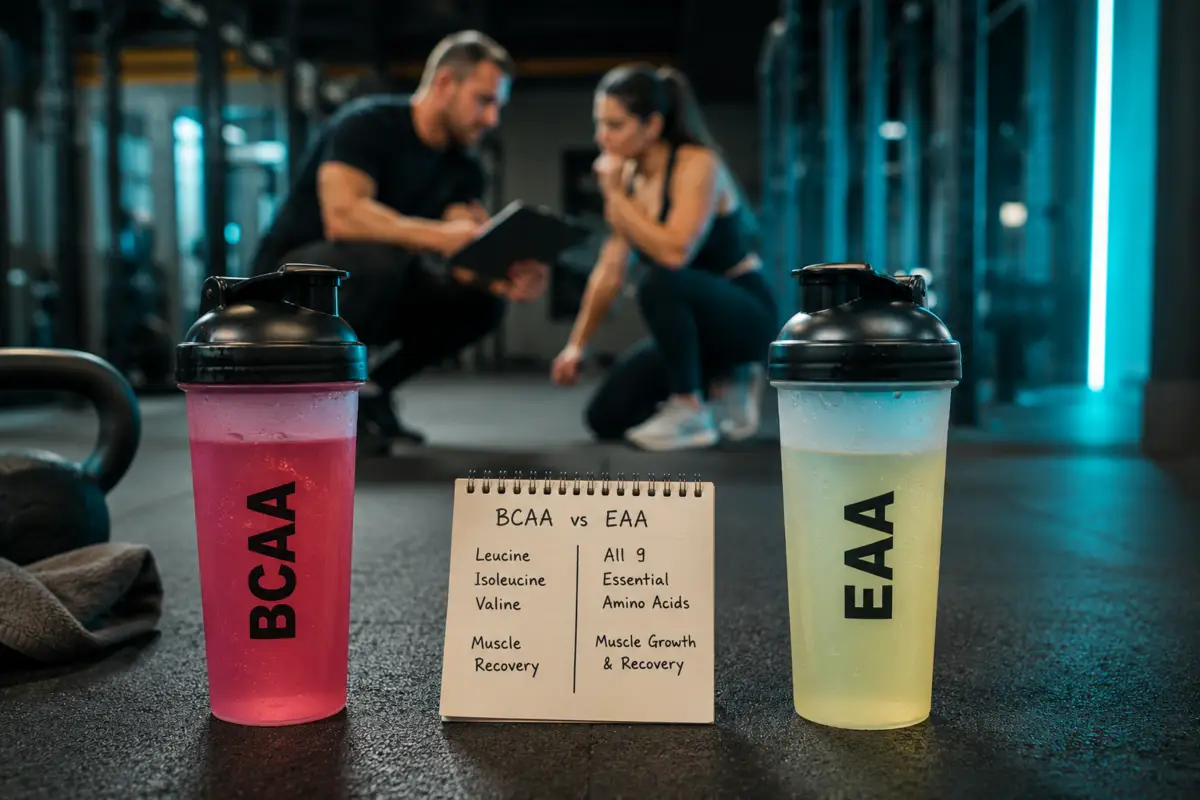

You’re standing in the supplement aisle, one tub of EAAs in your left hand, BCAAs in your right. The labels scream different promises at you. One says “complete recovery,” the other says “anti-catabolic muscle protection.” You just want to know which one actually deserves your hard-earned money.
I’ve been in that exact spot. Multiple times. And after 10-plus years in the bodybuilding trenches and over seven years coaching clients internationally, I’ve made every mistake possible with both. This guide will cut through the noise so you can decide based on your diet and your training — not marketing budgets.
Let me give you the answer upfront. Then we’ll dig into the why.
Table of contents
The Short Answer: Which One Do You Actually Need?
I’m going to make this painfully simple. Here’s a decision table based on real athlete profiles I work with daily.
Find Your Athlete Profile:
If You… | You Should Take… | Why |
|---|---|---|
Eat 1.6–2.2g/kg of complete protein daily (meat, eggs, dairy, whey) and train fed | Neither — spend your money on whole food | You’re already flooding your bloodstream with all essential amino acids. The supplement is redundant. |
Are vegan, vegetarian, or consistently undereat protein | EAAs | Your diet likely lacks leucine thresholds and complete amino profiles. You need the full spectrum. For a complete breakdown, read this EAA muscle growth guide. |
Train fasted in the morning and worry about muscle loss | EAAs | BCAAs alone cannot build or preserve tissue. EAAs provide the actual building blocks. |
Are in an aggressive calorie deficit for a cut or competition prep | EAAs | Protein needs are higher in a deficit. EAAs are low-calorie, complete insurance. |
Train endurance sports (marathon, triathlon, long cycling sessions) | BCAAs may help with central fatigue | Some research suggests BCAAs compete with tryptophan at the blood-brain barrier, potentially delaying perceived fatigue. |
Do high-volume bodybuilding sessions over 90 minutes and want to sip something intra-workout | EAAs | You need repair materials available during the session, not just a leucine pulse. |
The one-sentence rule I teach my clients:
If your daily protein intake is solid and complete, EAAs and BCAAs won’t change your physique. If your diet has gaps, EAAs fill them. BCAAs are a niche tool at best.
Now let me walk you through the deeper science and my real-world experience so you understand why this table exists.
Taking EAAs? Don’t Let Bad Timing or Wrong Dosage Kill Your Progress.
I’ll map out exactly when and how much EAAs you need — personalized to YOUR body and YOUR goal.
Stop Wasting My EAAs — Show Me How →EAAs vs BCAAs: What’s the Real Difference?
I remember sitting in my apartment around 2015, staring at a notebook where I’d sketched out amino acid pathways. I was frustrated because I’d been religiously sipping BCAAs for two years, and my progress had stalled. My digestion felt off, and I wasn’t recovering any better than when I just ate chicken and rice. That notebook session changed everything for me.
Here’s what you need to understand:
Essential Amino Acids (EAAs) are nine specific amino acids your body cannot produce on its own. You must get them from food or supplementation. These nine are:
- Histidine
- Isoleucine
- Leucine
- Lysine
- Methionine
- Phenylalanine
- Threonine
- Tryptophan
- Valine
Think of them as the nine mandatory workers on a construction site. If even one calls in sick, the build stops. You cannot complete a brick wall with seven bricklayers and two empty spots.
Branched-Chain Amino Acids (BCAAs) are just three of the nine — leucine, isoleucine, and valine. They have a unique branched chemical structure and are metabolized directly in skeletal muscle rather than the liver.
This is where most supplement marketing twists the truth. They tell you BCAAs are the “most important” aminos because they’re metabolized in muscle. They conveniently leave out the fact that leucine, isoleucine, and valine alone cannot build a single new muscle protein strand. They need the other six essential amino acids present in adequate amounts.
Think of leucine as the ignition key to a car. It turns on muscle protein synthesis (MPS) beautifully. But if the gas tank — the other eight EAAs — is empty, you’re not going anywhere.
I learned this the expensive way. For roughly two years, I was that guy carrying around a shaker of pink-tinted BCAAs, sipping between meals, believing I was in a constant anti-catabolic state. My physique was decent, but it plateaued hard.
When I finally dug into amino acid metabolism research and realized I was chronically spiking serum leucine without providing the full EAA pool needed to complete the MPS signal, I felt foolish. The excess was simply being oxidized for energy or, worse, converted and stored.
I dropped the between-meal BCAA habit, saved roughly $40 a month, and my bloating disappeared within a week. My recovery from heavy leg sessions actually improved because I redirected that money toward better whole food.
Choose Based on Your Diet
This is where I start every client conversation about supplementation. Before we ever talk about training variables, we audit what’s on your plate.
If You Eat Enough Complete Protein Daily (1.6–2.2g/kg) — BCAA Redundancy
Here’s a reality check most supplement companies don’t want you to read.
If you’re consuming a palm-sized portion of chicken breast, fish, lean beef, or eggs at three to four meals per day, your bloodstream is already delivering all nine EAAs to muscle tissue repeatedly. Adding isolated BCAAs on top of that is like pouring a cup of water into an already full bucket.
The research from the McMaster University protein metabolism lab — led by Dr. Stu Phillips, whose work I’ve followed closely for years — has consistently shown that a meal containing 25–30g of complete protein maximally stimulates muscle protein synthesis for several hours. That meal already provides approximately 2.5–3g of leucine, which hits the threshold needed to trigger the mTOR pathway.
Adding BCAAs to that scenario achieves nothing except increasing your supplement expenses. If you’re curious about when BCAAs actually have a place, I’ve detailed the specific scenarios in this BCAA supplements guide covering benefits, timing, and safety.
My honest advice to well-fed clients:
Save the $30–$50 monthly supplement cost and put it toward higher-quality meat, wild-caught fish, or an extra physiotherapy session. The return on investment is infinitely better.
If You’re Vegan, Vegetarian, or Undereating Protein — EAA Advantage
This is where EAAs genuinely earn their place.
My client Lena, a 34-year-old vegetarian from Berlin, taught me this lesson permanently. She came to me preparing for her first bikini competition. Her daily protein sat around 110 grams from eggs, dairy, lentils, and plant sources.
In a steep calorie deficit, she was also doing fasted morning cardio and sipping 15 grams of BCAAs during her sessions, convinced it would preserve her hard-earned quad sweep. Over eight weeks, despite flawless adherence, I watched her lose noticeable muscle density in her glutes and quads. Her strength dropped. She was doing everything “right” by standard bodybuilding advice, yet her body was eating its own muscle tissue.
The problem was clear when I analyzed her intake. Plant-based proteins typically have lower leucine content per gram than animal proteins. Her total daily leucine was likely hovering right at or below the threshold needed for maximal MPS stimulation. On top of that, she was in a calorie deficit, which increases the body’s demand for gluconeogenic amino acids. The BCAAs she was sipping provided the key but not the building materials.
I made one change. I pulled the BCAAs completely and replaced them with 10 grams of unflavored EAAs during her training session. Within four weeks, her morning weight loss continued without further visible muscle flattening. Her squat and deadlift numbers stabilized. She stepped on stage tighter and fuller than we had projected.
If your diet leans heavily plant-based or you simply struggle to hit 1.6g/kg of complete protein, EAAs fill the gap efficiently and without excess calories.
If You Train Fasted — EAA for Muscle Preservation
Fasted training has its place. I’ve used it with clients who prefer morning sessions on an empty stomach. But here’s the physiological reality you need to understand.
When you train in a truly fasted state, your body’s amino acid pool is low. Cortisol is naturally elevated in the morning. Intense training further elevates cortisol, which promotes muscle protein breakdown to release amino acids for energy production. You’re essentially in a catabolic environment with no dietary amino acids available to offset the breakdown.
BCAAs in this scenario are not enough. They provide the signal but not the substrate. It’s like ordering construction workers to a building site and giving them only blueprints but no bricks.
EAA supplementation (5–10g pre or intra-workout) provides the full spectrum of building blocks your body would otherwise strip from your hard-earned muscle tissue. This is one of the few scenarios where I consider amino acid supplementation genuinely important.
I’ve personally tested several products in this exact context, and you can see my top recommendations in this breakdown of the best EAAs for fasted training with clean formulas and proven ratios.
Choose Based on Your Training
Your training style dictates your nutritional demands. Let’s map supplementation to specific goals.
Strength and Hypertrophy Goals — EAA for Maximal MPS
If you’re chasing a bigger deadlift, more pronounced delts, or a thicker back, your entire program revolves around maximizing muscle protein synthesis in the post-training window while minimizing breakdown during the session itself.
Mechanical tension from heavy resistance training sensitizes muscle tissue to amino acid uptake. This is a golden window where the muscle machinery is primed to accept building materials. But it needs the complete set of materials, not just three of nine.
I’ve programmed EAAs for advanced bodybuilders during high-volume accumulation phases, particularly when training sessions stretch beyond 75 minutes. The logic is simple: provide the full spectrum of substrates while the muscle is highly receptive, without adding digestive load that whole food would create mid-session.
Endurance Athletes — BCAA for Central Fatigue Management
Endurance work creates a different physiological challenge.
During prolonged exercise lasting two or more hours, plasma tryptophan levels can rise relative to BCAAs. Since BCAAs and tryptophan compete for the same transporter across the blood-brain barrier, this altered ratio may allow more tryptophan into the brain. Tryptophan converts to serotonin, and elevated serotonin is linked to central fatigue — that overwhelming sense of tiredness that makes you want to quit at kilometer 35 of a marathon.
The theory behind BCAA supplementation during endurance events is that keeping plasma BCAA levels high reduces tryptophan uptake into the brain, potentially delaying the onset of central fatigue.
The research here is mixed and honestly not as robust as the marketing suggests. Some studies show modest improvements in perceived exertion. Others show nothing. My personal take after working with a handful of marathoners and triathletes is that if you’re going to experiment with BCAAs at all, this is one of the few defensible use cases. But I would still prioritize carbohydrate and electrolyte strategies first.
High-Volume, Fasted Cardio — EAA Over BCAA
I see this scenario constantly during contest prep seasons. A client is doing 45–60 minutes of fasted incline walking or cycling in the morning, followed by a weight session later in the day.
The morning cardio session is catabolic by nature. If preserving muscle tissue matters to you, BCAA alone will not protect you. EAA supplementation immediately before or during fasted cardio provides the amino acid pool your body needs, preventing it from breaking down contractile proteins for fuel.
A practical tip I give all my prep clients: 5–8 grams of EAAs in your water bottle during fasted cardio is metabolic insurance that costs very little and pays off significantly when you step on stage or in front of the mirror.
When BCAAs Actually Make Sense
I’ve been openly critical of BCAA supplementation for most scenarios, but I want to be fair. There are a few specific contexts where they’re not completely useless.
The classic bodybuilding intra-workout protocol uses a 6:1:1 ratio of leucine to isoleucine to valine. The logic is that leucine provides a sharp pulse to mTOR signaling, isoleucine assists with glucose uptake into muscle, and valine competes with tryptophan at the brain. Some athletes report reduced perceived soreness and better session-to-session recovery when sipping this ratio during two-hour-plus training sessions.
I want to be transparent here. Even in this scenario, the benefit is modest and likely applies only to very advanced athletes training with high volume and frequency where the margins between optimal and sub-optimal recovery are razor-thin. For the majority of trainees, this is optimization theater.
The other niche where BCAAs can function is when you genuinely cannot afford to consume anything with caloric value but want a small leucine-driven MPS trigger. Some research models show that leucine alone can transiently stimulate MPS, though the effect is short-lived and incomplete without the full EAA spectrum. This might apply to clinical settings or medically supervised very low-calorie protocols — scenarios I rarely encounter in general fitness coaching.
When EAAs Are Clearly Superior
Let me be direct about the scenarios where EAAs are the clear winner.
Low protein meals: If you’re traveling, stuck in back-to-back meetings, or simply end up eating a lower-protein lunch than planned, a serving of EAAs provides the complete amino spectrum to salvage that meal’s anabolic potential.
Caloric deficits and aggressive cuts: When calories drop, protein requirements actually increase to preserve lean mass. EAAs deliver the essential aminos with roughly 0–40 calories per serving, making them extraordinarily efficient. I’ve used this strategy with over two dozen contest prep clients. The ones who included EAAs during their lowest-calorie phases consistently retained more muscle fullness than those who didn’t.
Older athletes: Sarcopenia — age-related muscle loss — involves anabolic resistance, where muscle tissue becomes less responsive to lower doses of amino acids. The leucine threshold required to stimulate MPS increases with age. EAAs provide a concentrated, easily digestible source that helps older clients overcome this resistance without having to consume massive protein portions they may struggle to digest.
Muscle retention during layoffs: When a client is injured, traveling extensively, or taking a planned training break, I often recommend 10 grams of EAAs once or twice daily between meals. It’s a minimal-cost intervention that appears to help preserve lean tissue during periods of detraining.
Hossein’s Personal Stacking Protocol
People always ask me what I actually do myself. Here’s my honest, current protocol. This has evolved over a decade of trial and error. It is not what I did in 2016. It is what I do now, after making all the mistakes.
Non-Training Days
I take nothing. Zero. My nutrition covers my bases completely. On rest days, I prioritize whole food meals with high-quality protein sources at regular intervals. The supplement tubs stay closed.
Pre-Workout (15–30 Minutes Before Training)
If I’m training mid-morning or afternoon after having eaten a solid meal within the previous two to three hours, I do not take EAAs pre-workout. That meal is still releasing amino acids into my bloodstream.
If I’m training fasted first thing in the morning, I will take 8–10 grams of EAAs with my pre-workout coffee or mixed in water.
Intra-Workout (Sipped During the Session)
For sessions under 60 minutes, plain water with electrolytes.
For sessions exceeding 75–90 minutes, particularly high-volume leg or back days, I mix and sip throughout the session:
- 10g unflavored powdered EAAs (with a 4:1:1 leucine-to-isoleucine-to-valine balance within the full EAA matrix)
- 5g micronized creatine monohydrate
- 2g pink Himalayan salt for electrolyte support
- 10–15g highly branched cyclic dextrin (only when the session exceeds 90 minutes and the client needs performance support without gastrointestinal distress)
I mix this in roughly one liter of water and sip from the first working set until I rack the last barbell. No artificial colors, no proprietary blends, no “matrix” nonsense. For a deeper dive into why each component matters and how to customize your own, check out this complete resource on intra-workout nutrition covering EAAs, carbs, and electrolytes.
Post-Workout
I prioritize a whole food meal within 60–90 minutes. If logistics prevent that — like when I’m coaching back-to-back clients or stuck in traffic — I’ll have a scoop of whey isolate. I do not use EAAs post-workout. A meal or whey shake provides everything the EAA supplement would, plus additional nutrients and greater satiety.
The honest summary I give all clients:
My intra-workout drink supports hydration, performance, and recovery simultaneously. But if you took it away and I still ate well, I’d be 95% the same athlete. The last 5% matters when you’re competing. For general health and aesthetics, it’s entirely optional.
Frequently Asked Questions
Can I take both EAAs and BCAAs together?
You can, but you’re wasting money. EAAs already contain all three BCAAs — leucine, isoleucine, and valine — in physiologically relevant amounts. Adding separate BCAAs on top of EAAs is redundant. I’ve seen supplement stacks from well-meaning athletes that include EAA powder, BCAA capsules, and a pre-workout containing BCAAs. That’s three layers of overlap for no additional benefit and potential digestive discomfort.
Do EAAs break a fast?
Technically, yes. EAAs contain calories, typically around 4 calories per gram, though many labels round down due to labeling regulations. They stimulate insulin and activate mTOR, which are both hallmarks of breaking a fasted state.
If your fasting goal is purely for gut rest or autophagy, EAAs will interrupt that process. If your fasting goal is weight management and you’re using them strategically around training, the metabolic cost is negligible, and the muscle-preserving benefit likely outweighs the theoretical fast-breaking concern.
Are EAAs better than whey protein?
For overall health, satiety, and general muscle-building, whole food protein and whey are superior. Whey provides bioactive peptides, immunoglobulins, and greater satiety that isolated EAAs lack.
EAAs shine in specific scenarios: intra-workout when you don’t want digestion competing with muscle blood flow, during aggressive calorie deficits where every calorie counts, and for individuals who experience bloating or digestive distress from concentrated protein powders. Think of EAAs as a targeted tool, not a replacement for dietary protein.
The question gets even more interesting when you look at other popular recovery supplements — I’ve unpacked the differences in this comparison of EAAs vs glutamine for recovery.
Will BCAAs help me build muscle if I eat enough protein?
No. If your total daily protein intake meets the 1.6–2.2g/kg threshold from complete sources, adding BCAAs provides no additional muscle-building benefit. You are already supplying your muscles with all nine EAAs in adequate amounts through dietary protein.
I have watched countless clients spend months paying for flavored BCAA powders that did absolutely nothing for their physique because their chicken and egg intake was already covering them.
How do I time EAAs around workouts?
For fasted training, take 8–10 grams 15–20 minutes before you start. For intra-workout use, begin sipping from your first working set and finish by the session’s end. For general amino acid gaps in your diet, 5–10 grams between meals when protein intake has been lower than ideal. Post-workout, prioritize whole food or a whey shake within 60–90 minutes rather than relying on EAAs.
What should I look for in an EAA supplement?
Look for a product with transparent labeling — exact gram amounts per amino acid, not just a “proprietary blend.” You want a product where leucine sits around 2.5–4 grams per serving, with full disclosure of the other eight EAAs. Avoid anything with added BCAAs stacked on top of the EAA matrix, as this is a marketing trick, not a formulation benefit.
Unflavored or naturally flavored options using stevia or monk fruit are preferable to artificial sweeteners for daily use. Some formulations also offer cognitive benefits beyond just muscle preservation — if that interests you, I’ve explored how certain aminos support EAAs for mental focus during training. And if you’re an athlete who lives in the world of heavy cleans, snatches, and jerks, you may want to read about using EAAs for explosive strength in Olympic lifts.
The Bottom Line
Here’s what I want you to walk away understanding.
The EAA versus BCAA debate is largely a creation of the supplement industry designed to sell you multiple products. For the vast majority of people eating adequate complete protein, neither supplement is necessary. If your diet has genuine gaps — whether from food preferences, calorie restriction, or lifestyle constraints — EAAs fill those gaps effectively. BCAAs are a niche tool with very limited application.
Fix your protein intake first. Optimize your training second. Prioritize your sleep third. Then, and only then, consider whether the remaining small margin matters enough for EAA supplementation.
That’s not what the supplement ads will tell you. But it’s the truth, backed by both research and over a decade of watching real bodies change in real life.
Train smart. Eat completely. Supplement strategically.

 Maximize Results
Leave a Reply