


Choosing between protein powder and ready-to-drink (RTD) shakes can be confusing. If you’ve searched for a simple protein powder vs shake comparison, you’ve probably found plenty of opinions but little clarity.
As a fitness coach, I’ve tested both personally and with my clients. Each has clear advantages—and hidden drawbacks you should know before buying your next tub of powder or pack of premade shakes.
Whey protein powder is versatile and budget-friendly, giving you full control over your nutrition. Ready-to-drink shakes win on convenience and speed. The real question isn’t which one is universally better—it’s which one matches your goals, your schedule, and your budget.
✨ 5 Essential Differences: Whey Protein Powder vs. Premade Shakes (RTDs)
Your Priority | Whey Protein Powder | Premade Shakes (RTDs) |
|---|---|---|
Best For | Budget-conscious athletes, home use, macro tracking | Busy professionals, travel, immediate post-workout |
Cost | Most cost-effective for long-term muscle building | Premium convenience (you pay more per serving) |
Customization | Full control over portion size, flavor, and mix-ins | Fixed nutrition—what you see on the label is what you get |
Convenience | Requires mixing, a shaker, and cleanup | Grab-and-go, zero preparation |
Core Advantage | Maximum value and flexibility | Superior speed and portability |
📌 Both provide high-quality protein. Powder wins on affordability and control; premade shakes win when time is your scarcest resource.
In this article, you’ll discover the real differences between powder and premade shakes, the science-backed benefits, and my own coaching insights so you can make the best decision for your goals.
Table of contents
- Whey Protein Powder vs Ready-to-Drink Shakes: Which Is Better?
- Head-to-Head Comparison: Powder vs. Shakes – Pros, Cons & Cost per Gram
- Why Whey Protein Powder is the Most Affordable Muscle-Building Supplement
- What Are Premade (Ready-to-Drink) Protein Shakes?
- When to Choose Whey Protein Powder
- When to Choose Ready-to-Drink Shakes (for Commuting, Busy Days & Grab-and-Go)
- How Do I Choose Between Protein Powder and Ready-to-Drink Shakes?
- Extra Considerations: Digestion, Storage & Shelf Life, Sustainability
- Frequently Asked Questions: Protein Powder vs. RTD Shakes
- Final Takeaway
Whey Protein Powder vs Ready-to-Drink Shakes: Which Is Better?
If you’re looking for the most cost-effective, versatile, and customizable option, whey protein powder usually takes the crown. It gives you freedom over portion sizes, flavors, and what you mix it with.

On the other hand, if convenience and time-saving are your top priorities, ready-to-drink (RTD) protein shakes can be a lifesaver. They’re grab-and-go, perfect for work, travel, or busy days when you can’t prepare a shake.
✅ The truth? Both can play a role in your nutrition plan. As a coach and athlete, I’ve used both in my own journey and with clients—and the “best” option often depends on lifestyle and goals rather than one being strictly better.
Head-to-Head Comparison: Powder vs. Shakes – Pros, Cons & Cost per Gram
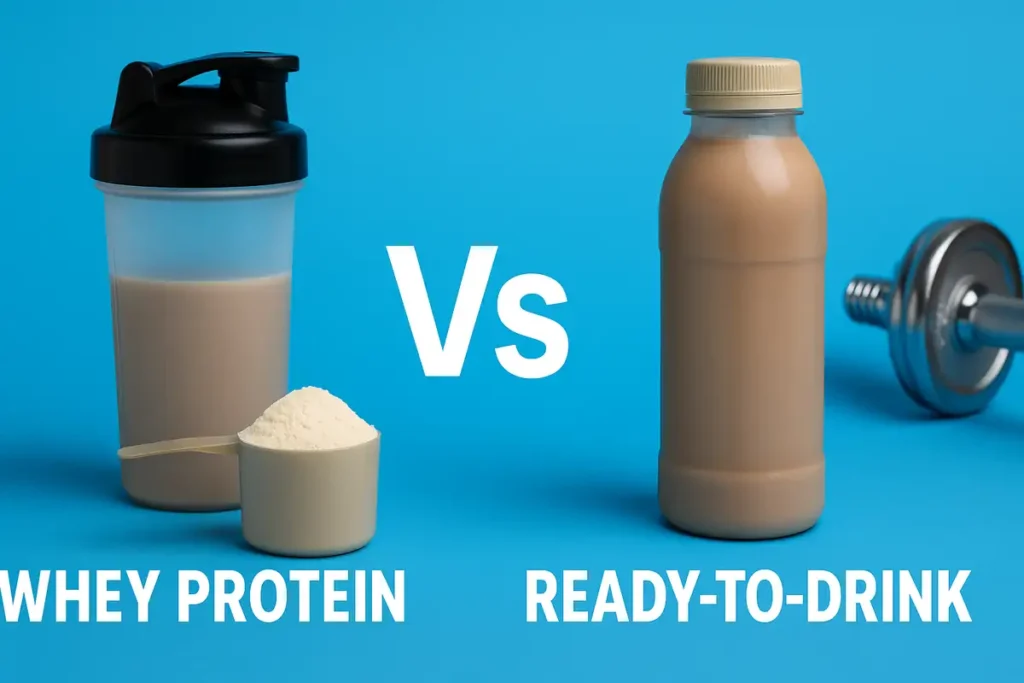
Comparison Feature | Whey Protein Powder | Ready-To-Drink (RTD) Shakes |
Nutrition Profile | High Control: Customizable serving sizes; can mix with oats, fruits, or nut butter. | Fixed Nutrition: Precise macros as stated on the label; no modification possible. |
Cost per Serving | Economical: 0.70$ – 1.20$ per serving. | Premium: 2.50$ – 4.00$ per serving (convenience fee included). |
Cost per Gram of Protein | ~$0.03 – $0.05/gram | ~$0.08 – $0.13/gram |
Convenience | Requires Effort: Needs a shaker bottle, water/milk, and cleanup afterward. | Instant: Grab-and-go; no preparation or cleaning required. |
Taste & Texture | Variable: Can be chalky if not mixed well; unlimited flavor combinations. | Consistent: Usually smoother and more uniform, though often sweeter. |
Customization | Versatile: Use in smoothies, protein pancakes, or overnight oats. | Static: Designed for immediate consumption directly from the bottle. |
Lifestyle Fit | Best for home use, budget-conscious athletes, and post-workout at the gym. | Best for long shifts, travel, office environments, or emergencies. |
Nutrition Profile
- Powder: Customizable—you control serving sizes, flavors, and can mix with oats, fruits, or nut butter.
- RTDs: Fixed nutrition. What’s on the label is what you get.
Cost per Serving & Cost per Gram of Protein
Whey Protein Powder:
- $0.70–$1.20 per serving
- ~$0.03–$0.05 per gram of protein
Ready-to-Drink Shakes:
- $2.50–$4.00 per serving
- ~$0.08–$0.13 per gram of protein
Powder delivers the same muscle-building protein at roughly one-third the cost per gram.
Convenience & Lifestyle Fit (Commute, Travel, Office)
- Powder: Needs a shaker and cleaning.
- RTDs: Instant. Perfect for office, travel, or emergencies.
Taste & Texture
- Powder: Can be chalky if rushed, but endless flavors and combos.
- RTDs: Smooth and consistent, though sometimes overly sweet.
Mixability & Customization
- Powder: Works in smoothies, pancakes, overnight oats.
- RTDs: No prep, no customization.
Why Whey Protein Powder is the Most Affordable Muscle-Building Supplement
Whey protein powder is a concentrated source of high-quality protein derived from milk. It is widely considered the most affordable whey protein for beginners and seasoned athletes alike because of its low cost-per-serving.
Unlike pre-mixed options, powder allows you to buy in bulk, making it the best budget-friendly protein source for those looking to maximize muscle protein synthesis without overspending.
According to a systematic review in Frontiers in Pharmacology, whey supplementation supports performance while maintaining a strong safety profile. That’s why it’s a foundation in so many diets.
It’s also affordable, easy to store, and available in different forms like concentrate, isolate, and hydrolysate. If you’re curious about alternatives, I’ve compared several options in this guide: whey protein alternatives.
I personally started with whey powder because of budget. It gave me room to experiment—mixing it with water post-workout for quick absorption, or blending it with oats, peanut butter, and banana to create a calorie-packed bulking shake.
Mixing whey with water has another benefit: faster amino acid delivery. A study on protein digestion and muscle protein synthesis confirmed that whey leads to a quicker rise in amino acids compared to slower proteins. That makes it perfect right after training.
But sometimes, slow absorption is useful too. When I want a steady release of nutrients—like during long workdays or before sleep—I mix whey with milk. The fats and casein in milk slow digestion and provide sustained fuel. A review on pre-sleep casein ingestion shows how milk-based proteins release amino acids gradually, which is exactly what you want overnight.
If you’re interested in combining dairy proteins, check out casein protein with probiotics for gut health or explore the best micronutrients to pair with casein.

One of my clients, Arman from Germany, is a perfect example. He needed to bulk on a budget, so we relied on whey protein with oats and eggs. Over three months, he gained 5 kg of lean mass—proof that whey can deliver big results without breaking the bank.
For more on its unique nutrition profile, I also recommend reading about why whey is considered a complete protein and how it compares in the debate of whey vs plant protein.
What Are Premade (Ready-to-Drink) Protein Shakes?

Ready-to-Drink (RTD) shakes are liquid protein supplements that come pre-mixed and sealed. They are designed for maximum convenience on-the-go, making them the best protein for busy professionals who don’t have time to clean a shaker bottle between meetings.
If you are looking for an easy post-workout protein that requires zero preparation, RTDs provide a high-quality, portable solution that fits perfectly into a fast-paced lifestyle.
I use RTDs on my busiest days when coaching back-to-back sessions. Having one on hand keeps me from skipping protein and derailing recovery.
The texture is often smoother than powder, but not all shakes are perfect. Some taste overly sweet, while others use additives that may not sit well with everyone. For example, a review on carrageenan shows that this common thickener can cause digestive discomfort in sensitive individuals.
That doesn’t mean every shake will cause issues—it just means checking the label matters.
One client, David from Canada, struggled to hit his protein target during 12-hour shifts. Switching to RTDs gave him consistency. Within weeks, his recovery improved noticeably. This matches what a review on protein supplementation found: consistent protein intake supports repair and reduces post-exercise soreness.
If you want to avoid additives, choosing organic whey can sometimes help. I’ve compared the differences in organic vs conventional whey so you can decide which is best for your routine.
When to Choose Whey Protein Powder
Is protein powder better than premade shakes for weight loss? Yes — because powder gives you full calorie control and you can mix it with water to keep it lean.
✅ Powder is your best choice if you:
- Want maximum value for money.
At $0.70–$1.20 per serving, powder is significantly cheaper than premade shakes. - Like customizing your shakes.
Mix with water, milk, oats, fruits, or nut butter—the flavor and texture are entirely in your hands. - Need flexibility with macros.
Adjust your serving size up or down to hit exact protein, carb, and fat targets—something no bottled shake can offer. - Prefer lighter digestion with water.
Mixed with water, whey digests fast and sits light, making it ideal right after training.
For me, powder is my staple post-workout. It’s clean, flexible, and adapts easily whether I’m cutting or bulking.
If weight loss is your goal, whey protein powder is often the better choice. Because you control the liquid base, you can mix it with just water to keep calories minimal—something pre-made shakes with added fats and sugars can’t promise. On the flip side, blend it into a high-calorie smoothie for a lean bulking powerhouse.
The bottom line: powder gives you the precision to match your macros exactly, avoiding the “one-size-fits-all” compromise of pre-made shakes.
📌 So, is protein powder better than premade shakes? If you want maximum value, total control over your macros, and the flexibility to adapt your shake to any goal—cutting or bulking—powder is the clear winner.
When to Choose Ready-to-Drink Shakes (for Commuting, Busy Days & Grab-and-Go)

RTDs shine if you:
- Work long shifts or travel often
- Need absolute convenience
- Struggle with consistency
- Don’t mind paying more for speed
I lean on RTDs during hectic days. They’re not a replacement for powder, but they’re a reliable backup that keeps protein goals on track.
💡 Brands like Muscle Milk and Optimum Nutrition Gold Standard offer popular on-the-go protein shakes that fit this need, but always evaluate the label for protein content and sugar, just as you would with a powder.
Is a Ready-to-Drink Shake Better If I Commute and Can’t Carry a Shaker?
Yes. The key difference for commuters is that a ready-to-drink protein shake requires zero preparation, no shaker bottle, and no cleanup. It’s a grab-and-go solution that fits in a work bag, while powder requires planning, mixing, and washing.
How Do I Choose Between Protein Powder and Ready-to-Drink Shakes?
- Choose powder if you want maximum value, full macro control, and don’t mind a little prep.
- Choose a ready-to-drink shake if time, convenience, and grab-and-go simplicity are your top priorities.
Extra Considerations: Digestion, Storage & Shelf Life, Sustainability
Digestion and Comfort
Some people tolerate powders better, especially when mixed with water. Others find RTDs can cause bloating due to gums or sweeteners. Everyone’s tolerance is different.
Storage and Shelf Life
Powder lasts months if kept dry. RTDs expire faster and need refrigeration once opened.
Sustainability
Powder tubs mean less waste than dozens of single-use bottles. If sustainability is a factor for you, powder has the edge.
Frequently Asked Questions: Protein Powder vs. RTD Shakes
Yes. Both provide the essential amino acids needed for muscle protein synthesis. The difference is delivery and price, not results.
Protein powder is significantly cheaper. Powder costs roughly $0.03–$0.05 per gram of protein, while ready-to-drink shakes cost $0.08–$0.13 per gram. Over a year, powder can save you $650 or more.
Protein powder is almost always better for weight loss. You control the calories by mixing it with water or low-calorie milk. Pre-made shakes often contain added fats, sugars, and carbs that increase the calorie count.
They are better only if convenience is your absolute top priority. For daily use, powder wins on cost, customization, and calorie control. Premade shakes work best as a backup for busy days.
Choose powder if you want maximum value, macro control, and don’t mind minimal prep. Choose a ready-to-drink shake if you commute, travel often, or need instant grab-and-go nutrition without a shaker.
Yes. A ready-to-drink shake requires zero preparation, no shaker bottle, and no cleanup. It’s the most practical protein solution for commuters.
RTD shakes often contain stabilizers and thickeners like carrageenan, xanthan gum, or guar gum. These additives, along with sugar alcohols and artificial sweeteners, can cause bloating or digestive discomfort in sensitive individuals.
Not ideally. Most RTD shakes are protein supplements, not complete meals. They typically lack the fiber, healthy fats, and micronutrients of a balanced meal. For a true meal replacement, blend protein powder with whole foods like oats, spinach, and nut butter.
No. Dry protein powder typically lasts 12–18 months when stored properly. RTD shakes are shelf-stable until opened, but once the seal is broken, they must be refrigerated and consumed within 24 hours.
Final Takeaway
So, which is better—whey protein powder or ready-to-drink shakes?
- Choose whey protein powder if you want the most affordable, customizable option with full calorie control.
- Choose ready-to-drink shakes if you commute, travel, or need grab-and-go convenience with zero prep.
The smartest strategy? Use both. Make powder your daily staple at home and keep RTD shakes as your backup for busy or chaotic days.
Consistency beats perfection—whether you scoop it or sip it, hitting your daily protein goal is what builds real results.
Leave a Reply