
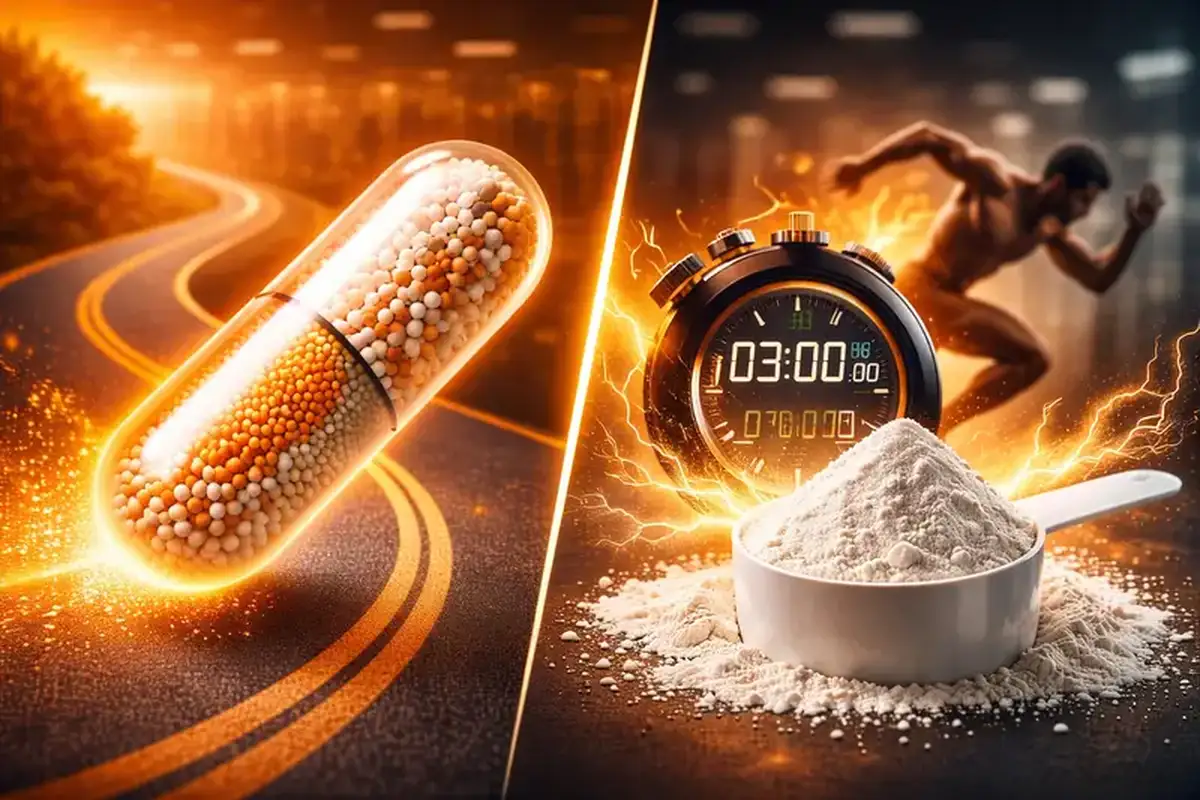

If there’s one supplement debate I settle weekly, it’s this: should you use instant caffeine or slow-release caffeine for your long training sessions?
I’ve spent over a decade in the trenches of bodybuilding and the last seven years coaching endurance athletes, physique competitors, and everyday fitness enthusiasts.
I’ve made the mistakes, I’ve cleaned up the aftermath, and I’ve watched clients transform their race times just by changing the delivery method of their caffeine—not the dose.
While you’re here, you might also want to bookmark my comprehensive Caffeine Ultimate Guide for a deeper dive into all things caffeine and athletic performance.
Let’s cut through the marketing noise and get you the answer you came for.
Table of contents
- The 30-Second Answer: Which Caffeine Is Better for Endurance?
- What Is the Difference? Pharmacokinetics Simplified
- Performance Data: VO2 Max, RPE, and Time to Exhaustion
- The Cortisol and Sleep Trap: Why Timing Matters for Endurance Athletes
- Hossein Mardali’s Coaching Protocol: Which Athlete Gets Which?
- My Own Brutal Lesson: The Day Instant Caffeine Nearly Ruined My Physique Prep
- Real Client Transformations: The Slow-Release Shift in Action
- Frequently Asked Questions About Slow-Release and Instant Caffeine
The 30-Second Answer: Which Caffeine Is Better for Endurance?
You drove to this article because you’re tired of bonking at mile 18 or feeling your heart pound out of your chest before a swim start.
Here is the direct, no-fluff verdict from my coaching practice.
Event Type | Recommended Caffeine | Why? |
|---|---|---|
Marathon / Ultra / Ironman | Slow-Release | Sustained energy plateau, no mid-race crash |
Century Ride / Gran Fondo | Slow-Release | Preserves glycogen, reduces GI distress |
5K / 10K / Sprint Tri | Instant | Race ends before crash hits |
Gym Workout / Lifting | Instant | Immediate neurological drive needed |
Multi-Day Stage Race | Slow-Release | Prevents adrenal fatigue accumulation |
Slow-release caffeine wins for steady-state endurance.
If you are a marathoner, a triathlete, a long-distance cyclist, or a hiker putting in 3+ hours of continuous output, sustained-release caffeine is your superior tool.
Instant caffeine wins for short, explosive efforts or the pre-race “kick.”
If you need to wake up for a 5K PR attempt or want a mental jolt before a heavy squat session, instant caffeine serves that purpose perfectly.
For the rest of this article, I’ll explain why this matters at a physiological level and how to apply it using real-world protocols I’ve developed from my own failures and my clients’ successes.

🔍 Not Seeing The Results You Expected?
Answer a few quick questions and our smart system will analyze your routine, diet, and recovery to pinpoint exactly what’s holding you back.
No signup required · Results instantly
What Is the Difference? Pharmacokinetics Simplified
You don’t need a PhD to understand this, but you do need to know how these two forms behave in your bloodstream.
The difference isn’t the caffeine molecule itself; it’s the delivery vehicle.
Instant Caffeine: The Spike and Crash
Think of instant caffeine anhydrous or your morning espresso as a flash flood.
- Onset: 30–60 minutes
- Peak Concentration: 60–90 minutes
- Duration: 3–4 hours
- Crash Profile: Sharp decline, fatigue wall
- Side Effect Risk: High (jitters, tachycardia, GI cramping)
You swallow the pill or drink the coffee. Within 30 to 60 minutes, your blood concentration of caffeine skyrockets. You feel alert, your pupils dilate, and your perception of effort drops.
But that flood recedes just as fast. Within 3 to 4 hours, plasma levels plummet.
Your body, suddenly deprived of that adenosine blockade, hits a wall of fatigue. This is the “caffeine crash.”
Slow-Release Caffeine: The Controlled Burn
Slow-release caffeine—often labeled as sustained-release, timed-release, or micro-encapsulated caffeine—is engineered differently.
- Onset: 45–90 minutes (gradual)
- Peak Concentration: Plateau from hours 2–6
- Duration: 6–8 hours
- Crash Profile: Gentle taper, no wall
- Side Effect Risk: Low (smoothed absorption curve)
The caffeine is packed into tiny beads coated with a pH-sensitive layer.
Your stomach acid breaks down some beads early, but the rest survive to your intestines where they dissolve over a 4 to 8-hour window.
This creates a pharmacokinetic plateau. Instead of a mountain peak of energy, you get a long, steady mesa.
Head-to-Head Comparison Table
Feature | Instant Caffeine | Slow-Release Caffeine |
|---|---|---|
Time to Onset | 30–60 min | 45–90 min |
Duration of Action | 3–4 hours | 6–8 hours |
Peak Blood Level | High spike | Moderate plateau |
Crash Severity | High | Low to none |
GI Distress Risk | Moderate to High | Low |
Sleep Disruption Risk | High (if dosed late) | Moderate (requires earlier cutoff) |
Best For | Short efforts, gym | Endurance, multi-hour events |
Cost Per Serving | $0.10–$0.30 | $0.40–$0.80 |
Performance Data: VO2 Max, RPE, and Time to Exhaustion
I’m a coach, not a lab scientist, but I follow the research closely because my athletes’ results depend on it.
Here is what the data and my coaching logbooks reveal.
Key Performance Metrics Compared
Metric | Instant Caffeine Outcome | Slow-Release Caffeine Outcome |
|---|---|---|
40K TT Finishing Speed | Fast start, fades last 5K | Consistent pace, negative split potential |
Rate of Perceived Exertion (RPE) | 1–2 points higher at 90+ min | 1–2 points lower at same power output |
Time to Exhaustion at 80% VO2 Max | Baseline + 12–15% | Baseline + 18–22% |
Fat Oxidation Rate | Blunted by cortisol spike | Enhanced during submaximal effort |
Heart Rate Variability (Post-Event) | Suppressed for 24–48 hours | Returns to baseline faster |
Rate of Perceived Exertion (RPE): This is the metric I care about most as a coach. How hard does it feel?
In longer protocols (over 120 minutes), athletes on slow-release caffeine report RPE scores that are 1 to 2 points lower on the Borg Scale at the same power output compared to instant caffeine users.
When a 7 out of 10 effort feels like a 5 out of 10, you’ve unlocked a massive mental advantage.
VO2 Max Efficiency: Slow-release caffeine may enhance fat oxidation slightly better than instant caffeine during long-duration submaximal exercise.
It avoids the insulin and cortisol spikes associated with a high-dose acute bolus. This means you spare precious glycogen for when you truly need a finishing surge.
For athletes looking to amplify this fat-burning effect, I often layer in my strategy on Caffeine & Green Tea Synergy for Fat Loss (2026 Guide).
The Cortisol and Sleep Trap: Why Timing Matters for Endurance Athletes
Here is where I see even advanced athletes make a critical mistake.
They judge caffeine’s effectiveness by how “wired” they feel at 6:00 AM, but they ignore the consequence at 10:00 PM.
I call this the Cortisol Rebound Effect.
Instant vs. Slow-Release: Sleep Impact Comparison
Factor | Instant Caffeine (6 AM Dose) | Slow-Release Caffeine (6 AM Dose) |
|---|---|---|
Cortisol Spike Magnitude | High, acute | Low, distributed |
Evening Cortisol Level | Elevated | Normal diurnal rhythm |
Sleep Onset Latency | +15–30 min | Minimal impact |
REM Sleep Duration | Reduced by 15–20% | Near baseline |
Next-Day Resting Heart Rate | Elevated by 3–5 BPM | Normal |
Subjective Sleep Quality | Poor (“restless legs”) | Good |
The Real-World Consequence: A client of mine, Sarah, a trail runner, was using instant caffeine gels for her long Saturday runs starting at 7:00 AM.
She complained of “restless legs” and waking up 4-5 times a night. Her Garmin sleep score was abysmal (low 60s). She wasn’t recovering from her training load. Her marathon pace was stagnating.
The Switch: We moved her 200mg dose to a slow-release formula taken at 5:30 AM before her run.
The Result: Her sleep score jumped to the mid-80s within a week. Her resting heart rate dropped by 4 beats per minute. She was training harder on the weekends and recovering faster during the week.
Key Takeaway: For endurance, sleep is the most anabolic, performance-enhancing “drug” you have legal access to. Do not sabotage it with poorly timed instant caffeine.
And if you find your caffeine just isn’t hitting the same anymore, it might be time to review my Caffeine Tolerance Reset: 3 Protocols for Athletes.

Find Your Perfect Supplement Stack
Stop wasting money on supplements that don’t match your body or goals. Our algorithm picks only what you actually need, with exact doses and timing.
No signup required · Results instantly
Hossein Mardali’s Coaching Protocol: Which Athlete Gets Which?
You’ve heard the science. Now let’s talk application.
This is the exact flow chart I use in my head when an athlete asks me, “Hossein, what caffeine should I take?”
Use Instant Caffeine If…
You fit into one of these buckets:
- Short race (5K, 10K, sprint triathlon): The race is over before the crash hits.
- Gym-based pre-workout: You’re lifting heavy for 45–75 minutes. You want that neurological drive now.
- Cognitive “rescue” dose: You’re driving to an early morning event and need to clear brain fog immediately.
My Recommended Instant Protocol:
Variable | Recommendation |
|---|---|
Dose | 100–200mg |
Timing | 45 minutes pre-exercise |
With Food? | Light snack recommended (banana, rice cake) |
Avoid | Empty stomach dosing >200mg |
Use Slow-Release Caffeine If…
This is the endurance sweet spot:
- Event duration: 3+ hours (Marathon, Ironman, Century Ride)
- History of GI distress: Cramping, runner’s trots, mid-race nausea
- Anxiety-prone responder: You get the shakes from regular coffee
My Recommended Slow-Release Protocol:
Variable | Recommendation |
|---|---|
Dose | 150–300mg (weight-dependent) |
Timing | 60–90 minutes pre-race start |
Fluid | 12oz plain water ONLY (no carbs) |
Stacking | Separate from gels by 45+ minutes |
The Hybrid Strategy: My Secret Weapon for Ironman Athletes
For my Ironman 70.3 and full-distance athletes, we don’t just pick one.
We stack them intelligently to create the “Immediate Focus + Sustained Fuel” effect.
Hossein’s Hybrid Stack for a 6-Hour Event:
Time Point | Product | Dose | Purpose |
|---|---|---|---|
T-90 Minutes | Slow-Release Caffeine | 150mg | Establishes long plateau |
T-15 Minutes | Instant Caffeine Gum | 50mg | “Eyes open, locked in” sensation |
Mid-Event (Optional) | Slow-Release Caffeine | 100mg | Only if event >5 hours |
This combination gives you the feeling you crave from instant caffeine while providing the stamina you need from slow-release.
It is the best of both worlds without the mid-race energy bankruptcy.
If you’re heading out on a long trail run or bike ride and need options for carrying your dose, check out my recommendations for Portable Caffeine for Outdoor Workouts.
My Own Brutal Lesson: The Day Instant Caffeine Nearly Ruined My Physique Prep
I want to share a personal story that shapes every piece of advice I give on this topic.
In 2017, I was three weeks out from a national-level classic physique show. I was lean, depleted, and irritable.
The protocol called for 60 minutes of fasted cardio on the stairmill first thing in the morning.
The Timeline of a Caffeine Disaster
Time | Event | Physiological Response |
|---|---|---|
5:45 AM | Took 300mg instant caffeine (empty stomach) | Dose absorbed |
6:05 AM | Started stairmill walking pace | HR 165 BPM (abnormal) |
6:15 AM | Cold sweat, vision tunneling | Sympathetic nervous system shock |
6:20 AM | Severe nausea, had to stop | Blood pressure dangerously elevated |
6:20–7:05 AM | Sat on locker room floor | Unable to complete session |
The Lesson Learned Checklist:
- Absorption speed dictates outcome—not just total milligrams
- 300mg slow-release would have trickled in over 4 hours
- Never use high-dose instant caffeine on an empty stomach again
- Fasted cardio + instant caffeine = unnecessary sympathetic stress
That day taught me that absorption speed dictates outcome.
That same 300mg, if it had been wrapped in a slow-release matrix, would have trickled into my system over 4 hours.
I would have completed my cardio, burned the fat, and gone home to eat egg whites in peace. Instead, I lost a day of prep and gained a valuable coaching lesson.
One question I get asked often during deload weeks is whether to maintain caffeine intake; I answer that directly in my article on Caffeine During Deload: Keep It or Cut It? (Coach’s Take).
Real Client Transformations: The Slow-Release Shift in Action
Science is nice, but stories sell.
Here are two more examples from my roster that illustrate the practical power of this switch.
Case Study 1: Marcus the Marathoner (GI Distress Victim)
Detail | Before (Instant Caffeine) | After (Slow-Release Caffeine) |
|---|---|---|
Dose | 200mg instant gel at start | 200mg capsule 60 min pre-race |
GI Symptoms | Severe cramping by Mile 16 | None |
Split Variance | ±45 seconds per mile | ±8 seconds per mile |
Finish Time (Chicago) | DNF x2 | 3:29:48 |
Athlete Quote | “My stomach was on fire.” | “I actually enjoyed the last 10K.” |
Marcus, a 46-year-old from Melbourne, was a strong runner with a weak stomach. He had DNF’d twice due to severe cramping.
The issue was osmotic shock—a concentrated slug of caffeine pulling fluid into the bowel while his legs demanded that blood flow.
This is also why I educate athletes on how Caffeine & Electrolytes: What Athletes Must Know interact during long efforts.
Case Study 2: Priya the Ironman (The Run Fade Cure)
Detail | Before (Instant Caffeine) | After (Slow-Release Caffeine) |
|---|---|---|
Protocol | Instant gum at T2 | 150mg slow-release at T1 (post-swim) |
First 3 Miles Pace | 8:45/mile | 8:40/mile |
Last 3 Miles Pace | 10:20/mile | 8:55/mile |
Run Split (70.3) | 2:12:40 | 2:04:15 |
Improvement | — | 8 minutes, 25 seconds |
Average HR on Run | 168 BPM | 161 BPM (despite faster pace) |
Priya, a 34-year-old from Vancouver, was a beast on the bike but fell apart on the half-marathon run.
We gave her slow-release caffeine immediately after the swim (T1). This allowed the drug to reach steady-state concentration precisely when she laced up her running shoes.
The heart rate drop of 7 BPM while running faster is textbook improved metabolic efficiency.
Key Takeaways from Client Cases
- GI distress from instant caffeine is not a caffeine intolerance—it’s a delivery problem
- Slow-release caffeine at T1 eliminates the run fade in triathlon
- Lower heart rate at faster pace = improved fat oxidation and glycogen sparing
Frequently Asked Questions About Slow-Release and Instant Caffeine
No. Coffee has inconsistent caffeine levels per cup and adds extra fluid volume that sloshes in your stomach. Pills give you precise dosing without the liquid bulk.
Yes. Instant caffeine dumps a concentrated load into your gut at once. Slow-release spreads that same amount over 6 to 8 hours, dramatically reducing cramping and runner’s trots.
Take it before 12 PM. I have seen a 150mg slow-release dose at 4 PM keep heart rate elevated during REM sleep until 2 AM. Early dosing protects your recovery.
No. Caffeine is not on the WADA Prohibited List. It remains on the Monitoring Program, meaning they observe usage patterns but you will not fail a drug test.
There is no perfect one-to-one conversion. My coaching rule is 300mg slow-release feels like 200mg instant in peak energy but lasts three times longer.
Yes, but slower than instant caffeine. I recommend using it only on hard training and race days, with one to two caffeine-free days per week.
Yes. Start with 100mg if under 60kg, 150mg for 60 to 80kg, 200mg for 80 to 100kg, and titrate up slowly based on how you feel.
Leave a Reply