
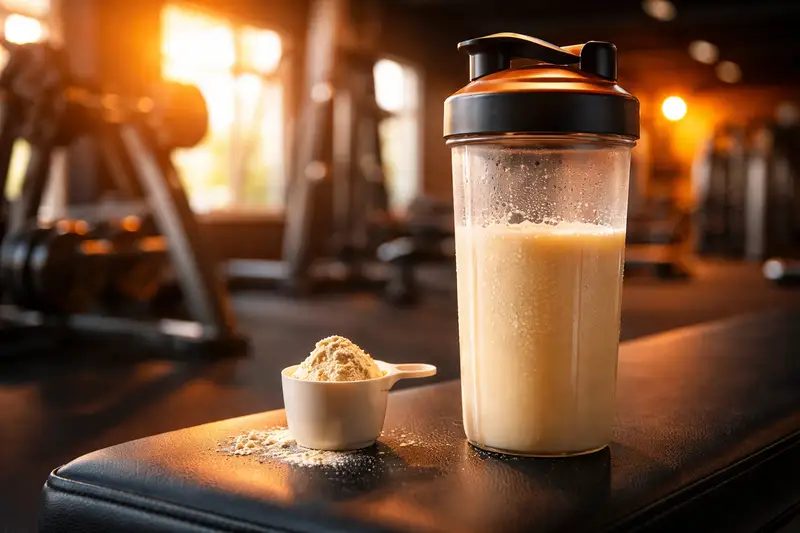

Let me cut through the noise right now. You don’t need to chug a 1,200-calorie shake to see results. In fact, if you’re doing that, you’re probably just making an expensive donation to your body fat percentage.
Here is the exact protocol I give my clients on day one:
Take half the recommended serving. Aim for a shake that lands between 300 and 500 calories, not 1,200.
Use it as a supplement between meals, not as a meal replacement.
And if you really want to optimize the outcome, drink it post-workout or as a 3 PM bridge snack when your appetite normally crashes.
That’s it. That’s the secret.
Now, if you want to understand why that works and how to execute it like a pro, let me walk you through the exact framework I’ve used for seven years with hundreds of clients.
For a deeper dive into the science behind these products, you can explore the Mass Gainer Ultimate Guide.
Table of contents
- Why Most People Use Mass Gainers Wrong (The “Dirty Bulk” Trap)
- Step 1: Calculate Your Actual Caloric Gap
- Step 2: The “Half Serving” Rule for Gradual Intake
- Step 3: Strategic Timing for Lean Tissue Support
- Step 4: Ingredient Blending for Slower Digestion
- Step 5: Mass Gainer vs. Whey + Oats: Which is Better for Gradual Gains?
- Step 6: Tracking Progress: The Scale is Lying to You
- Frequently Asked Questions
Why Most People Use Mass Gainers Wrong (The “Dirty Bulk” Trap)
I need to share a story that represents about 40% of the new clients who walk through my door.
A guy named Marcus signed up with me last year. He was frustrated. He had been “bulking” for six weeks and gained 12 pounds.
On paper, that sounds incredible, right?
But here is the problem nobody talks about: his waist measurement went up by nearly three full inches while his biceps didn’t budge a millimeter.
When I reviewed his food log, the culprit was obvious. Every single night at 10 PM, right before scrolling his phone in bed, Marcus was downing a 1,600-calorie mass gainer shake.
He called it his “nighttime anabolic window.” I call it a “fat storage bomb.”
The Problem with Monster Shakes
Here is what actually happens physiologically when you flood your system with 200 grams of carbohydrates and minimal fiber right before you lie horizontally for eight hours:
The Mistake | The Biological Reality | The Result |
|---|---|---|
1,200+ Calorie Shake | Massive insulin spike with nowhere for glucose to go. | Fat Gain (specifically visceral fat). |
Drinking it Before Bed | Suppressed Growth Hormone release during deep sleep. | Poor Recovery and digestive distress. |
Using Water Only | Rapid gastric emptying; blood sugar crash in 90 mins. | Bloating and Increased Hunger later. |
The industry has convinced you that more powder equals more muscle. My decade in the bodybuilding trenches has taught me the opposite: more frequency with less volume equals more lean tissue.
This is especially critical if you’re dealing with a skinny-fat body composition and seeking the mass gainer truth.
⚡ Mass gainer turning into fat?
Wrong timing builds your waistline. Right timing builds your muscles.
Turn Gainer Into Muscle FreeStep 1: Calculate Your Actual Caloric Gap
Before you even touch the scoop, we need to have an honest conversation about numbers.
I can’t tell you how many lanky athletes have sat across from me and said, “Hossein, I eat everything in sight and can’t gain weight.”
Then we track their food for three days. The reality? They eat like a horse for one meal and a bird for the next two.
The 300-500 Calorie Rule for Gradual Gain
Forget the “dirty bulk” mentality of eating 1,000 extra calories. Muscle protein synthesis has a ceiling. You cannot force-feed muscle growth.
Once you exceed a 300 to 500 calorie surplus, the excess energy has exactly one place to go: adipose tissue (body fat).
Your Gradual Gain Math:
- Find Maintenance: (Bodyweight in lbs x 15) is a rough starting point.
- Add the Bridge: Add 300 calories if you are prone to fat gain; add 500 calories if you are a true ectomorph.
- Mass Gainer’s Role: That 300-500 calorie gap is exactly where your half-serving shake belongs. It’s not a meal; it’s a caloric bridge.
Step 2: The “Half Serving” Rule for Gradual Intake
I want you to grab your tub of mass gainer right now and look at the label. You’ll likely see something like: “Serving Size: 4 Heaping Scoops (334g).”
I want you to completely ignore that.
In my 7 years of coaching, I have never—and I mean never—prescribed a full serving of mass gainer to a client aiming for gradual weight gain.
The full serving is designed for a 6’5″ defensive lineman who trains twice a day, not for you trying to add lean mass for summer.
My 7-Year Coaching Tip: The Scoop Adjustment Chart
Use this table as your cheat sheet. It’s based entirely on real-world feedback from client digestion and body comp scans.
Your Goal | Recommended Powder Amount | Approx. Calories (Powder Only) | Ideal Mixing Liquid |
|---|---|---|---|
Lean Bulk / Gradual Gain | 1/2 Serving | 300 – 400 kcal | Milk or Almond Milk |
Hardgainer Plateau Breaker | 3/4 Serving | 500 – 600 kcal | Whole Milk + Peanut Butter |
Extreme Bulk (Off-Season Pro) | Full Serving | 700+ kcal | Water (for faster digestion) |
Weight Maintenance | 1/4 Serving | 150 – 200 kcal | Coffee (as a creamer) |
A client named Priya changed her entire physique trajectory by starting at the bottom of that chart.
She had a sensitive stomach and a high-stress job. We started with one quarter scoop in her morning coffee. That’s it. 150 calories.
It was so small her body didn’t even register it as “food.” Two weeks later, we added a half-scoop smoothie after dinner.
That is the definition of gradual. Seven months later, she was up 14 lbs with a tighter waist.
If you’re someone who struggles to eat enough food throughout the day, you might benefit from reading my dedicated guide for using mass gainer with poor appetite where I explain how to get calories in without the force-feeding discomfort.
📋 You just read everything about mass gainers. Now let’s make it work for YOUR body.
I’ll design your personalized supplement protocol — exact timing, dosage, and stacking for your specific goal. No templates. No bots. A real coach who reads your answers.
Pay what you want after you receive it. No risk. No pressure.
Step 3: Strategic Timing for Lean Tissue Support
When you drink the shake matters almost as much as how much you drink.
You have two specific windows where a mass gainer behaves differently in your body.
Option 1: The Post-Workout Window (Best for Nutrient Partitioning)
When: Within 60 minutes of finishing your last set.
Why it Works: Your muscles are screaming for glycogen replenishment. They are more insulin sensitive.
This means the carbohydrates in that half-serving of mass gainer are far more likely to be shuttled into muscle cells rather than stored as fat.
My Go-To Post-Workout Shake:
- 1/2 serving vanilla mass gainer
- 1 cup unsweetened almond milk
- 1/2 cup liquid egg whites (trust me, you won’t taste it, but you’ll feel the difference in recovery)
- Handful of ice
Option 2: The Snack Bridge (Best for Appetite Management)
When: Between Lunch and Dinner (approx. 3:00 PM – 4:00 PM).
Why it Works: Most people crash here. They reach for a candy bar or a fourth cup of coffee.
A controlled 350-calorie shake stabilizes blood sugar and prevents the evening binge.
Crucially, because we are adding fat to this shake (see Step 4), it slows digestion enough that you will still be hungry for a proper dinner at 7 PM.
Step 4: Ingredient Blending for Slower Digestion
This is the “Pro Secret” that separates the bloated gym-goer from the lean, muscular athlete.
Most people mix mass gainer with water. Stop doing that.
Mixing mass gainer with water creates a high-osmolality fluid that rushes through your stomach. This leads to the dreaded “mass gainer bloat” and a sugar crash 90 minutes later.
If you want gradual weight gain, you need gradual digestion.
Coach’s Mix: The Gradual Gain Formula
Here is the exact recipe I use in my own off-season. I’ve been doing this for 10+ years, and it’s the only way I can gain weight without looking like I swallowed a beach ball.
The “No Bloat” Mass Gainer Blend:
- Liquid Base: 8 oz Whole Milk OR Unsweetened Almond Milk.
- Why? The fat in milk or almond milk slows gastric emptying. This means a steady drip of amino acids into your bloodstream over 3-4 hours, not a flood over 20 minutes.
- Protein Boost: 1/4 cup Liquid Egg Whites (pasteurized).
- Why? Adds 6-7g of pure protein with zero flavor change. It makes the shake texture creamier, not eggy.
- Healthy Fat: 1 Tablespoon Natural Almond Butter or Peanut Butter.
- Why? This is the game-changer. Adding a source of monounsaturated fat cuts the glycemic response of the maltodextrin in the mass gainer by roughly 30-40%. You get the calories without the insulin roller coaster.
Ingredient Choice | Digestion Speed | Resulting Physique Effect |
|---|---|---|
Powder + Water | Very Fast (60-90 mins) | Bloating, Fat Storage Tendency |
Powder + Milk | Moderate (2-3 hours) | Steady Energy, Leaner Gain |
Powder + Milk + Nut Butter | Slow (3-4 hours) | Sustained Anabolism, Minimal Bloat |
Step 5: Mass Gainer vs. Whey + Oats: Which is Better for Gradual Gains?
I get this question weekly. Should you buy the expensive tub of “Mass Tech 5000” or just blend some whey with oatmeal and peanut butter?
Here is my unbiased, experience-based breakdown for the gradual gainer.
The Comparison Table
Feature | Mass Gainer Powder | Whey + Oats (Homemade) |
|---|---|---|
Convenience | Winner. 30 seconds with a shaker cup. | Loser. Requires a blender and 3-5 minutes prep. |
Macro Control | Loser. You’re stuck with the ratio on the label. | Winner. You control exactly how many oats/fats. |
Digestive Comfort | Variable. Some powders use cheap maltodextrin. | Winner. Whole food fiber is gentler on the gut. |
Cost per Calorie | Loser. You’re paying for marketing. | Winner. Bulk oats are $0.10 per serving. |
Best Use Case | The busy professional with zero time. | The person who wants perfect control over ingredients. |
My Honest Verdict: For gradual weight gain, I prefer the homemade route 80% of the time.
But I still use a quality mass gainer powder on days when I’m running between clients and don’t have 5 minutes to wash a blender.
Use the powder as a tool for consistency, not as a crutch.
If you’re aiming specifically for lean tissue accrual without unnecessary sugar spikes, you’ll want to review my recommendations for a high-protein low-sugar mass gainer to make the best choice.
Step 6: Tracking Progress: The Scale is Lying to You
If you step on the scale tomorrow and see you’re up 2 lbs, do not celebrate yet.
That is water, glycogen, and the undigested oats in your colon. It is not new muscle tissue.
What a Realistic Gradual Gain Looks Like
- Rate of Gain: 0.5 to 1.0 lb per week.
- Waist Measurement: Should remain stable (or even decrease slightly as posture improves).
- Performance: Your lifts in the gym should be trending up (even by 2.5 lbs or 1 rep).
The Adjustment Protocol
- Scenario A: You gained 2 lbs this week, but your belt is tighter.
- Action: Reduce the scoop size. You’re spilling over into fat storage.
- Scenario B: Weight hasn’t moved in 2 weeks, but you feel stronger.
- Action: Add 1 Tablespoon of Peanut Butter to the shake. That’s a 100-calorie bump. Wait 2 more weeks. Small adjustments yield big results.
Frequently Asked Questions
Yes. Use a half serving on training days. Cut it to a quarter serving on rest days. This keeps you in a small surplus without adding unwanted fat.
Not if you stick to a half serving. Belly fat happens when you consume way more calories than your body can use. A controlled 300 to 400 calorie shake added to a clean diet will not cause belly fat.
Milk is better. The fat in milk slows digestion. This gives you steady energy and less bloating. Water makes the shake digest too fast and can cause a sugar crash.
Yes. Gradual gain is made for hardgainers. Small shakes spaced throughout the day respect a small stomach. You get the calories without feeling stuffed or sick.
About 30 to 40 days. A tub labeled “16 servings” lasts much longer when you only use half scoops. This makes the cost per day very affordable.
Yes. A half serving is gentle on a recovering stomach. It provides easy calories and protein without forcing large meals.
No. Without training, your body has no reason to build muscle. The extra calories will mostly turn into body fat.
Yes. Swimmers should take smaller portions to avoid bloating in the water. Drink it right after training so you do not feel heavy during laps.
Leave a Reply