


Creatine is one of the most trusted supplements for athletes. But when you put creatine ethyl ester vs creatine monohydrate side by side, which one actually works?
Marketers will tell you ethyl ester absorbs better. No bloating. More results.
Science says otherwise.
I’ve tested both. I’ve coached athletes worldwide who’ve tried both. And here’s the honest truth: monohydrate wins every single time.
⚠️ Here are the 5 undeniable reasons creatine ethyl ester fails:
- It converts to useless creatinine before your body can use it.
- Zero strength or performance gains in head-to-head studies.
- Costs significantly more than monohydrate for zero extra benefit.
- The “better absorption” claim has been completely debunked.
- It fails the only test that matters — real athlete results.
The studies are clear, but the marketing isn’t. Here’s exactly how they stack up:
If you want… | Choose this |
|---|---|
Proven results | Creatine Monohydrate |
Cheapest option | Creatine Monohydrate |
Most research | Creatine Monohydrate |
Less bloating | CEE (but no results) |
Fancy name | CEE (waste of money) |
Quick decision guide: creatine monohydrate vs ethyl ester — proven results, lower cost, and more research vs a fancy name with no real benefits.

Go with creatine monohydrate — proven, cheap, effective.
Skip creatine ethyl ester — mostly hype. Breaks down into creatinine. No real performance benefits.
Now let’s break down why.
Table of contents
- What Is Creatine Ethyl Ester? The Truth Behind the Hype
- What Is Creatine Monohydrate? The Gold Standard Explained
- Does Creatine Ethyl Ester Really Work? An Honest Look
- Creatine Ethyl Ester vs Monohydrate — A Direct Comparison
- Creatine Monohydrate or Ethyl Ester: How to Choose
- Why You Won’t Find a “Best” Creatine Ethyl Ester
- My Honest Experience with Creatine Ethyl Ester
- Side Effects & Safety: What You Need to Know
- Practical Recommendation for Athletes
- Frequently Asked Questions (FAQs)
What Is Creatine Ethyl Ester? The Truth Behind the Hype
It sounds fancy. But here’s what it really is.
Creatine ethyl ester (CEE) is regular creatine with an ester attached. Marketers added it so they could claim “better absorption” and “no bloating.”
Sounds great, right?
Only one problem: your stomach breaks it down too fast. Most of it turns into creatinine — a waste product your body just pees out. You don’t get the performance benefits.
So while the name sounds advanced, the reality is disappointing.
What Is Creatine Monohydrate? The Gold Standard Explained
Creatine monohydrate is a simple molecule made of three amino acids. Your body naturally stores it in your muscles, where it helps produce energy during heavy lifting or sprinting.
That’s it. Nothing fancy. And it’s the most researched supplement in sports nutrition. Period.
Here’s what it does: it increases phosphocreatine stores in your muscles, which helps you regenerate ATP — the main fuel for high-intensity exercise. More ATP means more reps, heavier lifts, and faster recovery.
I noticed the difference within two weeks. My bench press went up by 7 kilos. Recovery between sets? Way faster.
The only side effect? Mild water retention. But honestly, it made my muscles look fuller. I wasn’t complaining.

One of my clients, David from Germany, saw the same. After six weeks, his squat strength jumped 15%, and his recovery improved noticeably.
👉 Read more: Creatine Monohydrate and Testosterone – The Real Link
Does Creatine Ethyl Ester Really Work? An Honest Look
Short answer? No. Not really.
Here’s the long answer.
When creatine ethyl ester first hit the market, the ads were everywhere. “Better absorption!” “No bloating!” “More results than monohydrate!”
Sounds amazing. Too bad it’s not true.
Here’s what actually happens when you take CEE:
Your stomach acid breaks it down — fast. Most of it converts into something called creatinine. That’s a waste product. Your kidneys filter it out, and you pee it away. Very little, if any, reaches your muscles.
So while you’re paying extra for “advanced” creatine, your body is just throwing most of it in the trash.
What the research says:
Studies show creatine ethyl ester does not increase muscle creatine levels better than monohydrate. In fact, it performs worse. Some research found no difference at all between CEE and a placebo.
Meanwhile, monohydrate has over 700 studies proving it works.
The bottom line: If you take CEE, don’t expect more strength, bigger muscles, or faster recovery. Expect lighter wallet and zero results. Stick with what actually works.
Creatine Ethyl Ester vs Monohydrate — A Direct Comparison
Let’s cut through the marketing.
Both supplements claim to do the same thing: boost strength, speed up recovery, and build muscle. But only one actually delivers.
Here’s how they stack up side by side.
Feature | Creatine Monohydrate | Creatine Ethyl Ester (CEE) |
|---|---|---|
Scientific studies | 700+ | Very few |
Muscle creatine increase | Proven | Unreliable |
Converts to creatinine | Low | High (fast) |
Bloating | Possible (mild) | Less (but no benefits) |
Cost per serving | $0.05–$0.10 | $0.30–$0.60 |
Recommended by athletes | Yes | No |
What This Means for You
- Monohydrate is the workhorse. Decades of research. Proven results. Cheap.
- CEE sounds newer and smarter. But your stomach breaks it down too fast. Most of it turns into creatinine — a waste product you just pee out. No performance boost.
So when someone asks “creatine ethyl ester vs monohydrate — which is better?” the answer isn’t close.
✅ Monohydrate wins. Every time.
Key Differences Between CEE and Monohydrate
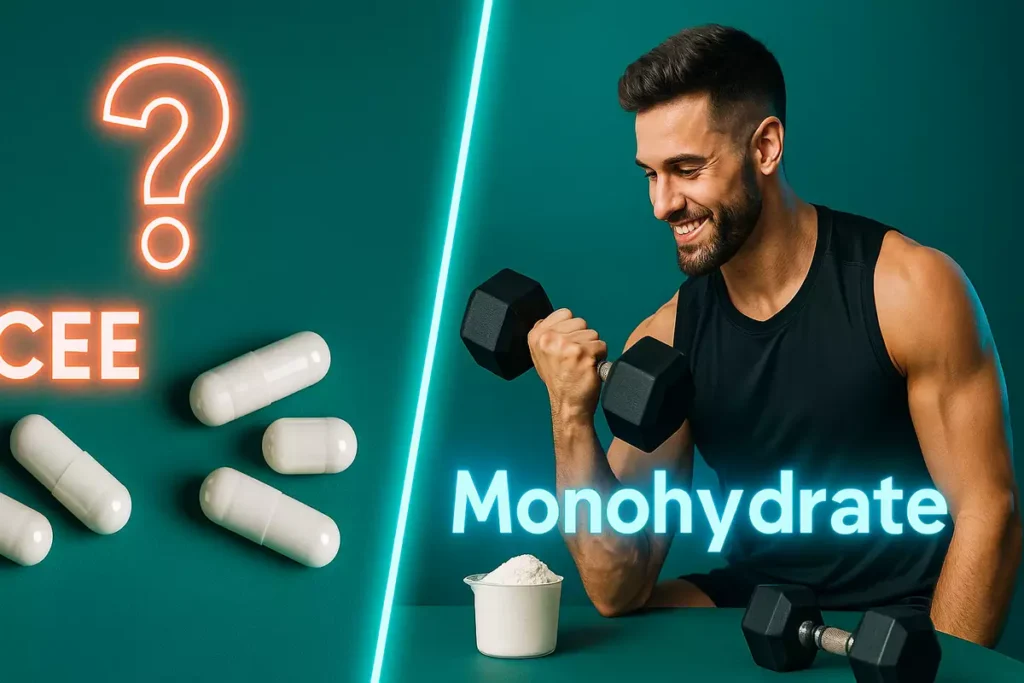
Here’s the breakdown:
- Absorption: Marketers claim CEE absorbs better. But studies show it converts to creatinine before your muscles can use it. Monohydrate stays intact and gets where it needs to go.
- Performance: Monohydrate boosts strength, sprinting, recovery, and muscle growth. CEE? Most users report nothing.
- Cost: Monohydrate is cheap — pennies per serving. CEE costs way more for way less.
- Bloating: Some people bloat on monohydrate. It’s mild and usually goes away. CEE causes less bloating, but who cares if you’re not getting results?
👉 Related: Loading vs. No Loading – Creatine Results Explained.
Creatine Monohydrate or Ethyl Ester: How to Choose
Here’s a simple decision flow.
Choose Creatine Monohydrate if:
- You want proven results (strength, recovery, muscle growth)
- You care about value (pennies per serving)
- You trust 700+ studies over marketing claims
- You’re an athlete who actually wants to perform better
Choose Creatine Ethyl Ester if:
- You like wasting money
- You prefer hype over science
- You don’t mind peeing out most of your supplement
See what I mean?
The One-Minute Verdict
Your goal | Your choice |
|---|---|
Build muscle | Monohydrate |
Get stronger | Monohydrate |
Recover faster | Monohydrate |
Save money | Monohydrate |
Avoid bloating at all costs | Maybe CEE — but get ready for zero gains |
Bottom line: Unless you’re willing to trade all results for slightly less bloating, pick monohydrate.
Every serious athlete does.
Why You Won’t Find a “Best” Creatine Ethyl Ester
Simple answer: because there isn’t one.
You can search “best creatine ethyl ester” on Google, Amazon, or Reddit. You’ll find brands selling it. But you won’t find athletes recommending it.
Here’s why:
- No brand can fix how CEE works. The problem isn’t the manufacturer — it’s the ingredient itself. Your stomach breaks down creatine ethyl ester into creatinine before your muscles can use it. That happens with every brand, every batch, every dose.
- No studies show any CEE outperforms another. When the ingredient itself doesn’t work reliably, picking a “best” brand is like picking the best flavor of sugar water. It doesn’t matter.
- Real users report the same thing across brands. No strength gains. No recovery boost. Just lighter wallet.
So if you see a “best creatine ethyl ester” list online? That’s marketing, not science.
Stick with monohydrate. That’s where the real “best” lives.
Quick Summary:
Question | Answer |
|---|---|
Is there a best CEE? | No |
Why? | The ingredient itself fails |
What should you buy instead? | Creatine monohydrate |
My Honest Experience with Creatine Ethyl Ester
I fell for the hype. Early in my bodybuilding years, I tried CEE for a couple of months. Why? No bloating. Better absorption. Sounded perfect.
Here’s what actually happened: nothing.
No strength gains. No recovery boost. No muscle fullness. Just wasted money and a lot of disappointment.
I thought maybe I was the problem. So I asked my clients to try it too.
- Ana from Brazil used CEE for weeks. Zero progress. She switched to monohydrate — better recovery and strength within three weeks.
- Kenji from Japan told me he actually felt bloated on CEE. Never had issues with monohydrate.
The pattern was clear. CEE sounds smart. But it doesn’t deliver.
✅ What I Learned:
What CEE Promises | What I Got |
|---|---|
Better absorption | Faster breakdown to creatinine |
No bloating | No results either |
Advanced formula | Overpriced disappointment |
Bottom line: I don’t recommend CEE to any of my clients anymore. Not worth the money. Not worth the hope.
Side Effects & Safety: What You Need to Know
Let’s talk about the two big fears: kidney damage and bloating.
Is Creatine Safe for Kidneys?
Yes. This myth won’t die, but science is clear.
Creatine monohydrate has been studied for decades. At 3–5 grams per day, it’s safe for healthy people.
I had a client named Omar from Egypt who avoided creatine for years because he thought it would hurt his kidneys. When he finally tried monohydrate? No issues. Just more strength and faster recovery.
📌 If your kidneys are healthy, creatine won’t harm them.
What About Bloating?
Monohydrate can cause mild water retention — but that’s actually a good sign. It means creatine is entering your muscles. The “bloat” usually fades within a week, and your muscles look fuller.
CEE? Some people still feel bloated on it, like my client Kenji from Japan. But here’s the difference: monohydrate gives you results with possible mild bloat. CEE gives you nothing and possible stomach discomfort.
Which One Is Safer?
Consideration | Creatine Monohydrate | Creatine Ethyl Ester (CEE) |
|---|---|---|
Decades of research | ✅ Yes | ❌ No |
Known side effects | Mild, temporary | Stomach discomfort possible |
Worth the risk? | ✅ Absolutely | ❌ No benefits to justify it |
👉 Learn more: Creatine Monohydrate Bloating and Cramps – Guide
Practical Recommendation for Athletes
Here’s what actually works.

If your goal is performance, recovery, and keeping muscle during tough training blocks — choose creatine monohydrate. Every time.
My Simple Protocol
- Dose: 5 grams daily
- Timing: After workout, with a protein shake or meal
- Cycling: Not needed. I use it year-round. The benefits are too good to skip.
What About Fat Loss?
Creatine helps here too.
When calories drop, strength usually drops with them. Creatine protects your power output. My client Marta from Italy used it while dieting — she pushed harder in cardio sessions and held onto her muscle mass.
That’s the difference between grinding through a cut and actually performing well.
One More Thing
Don’t overcomplicate it. You don’t need loading phases or fancy timing. Just take 5 grams daily. Stay consistent. Let the results build.
👉 Also read: EAAs + Creatine Pre-Workout Combo Guide.
Frequently Asked Questions (FAQs)
No. Creatine monohydrate is better. It has more research, raises muscle creatine levels, and improves strength. CEE breaks down into a waste product called creatinine before your muscles can use it.
Not really. Studies show it doesn’t increase muscle creatine like monohydrate does. Most people see no strength or performance gains.
None. Save your money. Creatine monohydrate is cheaper, safer, and proven to work. CEE is mostly marketing hype.
It’s a modified version of creatine with an ester attached. Marketers claimed it absorbs better without bloating. But research shows it breaks down too fast in the stomach.
Buy creatine monohydrate. It’s the gold standard. CEE costs more and delivers less. No serious athlete or coach recommends CEE.
Because it converts to creatinine (a waste product) in stomach acid. Monohydrate stays intact and reaches your muscles. Less than 10% of monohydrate converts to creatinine. For CEE, it’s 40–50% or more.
Less than monohydrate, but that’s because it doesn’t work. The mild water retention from monohydrate is actually a good sign — it means creatine is entering your muscles.
Studies show CEE does not raise muscle creatine levels better than monohydrate. Some research finds no difference at all. Monohydrate has over 700 studies supporting its safety and effectiveness.
You can, but you won’t see results. You’re better off taking 3–5 grams of monohydrate daily. It’s cheaper, safer, and actually works.
Because it sounds new and “advanced.” Brands know beginners will pay more for something that claims to be better. It’s a marketing product, not a performance product.
Leave a Reply