

Caffeine pills or pre-workout — which one actually delivers better energy, pumps, and focus?
Whether you’re staring at a simple caffeine pill or a full-blown pre-workout powder, the choice isn’t always obvious.
As a certified fitness coach with over a decade of real training and coaching experience, I’ve put both to the test on myself and hundreds of clients. The question I hear most often:
Which one gives better results in the gym, without the jitters, crash, or wasted money?
In this guide, you’ll get the science, my firsthand coaching stories, and a no-BS framework to choose whether caffeine pills or a pre-workout supplement fits your goals best.
No hype. No fluff. Just real-world insight backed by training floors and science.
Table of contents
- Caffeine Pills vs Pre-Workout: How They Compare
- Caffeine Only: Coffee, Pills, and Why It Works
- What’s in a Pre-Workout Supplement?
- Trainer’s Insight: Real Client Results with Caffeine vs Pre-Workout
- Caffeine & Pre-Workout Side Effects (Plus Avoiding Tolerance)
- Is Caffeine Better Than Pre-Workout for Your Goals?
- Which One Should You Use? A Goal-Based Guide
- Coach’s Verdict: The No-BS Truth About Caffeine vs Pre-Workout
- Frequently Asked Questions
Caffeine Pills vs Pre-Workout: How They Compare
When deciding between caffeine pills and a pre-workout supplement, it boils down to what you need beyond just energy.
Both can fuel your session, but the experience, control, and extras are worlds apart.
The real answer to the caffeine pills vs pre workout question depends on your priorities.
Here’s how they stack up side by side:

Tell us your goal & discover your perfect stack — backed by science, no BS.
Free. Takes 2 Min | No sign-up needed
- Speed of absorption – Coffee hits slightly faster, but caffeine pills and pre-workout powders both reach peak blood levels in around 30–45 minutes. Pre-workout liquids or effervescent tablets might shave a few minutes off, but the difference is marginal.
- Dosage control – Caffeine pills (typically 200mg) give you exact, predictable dosing every time. With pre-workout powders, scoop sizes and proprietary blends can make it harder to know exactly how much caffeine you’re getting – unless you stick to fully transparent labels.
- Additional ingredients – Pre-workouts bring pump agents, endurance boosters, and focus enhancers like citrulline, beta-alanine, and tyrosine.
Caffeine pills deliver pure stimulation. If you’ve ever wondered is pre workout just caffeine, the answer is absolutely not – and that changes the game depending on your goal. - Cost and convenience – Pre workout vs caffeine pills from a budget angle is no contest: caffeine tablets cost pennies per serving, store easily, and require no mixing. A quality pre-workout gives you more tools in one scoop, but at a higher price point.
Some lifters even rotate between both: caffeine tablets vs pre workout becomes a training-day decision rather than a lifelong allegiance.
Use caffeine-only for fasted cardio or low-energy mornings; use a full pre-workout when chasing pumps and performance peaks.
Caffeine Only: Coffee, Pills, and Why It Works
Caffeine—whether from black coffee or a simple pill—can be a game-changer.
It boosts:
- Mental focus
- Physical energy
- Fat oxidation during training
I usually go with 200mg caffeine pills or just a cup of strong coffee when I train early or during cutting. It’s clean, predictable, and doesn’t come with any tingles, crashes, or sugar.
- Why it works: It’s direct stimulation without the extras.
- Best for: Morning fasted workouts, beginners, budget-friendly routines.
What’s in a Pre-Workout Supplement?
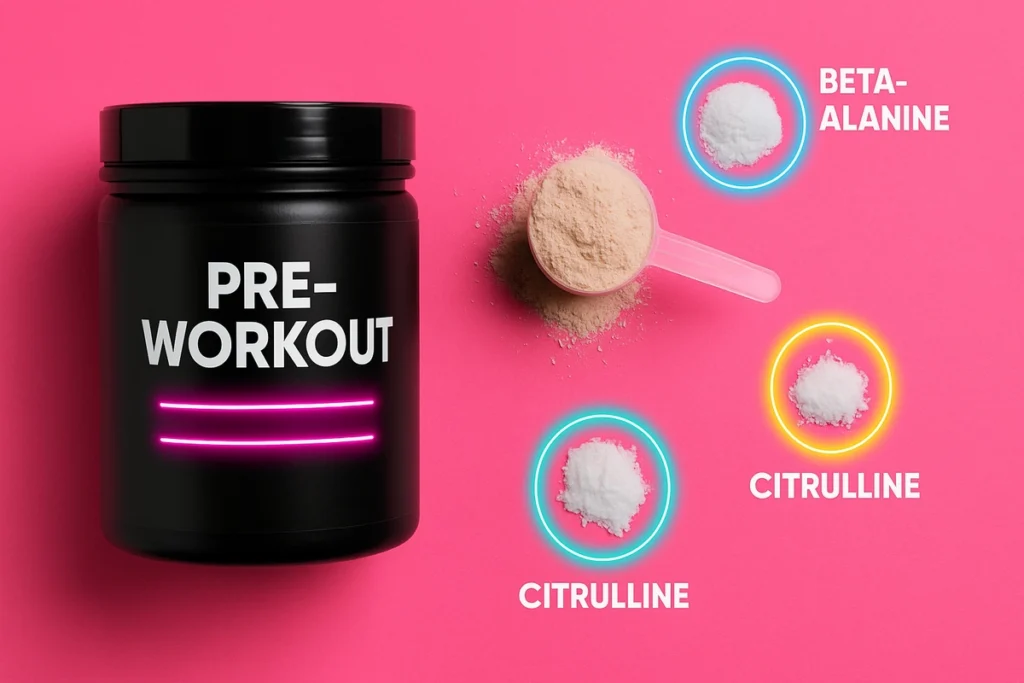
Most pre-workouts are far more than just caffeine. A well-formulated one layers multiple ingredients to boost energy, endurance, blood flow, and mental focus in a single scoop.
Here’s what you’ll typically find:
- Caffeine (stimulant for energy and alertness) – The core driver of wakefulness and power output, usually 150–300 mg per serving.
- Beta-Alanine (endurance buffer) – Delays muscle burn by buffering acid; often causes a harmless tingling sensation.
- Citrulline Malate (pump and blood flow) – Expands blood vessels to deliver more oxygen and nutrients, giving that “full” muscle feeling.
- Creatine Monohydrate (power and strength) – Increases short-burst power output, especially useful during heavy lifts.
- Tyrosine or Theanine (mental focus and calm) – Tyrosine supports focus under stress; theanine smooths out the jitters without drowsiness.
I don’t use them all the time—but during intense hypertrophy blocks, or when coaching clients through performance peaks, a good pre-workout can make a noticeable difference.
Caffeine content at a glance:
Pre-Workout Type | Caffeine per Serving |
|---|---|
Standard pre-workout | 150–200 mg |
High-stim pre-workout | 300–400 mg |
Low-caffeine / stim-free | 0–100 mg |
⚠️ Always check the label. Some brands hide exact doses behind “proprietary blends,” making it impossible to know how much caffeine—or anything else—you’re really getting. Stick with transparent formulas that list per‑ingredient amounts.
Trainer’s Insight: Real Client Results with Caffeine vs Pre-Workout
Let me be real: what works for me isn’t always what works for you. I adjust recommendations based on lifestyle and training level.
For instance, Lucas, a 29-year-old client from Germany, came to me feeling anxious and jittery after his pre-workout. We simplified his stack—just 200mg caffeine and 3g creatine—and in 2 weeks he was lifting more consistently and feeling better mentally.
On the other hand, Ayesha, a busy mom and fitness lover from Dubai, needed help getting through early fasted cardio. A 150mg caffeine pill before training helped her burn fat efficiently without the need for sugary energy drinks.
Caffeine & Pre-Workout Side Effects (Plus Avoiding Tolerance)
Pre-workouts can hit hard—but they can also hit wrong. And even plain caffeine isn’t risk‑free if you treat it like candy.

I’ve seen clients deal with:
- Sleep issues (from both)
- Jitters or anxiety (common with high‑dose caffeine pills and strong pre‑workouts)
- Energy crashes
- Stim tolerance buildup
One of my clients, Carlos from Brazil, once took a double scoop of pre‑workout “for fun” and ended up dizzy mid‑leg day. Since then, we stick to single‑ingredient supplements whenever possible—it’s much easier to control the dose.
With caffeine alone, I find the problems are usually simpler: too much too late, and your sleep is wrecked. Or you take 400 mg every day, and suddenly that “sharp focus” is just baseline survival.
My advice across the board? Start low, go slow. Never jump into full scoops (or max‑dose pills) if you’re new. To keep tolerance low, cycle off stimulants for 1–2 weeks every 6–8 weeks, or at least have a stim‑free week now and then. Your brain and adrenal glands will thank you.
Is Caffeine Better Than Pre-Workout for Your Goals?
Caffeine alone—from pills or a strong black coffee—is powerful, dirt cheap, and all most beginners or fasted trainers really need.
But if you’re chasing skin-splitting pumps, locked-in focus, and an all-in-one edge during a cut or heavy block, a well-formulated pre-workout supplement will push you further.

Take this 2-minute assessment & get a science-backed training, nutrition & supplement roadmap built for YOUR body.
🔬 12,000+ personalized roadmaps generated
Here’s how they stack up goal by goal.
When caffeine-only wins
- Fat loss (especially fasted cardio): Caffeine pills or black coffee boost fat oxidation and mental sharpness without breaking a fast. No extra calories, no sugar.
- Simplicity and budget: A 200mg caffeine pill costs pennies per session. No proprietary blends, no guesswork.
- Late-day training: A low-dose caffeine pill or small coffee won’t overstimulate you like a full pre-workout, which may contain 300mg+ and wreck your sleep.
- Sensitive stomach or anxiety-prone lifters: Pre-workout ingredients like beta-alanine, artificial sweeteners, or high niacin doses can cause flushing, itching, or jitters. Caffeine alone gives you clean energy with less risk.
When a full pre-workout makes sense
- Muscle building and hypertrophy: Ingredients like citrulline malate and arginine drive blood flow for better pumps and nutrient delivery. That pump isn’t just cosmetic—it can improve muscle activation and growth signaling during high-volume work.
- Strength and power blocks: Creatine monohydrate in many pre-workouts supports ATP production for short bursts of strength. Combined with caffeine’s CNS kick, you get a noticeable output boost.
- Endurance and high-volume training: Beta-alanine buffers lactic acid, delaying that burning sensation so you can squeeze out extra reps.
- Mental drive when you’re dragging: Pre-workouts with tyrosine, theanine, or alpha-GPC can sharpen focus and motivation without making you jittery—ideal for sessions when you’d rather skip the gym.
Trainer’s note:
I’ve had clients who swore by pre-workouts until they simply cycled onto caffeine pills and creatine monohydrate separately—and broke through plateaus because they started sleeping better and stopped overstimulating their nervous systems. If you’re stacking ingredients yourself, you control the dose of each. With a pre-workout, you’re locked into whatever blend the manufacturer decided to dump in one scoop.
Which One Should You Use? A Goal-Based Guide
Your best choice depends entirely on your goal, your sensitivity to stimulants, and when you train.
Use this table to pick your tool instantly:
Your Goal | Best Choice | Why It Works |
|---|---|---|
Beginner | Caffeine-only | Clean energy, no overwhelming extras. Easy to gauge tolerance. |
Fat loss (especially fasted) | Caffeine-only | Boosts fat oxidation and focus without added calories or pump ingredients. |
Muscle building | Pre-workout (with pump agents) | Citrulline, beta-alanine, and creatine drive blood flow, endurance, and power output. |
Advanced training block | Pre-workout | Full-spectrum formula supports max output during high-volume or strength peaks. |
Budget-friendly energy | Caffeine pill or black coffee | Lowest cost per serving. Zero fluff, full stimulation. |
Sensitive to stimulants or late workouts | Low-caffeine or stim-free pre-workout | Still delivers pumps and focus without jitters or sleep disruption. |
If you want clean energy and mental focus without any extras—go caffeine-only.
If you want the full workout experience with intense pumps, skin-tingling endurance, and laser focus—a well-formulated pre-workout is your tool.
And if you love the performance benefits but can’t handle high stims (or train late), a low-caffeine or stim-free pre-workout gives you the best of both worlds.
Coach’s Verdict: The No-BS Truth About Caffeine vs Pre-Workout
After a decade of training and 7+ years of coaching real clients, I’ve tested more supplement stacks than I can count. My honest take?
Caffeine-only is criminally underrated. A pill or a cup of black coffee is cheap, predictable, and gives clean energy without the noise. For most gym-goers, it’s the best return on investment.
Pre-workouts can be excellent — but only when they come from transparent brands with clearly listed dosages. If the label hides behind a proprietary blend, walk away.
I trust ProLab Caffeine Pills for pure, no-frills energy. For full-spectrum pre-workouts that deliver the pump and focus without hidden junk, I stick with Legion Pulse or Transparent Labs Bulk.
Whatever you choose, cycle off every 6–8 weeks for at least a full week. Your nervous system needs that break to reset your stim sensitivity and avoid running on empty.
For precise dosing advice, read my guide on Caffeine Dosage for Fat Burning and Focus.
For nailing the timing, check out Best Time to Take Caffeine Before a Workout.
One final truth I’ve learned from the gym floor: more stimulation is never the same as better performance. Know your body, match the tool to your goal, and never confuse tingles and jitters with a quality session.
Frequently Asked Questions
No. Caffeine is the main stimulant, but a quality pre-workout also includes performance ingredients like beta-alanine, citrulline malate, and creatine. If all you want is pure, controllable energy, caffeine pills are the simpler, cheaper choice.
Most standard pre-workouts contain 150–300 mg of caffeine per scoop. High-stim versions can go up to 400 mg or more, while low-caffeine or stim-free options sit at 0–100 mg. Always check the label — proprietary blends sometimes hide the exact dose.
Absolutely. A 200 mg caffeine pill works perfectly as a no-frills pre-workout. You won’t get pump enhancers or endurance buffers, but for clean energy, fat-loss sessions, or fasted training, it’s a proven, cost-effective option. Many experienced lifters combine caffeine pills + creatine separately for full control.
It’s not recommended. Since most pre-workouts already pack 150–300 mg of caffeine, adding another pill or coffee can easily push you past the 400 mg daily safety ceiling. This often leads to jitters, racing heart, or sleep disruption. If you need an extra kick without overstimulation, stack a stim-free pump formula instead.
If you’re sensitive or train late in the day, look for a low-caffeine or stim-free pre-workout that still delivers pumps and focus via ingredients like citrulline and tyrosine. You can also simply use half a scoop of your regular pre-workout. A non-stim pump product paired with a small coffee is another practical solution.
Take either 30–45 minutes before training. Caffeine pills and black coffee kick in quickly; pre-workout powders with food or slower-digesting ingredients may need a little more time. Avoid them within 6 hours of bedtime to protect sleep quality.
Common side effects of pre-workouts include jitters or anxiety (from high caffeine), a harmless tingling skin sensation (from beta-alanine), upset stomach (often from niacin or artificial sweeteners), and trouble sleeping if taken too late in the day.
Yes. Your body builds tolerance to stimulants over time. I recommend a 1–2 week break every 6–8 weeks. During the off-cycle, use stim-free pump products to keep performance up while resetting your sensitivity.
Often yes. A 200 mg caffeine pill or strong black coffee before fasted cardio boosts fat oxidation and mental focus without extra calories, sugar, or ingredients that don’t matter during a cut. Pre-workouts can still be useful, but caffeine-only is cleaner and just as effective for pure fat-loss goals.

Leave a Reply