


If you’ve ever wondered when exactly you should take caffeine before hitting the gym — I’ve got your answer right here, based on science and over a decade of coaching experience.
What is the best time to take caffeine before a workout?
The best time to take caffeine for workout energy is 30 to 60 minutes before you start training. This allows the caffeine to peak in your bloodstream right when you need focus, strength, and endurance.
That timing has worked consistently for me, my own workouts, and hundreds of clients.
Now let’s break it down — no fluff, just what works.
Table of contents
- Why Caffeine Boosts Workout Performance
- How Long Before a Workout Should You Take Caffeine? (The 30-60 Minute Rule)
- Best Time of Day to Take Caffeine for Your Workout
- How Much Caffeine Should You Take Before a Workout? (Dosage Guide)
- Common Pre-Workout Caffeine Mistakes (and How to Avoid Them)
- Natural vs. Supplement Caffeine – What Works Best?
- When Not to Take Caffeine Before a Workout
- Final Thoughts – Maximize Caffeine, Maximize Gains
- Pre-Workout Caffeine Timing: Quick Answers to Your Top Questions
Why Caffeine Boosts Workout Performance

Caffeine works by stimulating your central nervous system. It increases adrenaline levels and improves neuromuscular activation — meaning you feel more awake, more explosive, and more locked in.
Here’s what studies (and my own experience) show caffeine can do:
- Boost strength and endurance
- Increase focus and energy
- Help with fat burning during cardio
💬 Coach Insight: I’ve personally trained well over 2000 athletes online. Nearly every one of them reported better performance and higher motivation on training days when they timed their caffeine right. It’s one of the simplest yet most underrated tools in the gym bag.
How Long Before a Workout Should You Take Caffeine? (The 30-60 Minute Rule)
It typically peaks in your bloodstream 45 minutes after consumption. That’s why I recommend taking it 30 to 60 minutes before your session, depending on how fast your body processes it and what form you use.
💬 Story from Experience:
A client of mine, Alyssa from New Zealand, used to drink coffee during her warm-up because she assumed that’s when the energy boost would happen. She felt decent but not her best.

Tell us your goal & discover your perfect stack — backed by science, no BS.
Free. Takes 2 Min | No sign-up needed
We adjusted her routine — she drank her coffee 40 minutes before training instead — and within 10 days, she hit a personal best in Romanian deadlifts. She told me, “It was like my brain and body were finally in sync.”
Best Time of Day to Take Caffeine for Your Workout
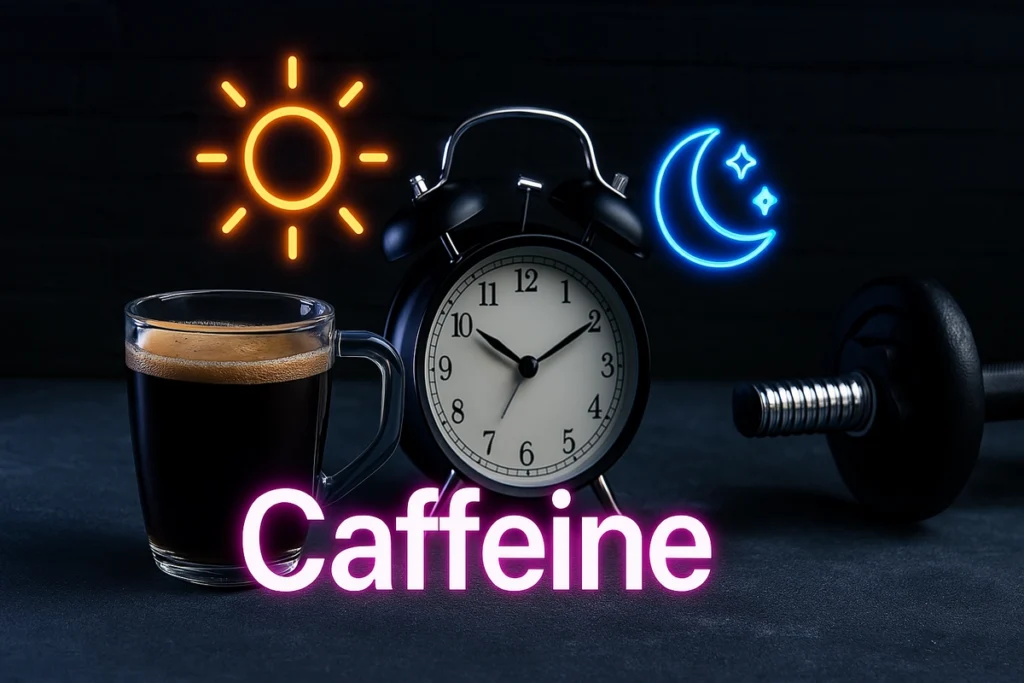
For most people, the safest window to use caffeine is before 2 PM to 3 PM.
This gives your body enough time to clear a significant portion of the stimulant before bed, so you get the performance lift without wrecking sleep.
- If you train in the morning or early afternoon, you’re in the clear.
- If your workout regularly starts after 5 PM, think twice before reaching for a full‑scoop pre‑workout or large coffee.
Caffeine’s half‑life averages 5 to 6 hours — meaning that 200‑mg dose at 6 PM leaves roughly 100 mg still active in your system at 11 PM. Poor sleep, elevated cortisol, and blunted recovery often follow.
What happens when you ignore this:
- Deep sleep and REM cycles get cut short
- Next‑day strength, mood, and fat‑loss efforts take a hit
- You end up needing more caffeine to compensate, creating a vicious cycle
Simple rule of thumb: Stop all caffeine 8 to 10 hours before your usual bedtime to protect sleep quality. For a 10 PM bedtime, that means no caffeine after 12 PM–2 PM, depending on your sensitivity.
💬 Real Coaching Example:
Daniel from Berlin trained at 6 PM and used a full‑scoop pre‑workout. After weeks of poor sleep, stalled lifts, and low HRV, we swapped his stimulant for a stim‑free formula. Within one week, his sleep tracker showed deeper sleep and higher heart‑rate variability. The following Monday, he hit a lifetime squat PR — not because of caffeine, but because he finally recovered well.
Evening lifter? Here’s what to do instead:
- Use a stim‑free pre‑workout that focuses on pump, focus, or beta‑alanine without caffeine
- Try a smaller half‑scoop of regular pre‑workout no later than 4 PM if you really need a kick
- Lean on hydration, electrolytes, and a high‑energy playlist (it works better than you think)
Timing the clock is just as important as timing the minutes before your set. Match your caffeine use to your training slot, and you’ll keep both your performance and your sleep on track.
How Much Caffeine Should You Take Before a Workout? (Dosage Guide)
The sweet spot for most lifters is 100–250 mg of caffeine taken 30–60 minutes before training. This range delivers a noticeable boost in focus, strength, and endurance without tipping into jitters or poor sleep.
If you’re new to pre‑workout caffeine or haven’t used it in weeks, start on the low end — around 100 mg (roughly one strong cup of coffee) — and assess how your body responds.
More experienced users with higher tolerance can push toward 200–250 mg on heavy compound days or when training fasted, but I rarely recommend exceeding 400 mg in a single dose, as side effects (anxiety, rapid heart rate, and gut discomfort) start to outweigh the performance benefits.
As a rule of thumb, your ideal dose depends on three things:
- Tolerance — the more often you use caffeine, the more you may need until you cycle off.
- Session intensity — light recovery days often don’t need any, while max‑effort strength or competition days benefit from the higher end.
- Body weight — although not an exact science, doses of 3–6 mg per kg of body weight are commonly used in research (for an 80 kg / 176 lb person, that’s 240–480 mg, though I prefer capping at 400 mg for safety).
If you ever feel overstimulated, skip the middle dose next time and work your way up slowly. Caffeine is a tool, not a requirement — matching the dose to the workout is what turns it into a performance advantage.
Common Pre-Workout Caffeine Mistakes (and How to Avoid Them)
Caffeine can be a game‑changer, but small missteps turn it into a liability.
These are the most common mistakes I see — and exactly how to fix them.
1. Taking Too Much Caffeine
More caffeine does not equal more gains. Overdoing it triggers jitters, a racing heart, dizziness, and can force you to cut a workout short — or skip it altogether.
✅ Fix: Stick to 100–250 mg per session. Start low and go up only if needed.
Client story: Lucas from Toronto dry‑scooped two servings of a high‑stim pre‑workout. Ten minutes in, his heart was pounding, his head was spinning, and he had to leave the gym. We dropped him back to 150 mg — now he trains like a machine, with zero side effects.
2. Using Caffeine Too Late in the Day
Late caffeine kills sleep quality. Caffeine’s half‑life is 5–6 hours — half of it is still in your bloodstream when your head hits the pillow. Poor sleep means poor recovery, and that undercuts every bit of work you put in.

Take this 2-minute assessment & get a science-backed training, nutrition & supplement roadmap built for YOUR body.
🔬 12,000+ personalized roadmaps generated
✅ Fix: If you train after 5 PM, skip the stimulants or use a stim‑free alternative.
Client story: Daniel from Berlin took a full scoop of pre‑workout before his 6 PM session. Weeks of restless sleep, stalled strength, and low readiness followed. After switching to a stim‑free pre‑workout, his sleep tracker showed deeper sleep and better HRV within days — and he hit a squat PR the next Monday.
3. Using Caffeine Every Day Without a Break
Daily use builds tolerance fast. The energizing effect shrinks, and you end up taking more just to feel normal. A short reset brings the magic back.
✅ Fix: Every 6–8 weeks, take a 7‑10 day caffeine deload — zero caffeine from all sources.
Client story: Carlos from Brazil relied on caffeine just to get through his workouts. He wasn’t happy when I pulled him off it for 10 days, but two weeks later his natural energy was back and his strength was climbing. Now he schedules his caffeine resets like clockwork.
Natural vs. Supplement Caffeine – What Works Best?
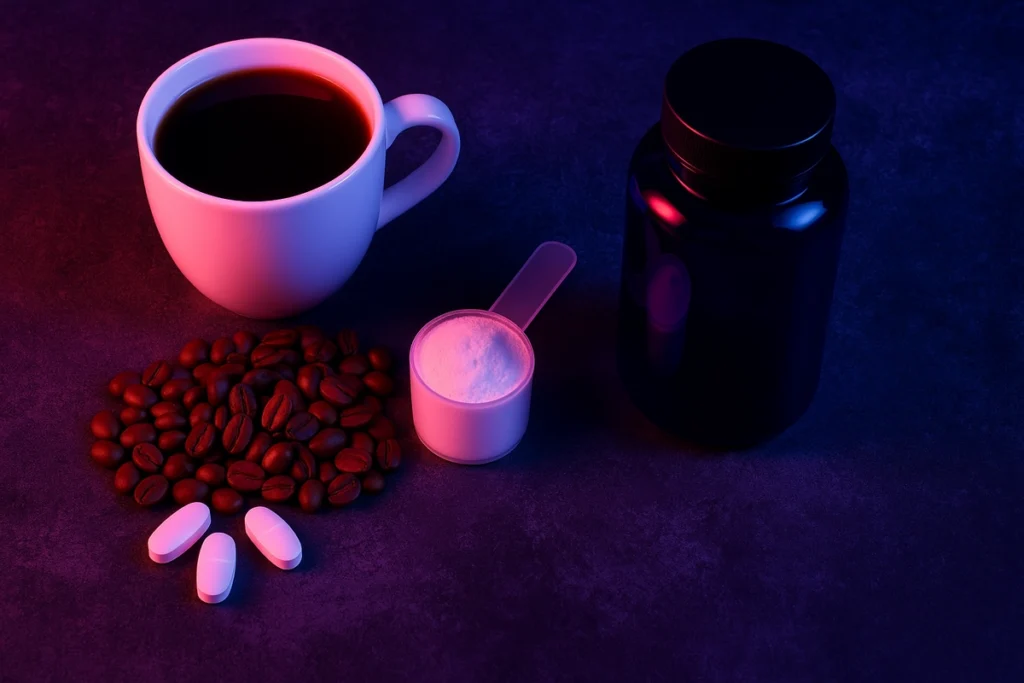
Caffeine isn’t just caffeine — how you take it matters.
Type | Speed | Control | Best For |
|---|---|---|---|
Coffee | Moderate | Low | Casual sessions, morning lifters |
Caffeine Pills | Fast | High | Beginners, precise dosing |
Pre-Workout | Fast | Medium | Lifters who want pump + energy combo |
I use pre-workout when I’m doing heavy compound days or intense hypertrophy blocks.
On low-carb mornings or fasted cardio days, I go with black coffee and a banana — fast, cheap, and effective.
When Not to Take Caffeine Before a Workout
Caffeine isn’t for everyone or every situation.
❌ I tell clients to skip caffeine if:
- They’re already sleep-deprived
- They’re dealing with high blood pressure or anxiety
- It’s a light cardio, recovery, or mobility session
- They’re already on medication that affects heart rate
💬 Client Tip: For clients in fat loss mode with poor sleep (which is common), I often replace caffeine with hydration, electrolytes, and a high-energy playlist. You’d be surprised how far that combo goes.
Final Thoughts – Maximize Caffeine, Maximize Gains
Caffeine is one of the most researched, affordable, and effective tools to boost performance — but like anything in fitness, it works best when used intelligently.
✅ Here’s how I coach it:
- Time it 30–60 minutes pre-workout
- Stick to 100–250 mg depending on your tolerance
- Avoid it late in the day
- Cycle it every 6–8 weeks
- Don’t rely on it to mask poor sleep or bad programming
If you treat caffeine like a strategic weapon, not a crutch, it can help you train harder, focus deeper, and maybe even set your next PR.
Takeaway from a Coach Who’s Been There: As someone who’s trained through groggy mornings, fasted cardio, late-night lifts, and everything in between — I can say with full confidence: caffeine is powerful, but timing is everything.
Whether it’s your first pre-workout or your fiftieth, use it with intention, and it’ll reward you every time.
Pre-Workout Caffeine Timing: Quick Answers to Your Top Questions
Take it 30 to 60 minutes before training. That window lets caffeine reach peak levels in your blood right when you need focus, strength, and endurance.
Caffeine peaks about 45 minutes after you consume it. You’ll usually feel the full effects within that 30‑60 minute range.
It’s best to avoid caffeine after 5 PM. Its half‑life is 5‑6 hours, so late doses often hurt sleep quality and next‑day recovery.
Take a 7‑10 day break from all caffeine every 6‑8 weeks. This resets your sensitivity so you get the same energy boost with lower doses.
Coffee works well for moderate energy and casual sessions. Pre‑workout supplements offer faster absorption, precise dosing, and extra performance ingredients like beta‑alanine or pump enhancers.
Start with 100‑250 mg depending on your tolerance. If you’re new to caffeine, begin at the lower end and adjust based on how your body responds.

Leave a Reply