
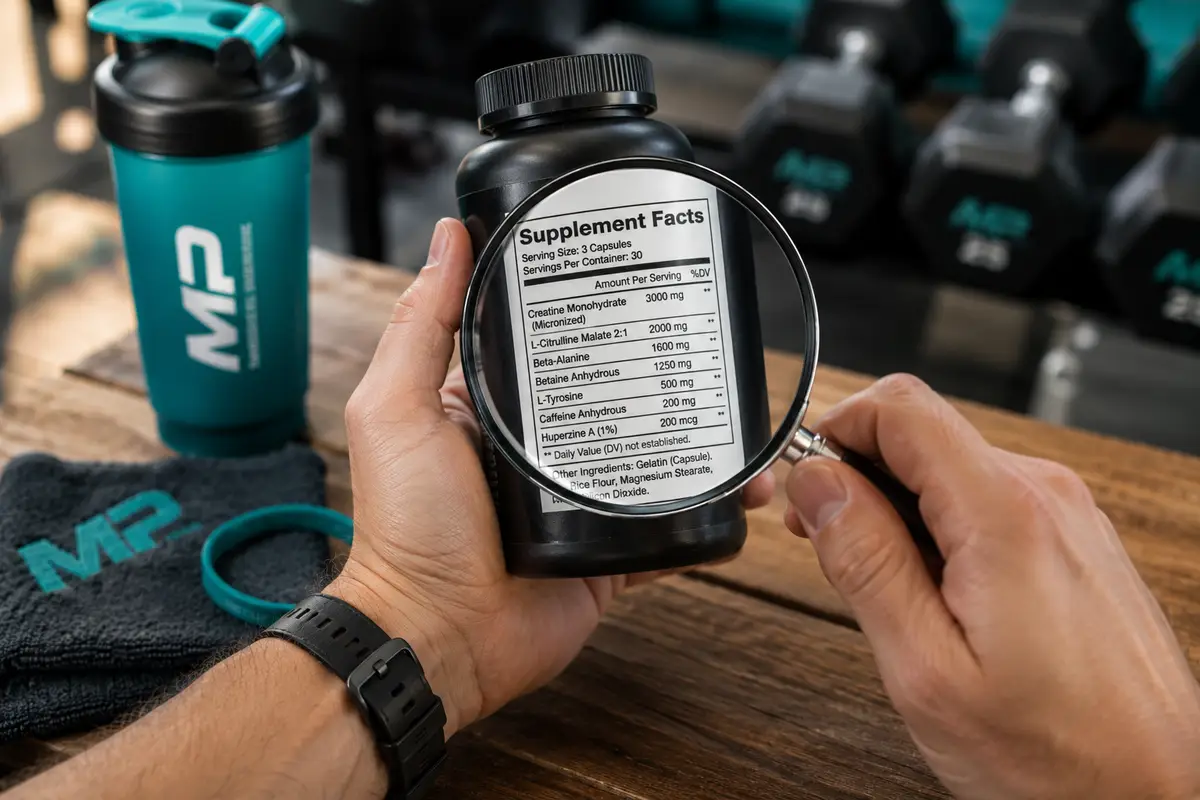

I’ve spent over a decade in the fitness trenches — first as an athlete figuring things out the hard way, then as a coach watching clients make the same expensive mistakes I once did.
If there’s one skill that separates smart buyers from marketing victims, it’s knowing how to read a supplement label properly.
The front of the bottle is a sales pitch. The side panel tells the truth.
Here’s exactly how I teach my clients to scan a supplement label in seconds, what I flag first, and the real-world lessons that shaped my approach.
If you’re building a complete stack, you might also want to check out the 4-week natural muscle gain supplement blueprint for real results.
Table of contents
- 7 Supplement Label Red Flags I Check First
- The 10-Second Scan: Start With the Supplement Facts Box
- Proprietary Blends: The Coach’s Biggest Red Flag
- Ingredient Order That Tells the Real Story
- Third-Party Testing Seals You Can Actually Trust
- Claims vs. Clinical Reality: Cut Through the Hype
- Supplement Label Coaching Cheat Sheet
- Frequently Asked Questions
7 Supplement Label Red Flags I Check First
- Serving Size Tricks — 1 scoop listed, but you need 2-3 for clinical doses
- Proprietary Blends — “Matrix” or “Complex” with one total number, no individual doses
- Under-Dosed Actives — Ingredients below research-backed effective ranges
- Filler-Heavy Labels — Long “Other Ingredients” list with magnesium stearate, dyes, hydrogenated oils
- Missing Third-Party Seals — No NSF, Informed Sport, or BSCG certification on the bottle
- Fake “Clinically Proven” Claims — No study citation, no patented ingredient form, no clinical dose match
- Overhyped Categories — Mass gainers, proprietary T-boosters, fat-burning matrices with hidden dosing

We analyze your goal, body & budget — then recommend only what you need.
IT’S FREETakes 2 Min | No sign-up needed
The 10-Second Scan: Start With the Supplement Facts Box
Forget the promises on the front. My eyes go straight to the Supplement Facts panel before anything else. This is where the legal disclosure lives, and it’s the only part of the label that matters for decision-making.
Here’s what I check in order:
Step | What to Check | Why It Matters |
|---|---|---|
1 | Serving size | Labels often list 1 scoop when the flashy dose requires 2 or 3 |
2 | Active ingredients per serving | Compare every dose against clinical research ranges |
3 | Number of active ingredients | More isn’t better — 15 under-dosed ingredients lose to 4 properly-dosed ones |
4 | Total servings per container | That “affordable” tub might only last 15 days |
I’ve watched clients rave about a pre-workout’s ingredient list, only to discover the serving size is half a scoop and they’d need triple just to hit clinical minimums. The front label rarely tells you that.
Coach’s rule: If three or more active ingredients are under-dosed compared to research-backed ranges, the product goes back on the shelf. No exceptions.
Proprietary Blends: The Coach’s Biggest Red Flag
This is the hill I’ll die on. A proprietary blend is a single number that lumps multiple ingredients together without revealing individual amounts. It’s a black box dressed up as a feature.
Marco’s Story: Expensive Caffeine With Sprinkles
Marco, a client from Barcelona, came to me frustrated. He’d been using a hyped pre-workout for eight weeks. The front label boasted a “5000mg Performance Matrix” with nine ingredients stacked inside.
I flipped the tub over and pointed to the problem. Nine ingredients. One total number. No individual doses listed anywhere.
We did rough math based on ingredient order and serving size. The beta-alanine and citrulline — the two ingredients actually responsible for the tingles and pumps the product promised — were likely sitting under 1 gram each.
Clinical doses for reference:
- Beta-alanine: 3.2 grams daily
- Citrulline: 6-8 grams pre-workout
I told Marco: “You’re basically paying premium prices for caffeine with a dusting of everything else.”
He switched to a transparent-label pre-workout where every ingredient dose was fully disclosed. He felt the difference in his very first session — actual skin-tingling beta-alanine response, measurable pump, and sustained energy without the crash.
How to Spot Proprietary Blend Tricks
- The umbrella term trap: Words like “matrix,” “complex,” “blend,” or “proprietary formula” followed by one total milligram number
- The ingredient-stuffing tactic: 8-12 ingredients in one blend — statistically, most are sprinkle doses
- The trademark distraction: A flashy patented name means nothing if the dose sits hidden inside a blend
My honest take: I skip proprietary blends entirely now. There are enough transparent brands on the market that accepting hidden dosing is no longer necessary. If a company won’t tell you what’s in their product, ask yourself why.
Ingredient Order That Tells the Real Story
The “Other Ingredients” section sits quietly at the bottom of every label. Most people scroll past it. I read it first — because it often tells you more about product quality than the marketing claims ever will.
What Ingredient Order Actually Means
FDA regulations require ingredients to be listed in descending order of predominance. That applies to both the active panel and the “other ingredients” section. Whatever appears first is what you’re getting the most of.
Daan’s Story: When “Other Ingredients” Sabotaged Absorption
Early in my coaching career, a Dutch client named Daan mentioned constant bloating and zero noticeable benefit from a zinc supplement he’d bought cheap at a big-box retailer.
I asked him to bring the bottle to our next session. The “Other Ingredients” list was longer than the active panel. Magnesium stearate sat high on the list — before the capsule material itself.
Magnesium stearate is a flow agent used to prevent ingredients from sticking to manufacturing equipment. It’s common and not inherently dangerous, but in excess it can form a film around nutrients in the gut, potentially reducing absorption.
I switched Daan to a clean-label zinc glycinate with no flow agents, no artificial colors, and a single-ingredient capsule. His bloating resolved within a week. More importantly, he finally started feeling the immune and recovery benefits he was paying for.
Fillers and Additives I Tell Clients to Watch
Ingredient | What It Is | Why I Flag It |
|---|---|---|
Magnesium stearate | Flow agent | Can coat nutrients and reduce absorption in high amounts |
Titanium dioxide | Whitening agent | Unnecessary cosmetic additive, banned in EU food products |
Silicon dioxide | Anti-caking agent | Generally safe in small amounts, but indicates heavy processing |
Artificial dyes (Red 40, Yellow 5, Blue 1) | Coloring | Zero functional purpose, potential sensitivity reactions |
Hydrogenated oils | Processing fats | Source of trans fats, no place in a quality supplement |
The rule I teach: A long “Other Ingredients” list almost always signals more filler than active. The cleanest supplements I’ve found have three items or fewer in that section.
Third-Party Testing Seals You Can Actually Trust
Not all certification logos are created equal. Some are marketing badges designed by the company itself. Others represent rigorous, independent testing that actually protects you.
Sarah’s Story: A Failed Drug Test That Wasn’t Her Fault
Sarah was a competitive CrossFit athlete I coached for two regional seasons. She was meticulous about her training, nutrition, and recovery. She’d never intentionally take a banned substance — her career meant too much to her.
Then she failed an in-competition drug test.
The aftermath was devastating. Confusion. Panic. A two-year sanction from competitive sport. We traced everything she’d taken in the weeks prior and landed on a fat burner she’d purchased online from a smaller brand with no third-party certification seal.
The likely cause? Cross-contamination during manufacturing. A shared facility, inadequate cleaning protocols between production runs, and no independent batch testing to catch it. The product itself probably contained traces of a banned substance the company never intended to include — but intent doesn’t matter to anti-doping agencies.
Since that experience, every single athlete I coach must only use products carrying one of these certifications:

Take this 2-minute assessment & get a science-backed training, nutrition & supplement roadmap built for YOUR body.
🔬 12,000+ personalized roadmaps generated
Third-Party Seals Worth Trusting
Certification | What It Verifies | Best For |
|---|---|---|
NSF Certified for Sport | Banned substance screening, label accuracy, GMP compliance | Competitive athletes, drug-tested professionals |
Informed Sport | Batch-level banned substance testing, manufacturing audits | Athletes subject to WADA testing |
BSCG (Banned Substances Control Group) | Drug-free certification, label verification | Drug-tested athletes and professionals |
USP Verified | Ingredient purity, potency, manufacturing quality | General consumers seeking quality assurance |
What means nothing: A “cGMP compliant” claim printed by the manufacturer without third-party verification. cGMP is about manufacturing practices, not product purity or banned substance screening. Also, generic “lab tested” claims with no certifying body name attached.
This isn’t just an athlete concern. Even if you never compete, third-party testing tells you the product actually contains what the label claims — at the doses claimed — without contaminants.
Claims vs. Clinical Reality: Cut Through the Hype
Supplement marketing operates in a gray zone where “clinically proven” gets thrown around with little accountability. Learning to separate real research from trademarked fluff saves money and disappointment. The science of how creatine actually works in your muscles is a perfect example — simple, proven mechanisms, but often buried under marketing noise.
Javier’s Story: The $200 Testosterone Lesson
Javier, a client in his mid-40s, walked into my office with a shopping bag full of bottles. He’d spent nearly $200 on a “testosterone boosting stack” — three products marketed as a synergistic system for increasing natural testosterone.
He’d followed the protocol religiously for 60 days. Then he pulled blood work.
Total testosterone: unchanged. Free testosterone: unchanged. Estradiol, SHBG, liver enzymes — all flat.
Javier had paid $200 for expensive urine.
I walked him through every label. The ingredient panels were mostly herbal blends — ashwagandha, fenugreek, tribulus — with zero individual dosing transparency. The front labels referenced “clinical studies” but cited no specific research. They used phrases like “supports healthy testosterone levels” which is marketing language that legally means nothing.
I showed Javier that clinically-dosed standalone ashwagandha (600mg KSM-66) and fenugreek (500mg Testofen) would have cost him under $40 total — and he’d know exactly what he was taking.
How to Evaluate a “Clinically Proven” Claim
A real clinical claim includes:
- Reference to a specific published study
- The exact patented ingredient form used in that study
- The exact dose used in that study, fully disclosed on the label
A meaningless claim looks like:
- “Clinically proven” with no study citation
- “Research-backed formula” referencing ingredients tested individually, not the product itself
- Patented trademark names with no dose disclosure
Ingredient Hype Worth Questioning
Overhyped Ingredient | The Reality | Better Alternative |
|---|---|---|
Mass gainers (maltodextrin-based) | Cheap carbohydrate filler that spikes blood sugar | Whole food blend: oats, whey, peanut butter, banana |
Unspecified “testosterone complexes” | Proprietary blends of herbs at unknown doses | Standalone ingredients at clinical doses with blood work verification |
“Fat-burning matrices” | Caffeine plus sprinkle-dosed herbs | Evidence-based thermogenics at disclosed doses, paired with calorie deficit |
BCAA-only products | Incomplete without full essential amino acid profile | EAA supplement or adequate total protein intake |
Liam’s Mass Gainer Mistake
A young client named Liam desperately wanted to add size. He’d been buying a popular mass gainer — $80 per month — loaded with maltodextrin and processed seed oils. He was gaining weight, but it was mostly soft mass and digestive discomfort.
I calculated the macros in his gainer and built an equivalent whole-food shake:
- 1 cup rolled oats
- 2 scoops whey protein
- 2 tablespoons peanut butter
- 1 banana
- Whole milk
Same calories. Real food. One-third the cost. Liam switched, his bloating disappeared within days, and his body composition started actually trending toward muscle instead of belly fat. For clients wanting to optimize their protein strategy further, combining whey and casein together creates a hybrid protein approach for 24-hour muscle growth.
Supplement Label Coaching Cheat Sheet
This is the exact checklist I run through every time I pick up a new product. Save it. Screenshot it. Use it in the store.
The 5-Point Supplement Label Audit
Check | What to Look For | Pass or Fail |
|---|---|---|
Active Doses | Every ingredient at clinically-researched levels | Fail if 3+ ingredients are under-dosed |
Proprietary Blends | Zero hidden blends, full transparency on all doses | Fail if any blend exists without individual breakdown |
Other Ingredients | 3 or fewer items, no unnecessary additives | Caution if list exceeds 5 items or contains artificial dyes |
Third-Party Seal | NSF, Informed Sport, BSCG, or USP logo | Fail for competitive athletes without certification |
Claim Verification | Clinical claims reference specific studies at the label dose | Fail for “clinically proven” without citation |
My personal non-negotiable: The active ingredient dose panel. I compare every dose against clinical research before I even glance at price or reviews. I’ve left countless popular products on store shelves using this single rule. When it comes to foundational supplements like creatine, knowing the best creatine for heavy sweaters that avoids cramps and clumps can make all the difference.
Frequently Asked Questions
What’s the first thing a coach checks on a supplement label?
The Supplement Facts panel — specifically serving size and active ingredient doses. I ignore the front label entirely until I’ve verified that the formula uses research-backed amounts. Marketing claims mean nothing until the doses are confirmed.
Are proprietary blends always bad?
Almost always. Without individual ingredient amounts disclosed, you cannot verify clinical dosing. Most proprietary blends hide under-dosed actives behind a big total number that looks impressive but delivers little. There are too many transparent alternatives available now to accept hidden formulas.
How do I know if a “clinically proven” claim is real?
It should reference a specific published study, use the exact patented form of the ingredient tested in that study, and match the clinical dose used in the research. “Clinically proven” without a citation is a marketing phrase, not a factual claim.
Should I trust “cGMP” or “third-party tested” labels on supplements?
cGMP alone isn’t enough — it refers to manufacturing practices, not product purity or banned substance screening. Look for actual third-party certification logos from independent organizations like NSF, Informed Sport, or BSCG. A generic “lab tested” claim with no certifying body named means nothing.
What are the worst fillers to watch for on a supplement label?
Magnesium stearate in high amounts, titanium dioxide, artificial dyes, and hydrogenated oils are the ones I flag consistently. A long “Other Ingredients” section typically signals more manufacturing additives than active nutrition.
Are expensive supplements always better quality?
Absolutely not. I’ve seen $20 products with transparent labels and clinical doses outperform $80 products hiding behind proprietary blends. Price reflects marketing spend and brand positioning more often than ingredient quality. Always audit the label, never trust the price tag.
How can I verify a supplement is safe for drug-tested athletes?
Only use products carrying NSF Certified for Sport, Informed Sport, or BSCG certification. These programs test finished products at the batch level for banned substances. Any product without one of these specific seals represents a risk for drug-tested athletes — regardless of what the marketing claims.
Should women be concerned about taking creatine?
Not at all. In fact, there’s a lot of misinformation out there that keeps women away from one of the most effective supplements available. If you want the full picture, the complete guide to creatine for women covers benefits, proper dosage, and common myths.
Does when I take creatine really matter?
It can, depending on your goals and training schedule. Getting the timing right helps with consistency, absorption, and sometimes even performance in the gym. The definitive guide to creatine timing breaks down morning, pre-workout, and post-workout strategies for maximum results.
I’ve heard creatine causes hair loss — is that true?
This is one of the most persistent fears I hear from clients, especially younger guys. The short answer is no, but the full explanation requires understanding the actual science behind the concern. I recommend reading the truth about creatine and hair loss based on current scientific evidence.
The supplement industry counts on you skipping the fine print. Don’t give them that advantage. Read the label like your results depend on it — because they do.

Leave a Reply