
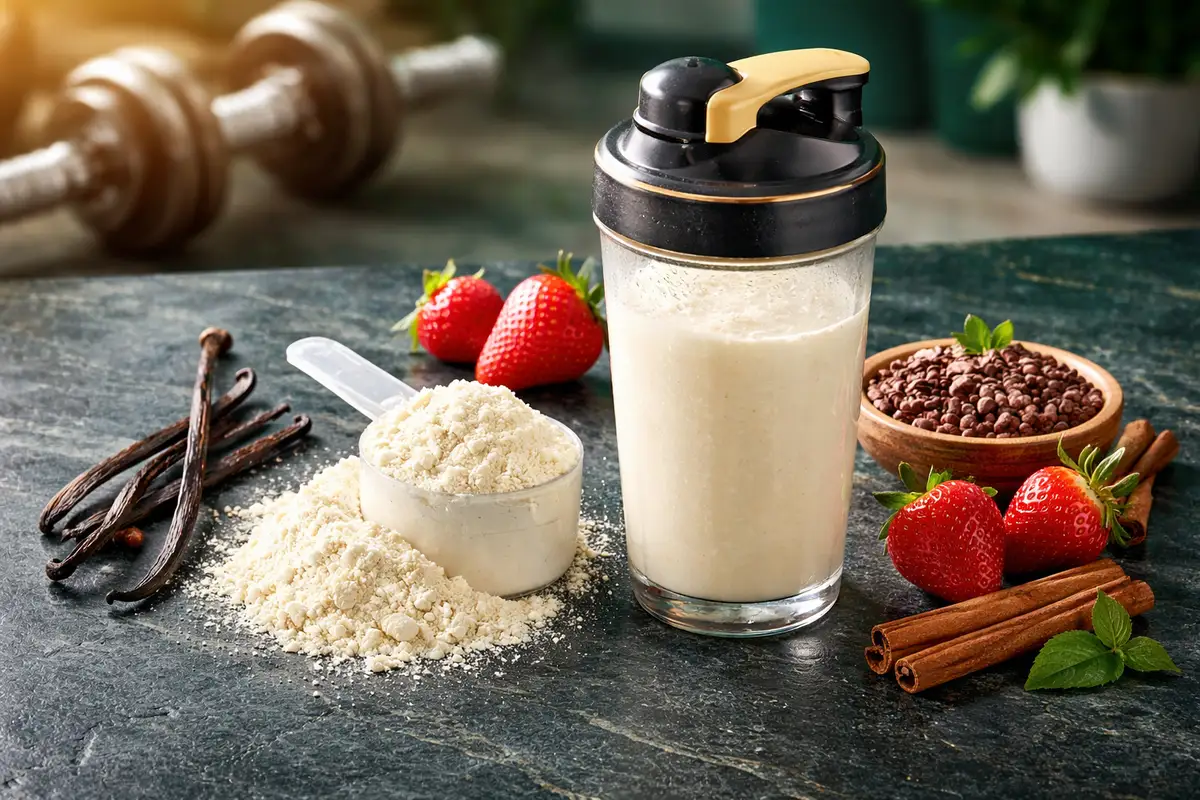

Look, I get it. You’re standing in the supplement aisle or scrolling through an online store, and you see that label. “Naturally Flavored Vanilla Ice Cream Whey.” It sounds clean. It sounds like something you could actually eat on a diet.
You probably think, “Hey, it’s natural, so it must be better for my gut and my gains, right?”
I’ve spent over a decade in the trenches of bodybuilding and seven years coaching clients one-on-one. And I’m here to tell you: The story behind how natural flavors are made is the most misunderstood chapter in the entire fitness nutrition book.
If you want to understand the full picture of this supplement, check out the Whey Ultimate Guide.
In this article, I’m pulling back the curtain. No marketing fluff. Just the real science, the real impact on your digestion, and my pro-coach rules for navigating the ingredient list like a pro.
Table of contents
- The Straight Answer: What Are Natural Flavors in Whey Protein?
- The Source List: Where Does “Vanilla” or “Chocolate” Actually Come From?
- The Extraction & Encapsulation Process
- The “Fading Flavor” Problem: Why Your 5lb Tub Tastes Different at the Bottom
- Hossein’s Pro Coach Take: Natural Flavor vs. Digestion & Gains
- Frequently Asked Questions (FAQ)
The Straight Answer: What Are Natural Flavors in Whey Protein?
Let’s cut through the noise immediately because this is what you Googled. When a whey protein tub says “Natural Flavors,” it does not mean someone squeezed a fresh vanilla bean or a basket of strawberries into your powder.
The Legal Definition: According to the FDA and global food standards, a natural flavor is an essential oil, oleoresin, essence, or extractive derived from a plant, animal, or fermentation source. Its primary function is to provide flavor, not nutritional value.

Here is the distinction that matters for your bodybuilding results:
Flavor Type | Source Example | Reality in Whey |
|---|---|---|
Natural Flavor | Rice Bran, Yeast Fermentation, Tree Bark | Chemical compounds isolated to mimic food. |
Natural Flavor WONF | Natural Flavors + Other Natural Flavors | A blend of multiple natural chemicals to round out taste. |
Artificial Flavor | Synthesized Petroleum Derivatives | Chemically identical to natural but made in a lab. |
The Critical Distinction for Your Gut: Just because it says “Natural” does not mean it’s inert or calorie-free. As a coach, I’ve seen “Natural Flavors” wreck a client’s digestion just as fast as artificial ones.
Speaking of which, I’ve written extensively about Artificial Sweeteners in Whey: Safe or Not? because that’s another hidden variable in the gut-health equation.
The solvent carriers used to stabilize these flavors (like propylene glycol or ethanol) and the high concentration of volatile compounds are often the hidden culprit behind the bloating you feel after a shake.
The Source List: Where Does “Vanilla” or “Chocolate” Actually Come From?
I had a client named Elena from Spain a few years back. She was on a strict cut and avoided all sugar. She chose a “Natural Banana” whey thinking she was getting potassium and trace minerals from real fruit. She was shocked when I showed her the lab breakdown.
Here’s the truth about your favorite flavors:
Natural Vanilla Flavor: You’re picturing an orchid bean from Madagascar. In reality, less than 1% of global “vanilla flavor” comes from actual vanilla beans.
Most “Natural Vanilla Flavor” in whey protein is Ferulic Acid extracted from rice bran or corn fiber, then fermented by bacteria or yeast to produce Vanillin. It smells like vanilla, it tastes like vanilla, but it’s a byproduct of grain processing.
Natural Chocolate Flavor: This is usually derived from Cocoa Extract that has been treated with alkali (Dutch processing).
However, to get that rich, fudgy note without adding sugar or fat, manufacturers use “reaction flavors.” This is where they take an amino acid (like Proline) and a reducing sugar, heat them up (Maillard Reaction), and create a “Natural Chocolate Flavor” that never actually touched a cocoa tree.
Natural Strawberry Flavor: This is the one I personally avoid at all costs. It is often a cocktail of esters like Ethyl Methylphenylglycidate.
While derived from natural sources, strawberry flavoring almost always requires Beet Root Extract or Fruit Juice Concentrate for color and tartness. This adds hidden FODMAPs and fructose to your “zero sugar” protein.
Real-Life Coach Story: Four weeks out from a photoshoot in Dubai in 2019, I was using a “Natural Strawberry & Cream” whey. My midsection was soft and watery despite perfect macros.
I dropped that flavor, switched to plain Vanilla, and peeled off nearly 2lbs of water retention in five days. The natural flavoring and the beet root color were fermenting in my gut.

The Extraction & Encapsulation Process
Why the Powder Doesn’t Taste Like Fresh Fruit?
You know that moment when you open a fresh tub of Natural Vanilla Whey and it smells like a bakery? Then you mix it with water and it tastes… well, thin?
There’s a chemical reason for that disconnect.
Here is the behind-the-scenes process that turns a leaf or a seed into the powder in your shaker cup.
Step 1: Isolation – The Hunt for the Aroma Molecule
To make a “Natural Flavor,” manufacturers first identify the single chemical compound responsible for the smell. For example, Isoamyl Acetate is the molecule that screams “Banana!”
To get it naturally, they might ferment yeast on a sugar substrate or extract it from corn byproducts. They don’t need the banana peel, seeds, or fiber—just that one volatile compound.
Step 2: The Carrier System (The Solvent “Myth”)
Essential oils and aroma compounds are incredibly unstable. They evaporate in seconds. To make them stick to whey powder for 18 months, they must be mixed with a carrier.
This is usually Propylene Glycol (derived from natural gas but GRAS certified) or Ethyl Alcohol.
While this is safe in the microscopic amounts used in a scoop of protein, it explains why some of you get a mild throat burn or “heat” from a shake. That’s the volatile carrier evaporating, not the protein itself.
Step 3: Spray Drying – Turning Liquid into Dust
The liquid flavor emulsion is sprayed onto a dry carrier base—usually Maltodextrin or Gum Arabic—inside a massive heated chamber.
The water evaporates instantly, leaving a dry, flavor-coated powder that blends seamlessly into your whey isolate.
The “Fading Flavor” Problem: Why Your 5lb Tub Tastes Different at the Bottom
This is one of the most common complaints I get in my DMs, and I experienced it firsthand with a client named Raj in London.
Raj bought a 5lb bag of “Natural Chocolate Sea Salt” whey. Week 1: “Hossein, this is the best thing I’ve ever tasted.” Week 4: “Hossein, this tastes like I’m licking a cardboard box.” He was ready to bin it.
Why This Happens: Natural flavor compounds are Volatile Organic Compounds (VOCs) . Unlike artificial flavors, which have chemical fixatives (think of them as glue), natural flavors are fragile.
Every time you open that tub, oxygen rushes in. The oxygen binds to the esters and aldehydes, breaking them down into stale, flat-tasting molecules.
My Pro Coach Solution: The Decanting Protocol
I mandate this for all my clients buying bulk protein to save money:
Immediate Fix for Stale Powder: Mix the remaining stale powder with 50g of Pure Unsweetened Cocoa Powder (if chocolate) or Ceylon Cinnamon (if vanilla). This introduces fresh, dry flavor particles to mask the oxidized ones.
Long-Term Prevention: As soon as you open a 5lb bag, split it into three Ziploc freezer bags. Squeeze the air out. Store two in the freezer, one in the pantry.
Cold temperatures dramatically slow down the oxidation of those natural flavor lipids. Your last scoop will taste 90% as good as your first.
For a complete breakdown on preserving your supplement investment, see my guide on How to Store Whey Protein: Prevent Spoilage & Clumping.
Hossein’s Pro Coach Take: Natural Flavor vs. Digestion & Gains
Alright, this is where my 10+ years of personal bodybuilding experience and coaching merge. You don’t just want to know how it’s made; you want to know what it does to your six-pack and your toilet schedule.
The Hidden FODMAP Issue
I had a client, Markus from Germany, who was meticulous with his macros. He logged every gram. Yet, he looked puffy and complained of gas by 3 PM daily. The culprit? A high-end Natural Vanilla Isolate.
The Problem: “Natural Strawberry” or “Cream” flavors often use Fruit Juice Concentrate or Inulin (chicory root fiber) as natural flavor enhancers or flow agents. These are high FODMAP foods. For anyone with even mild IBS or SIBO, this creates a fermentation party in your gut.
The Result: We switched Markus to Unflavored WPI with a pinch of pure Stevia. Within 72 hours, his bloating visual dropped by 90%, and his waist measurement came down 1.5cm. That wasn’t fat loss; that was inflammation reduction.
The Cephalic Phase Insulin Response (CPIR)
This is the science most trainers don’t know. The moment your tongue tastes “Sweet Vanilla,” even if it’s from a zero-calorie natural flavor, your brain sends a signal to the pancreas: “Sugar incoming! Release insulin!”
This is why understanding Whey Protein and Insulin: Does It Spike or Stabilize Your Levels? is crucial for anyone serious about body composition.
While the insulin spike is small, doing this 3 times a day with shakes can blunt fat oxidation over time. It’s one reason I limit flavored shakes for my physique clients to post-workout only.
My Client Checklist
- Bloating after a shake? Swap to Unflavored for 7 days. If bloating stops, the Natural Flavor carrier is your enemy.
- Can’t get rid of love handles? You might be spiking insulin with “sweet-tasting” natural flavors between meals.
- Recovery feeling slow? Did you know that Whey Protein Antioxidants: The Ultimate Recovery Hack can help? But only if you’re not bogging down digestion with problematic additives.
Frequently Asked Questions (FAQ)
They are safe according to food regulators. But for a bodybuilder focused on gut health, they are not optimal. Natural flavors are added for taste only. They do not help your muscles grow or recover. I see them as neutral at best and sometimes inflammatory.
Manufacturers use a blend called Natural Flavor WONF. This means With Other Natural Flavors. They mix vanillin with natural butter extracts and nut notes. It tricks your brain into tasting cake without adding real sugar or flour.
No. This is a common mistake. A flavor can come from a natural source like corn. But that corn could be sprayed with pesticides. Only a label that says “Organic Natural Flavor” means it is truly organic.
Yes. If you have allergies to sesame, soy, or corn, be careful. Natural flavor is a blanket term. Companies do not have to name the exact plant source. If you have severe allergies, use only unflavored protein.
This is about cost and shelf life. Artificial flavors last longer and taste stronger. Brands list natural flavors first because it sells better. They add a tiny bit of artificial flavor to keep the taste fresh in the tub.
Yes. You do not need a gym membership to benefit from protein. Quality protein helps repair muscle whether you lift heavy iron or just use bodyweight. The type of whey you pick matters even more when equipment is limited.
The same rules apply. Recovery is recovery. I have worked with cyclists who got bloated from flavored powders during long rides. A clean, simple whey works better for any sport.
Natural flavor compounds are fragile. They break down when exposed to air. Every time you open the tub, oxygen rushes in and destroys the taste molecules. This is called oxidation. Store your powder in smaller sealed bags to keep it fresh longer.
Unflavored and unsweetened whey isolate. It has the fewest ingredients. You control what goes into it. Add your own real vanilla or cacao for flavor without the gut issues.
Count the commas on the ingredient label. If there are more than five commas, the product has too many fillers and gums. Keep it simple. Fewer ingredients means better digestion and better results.
Leave a Reply