

Milk means faster weight gain and a caloric surplus. Water means leaner gains and effortless digestion. That’s the 10-second rule—and getting it right dramatically shifts your body composition.
As a fitness coach who’s used both methods for years, I’ve seen this single choice make or break a bulk. Milk turns your shake into a calorie-dense, anabolic driver that accelerates size. Water strips it back for rapid digestion and zero bloat.
Both build muscle. The secret is matching your mixer to your goal, metabolism, and recovery needs.
✅ Quick Answer: 10-Second Mass Gainer Rule
- Use Milk if: You want maximum calories, faster size gains, and a creamier shake.
- Use Water if: You prioritize a leaner look, easier digestion, and calorie control.
- Best Temperature: Cold or room-temperature milk—never boiling.
- Best Timing: Milk post-workout or before bed; water anytime for lighter digestion.
💡 But here’s the catch—choosing wrong means waking up bloated, sluggish, and stalled out instead of visibly fuller and leaner. Here’s exactly how to never get it wrong again.
Table of contents
- Milk vs Water: Quick Comparison Table
- Milk vs Water for Mass Gainer: A Detailed Breakdown
- When to Take Mass Gainer With Milk
- When to Take Mass Gainer With Water
- Hot Milk vs Cold Milk for Mass Gainer
- How to Mix Mass Gainer With Water or Milk (Step-by-Step)
- Common Mistakes to Avoid
- Still Unsure? FAQs on Mass Gainer With Milk vs Water
- Final Thoughts
Milk vs Water: Quick Comparison Table
Your Goal | Best Mixer | Why It Works |
|---|---|---|
Fast Weight Gain | Milk | Packs 120-150 extra calories and 8g protein per cup—accelerates caloric surplus and size gains. |
Lean Muscle Growth | Water | Strips away unnecessary calories, delivering pure macros for cleaner gains without fat spillover. |
Sensitive Stomach | Water | Rapid gastric emptying. No lactose, no bloating, no digestive slowdown during training. |
Maximum Taste & Texture | Milk | Creamier, thicker shake that feels like a real milkshake—makes daily consumption sustainable. |
Post-Workout Recovery | Milk | Slow-digesting casein plus whey extends amino acid delivery when your muscles need it most. |
Pre-Workout Fuel | Water | Ultra-fast absorption. Zero stomach heaviness so you can train hard without nausea or cramping. |
Milk adds density and drives aggressive bulking. Water prioritizes efficiency and digestive comfort. Neither is wrong—but one is definitely wrong for your specific goal.
Milk vs Water for Mass Gainer: A Detailed Breakdown
Choosing between milk and water isn’t just about taste—it’s about how your body responds to the nutrients, how you feel after drinking it, and how well it fits into your daily calorie and muscle-building plan.
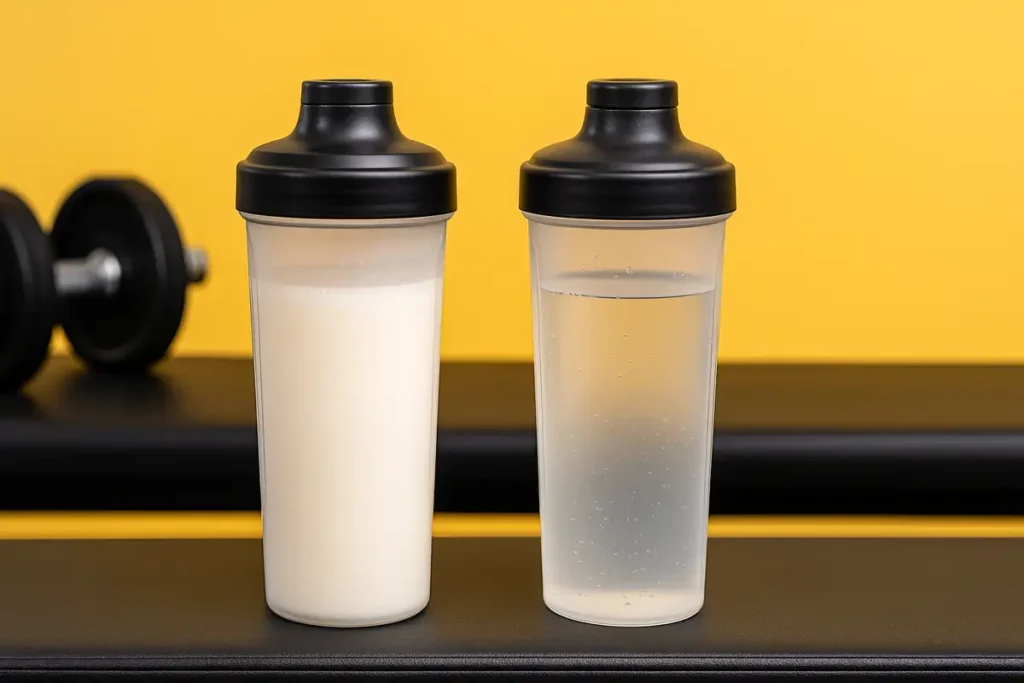
From coaching hundreds of athletes, I’ve seen firsthand how this choice impacts digestion, energy, and results.
Below is a detailed side-by-side comparison to help you make the best decision for your body and goals.
Aspect | With Milk | With Water | Best For |
|---|---|---|---|
Calories (per 250ml/1 cup) | +120–150 kcal | 0 kcal | Milk: Hardgainers needing a surplus Water: Lean bulking or cutting phases |
Added Protein (per cup) | +8g high-quality dairy protein | 0g | Milk: Extra muscle repair and synthesis |
Digestion Speed | Slower (contains fat, lactose, casein) | Fast and light | Water: Sensitive stomachs, pre-workout, or hot days |
Texture & Taste | Creamy, rich, milkshake-like | Light, less sweet, powder-forward | Milk: If you enjoy flavor and consistency Water: If you prefer no dairy taste |
Cost & Convenience | Higher cost, requires refrigeration | Very low cost, always available | Water: Budget-friendly, travel, simplicity |
Best Timing | Post-workout, before bed | Anytime, especially with meals or pre-workout | Milk: Recovery and overnight feeding Water: Hydration and controlled fueling |
Bloating Potential | Higher (due to lactose and thickness) | Very low | Water: Those prone to digestive discomfort |
Ideal User Profile | Hardgainers, bulking phases, dairy-tolerant individuals | Lean gainers, cutters, lactose-intolerant, or those with faster digestion | Match to your metabolism and tolerance |
What This Means for You
If you look at the table, the biggest takeaway is this: milk adds—water doesn’t.
Milk adds calories, protein, creaminess, and fullness. It’s a supplement to your supplement, turning your mass gainer into a more potent, calorie-dense muscle-building tool. That’s why I often recommend it to beginners, hardgainers, or anyone in a dedicated bulking phase.
Water, on the other hand, lets the powder do all the work. You get exactly what’s on the label—no extra calories, no dairy, no digestive slowdown. This is perfect when you want to tightly control your intake, avoid bloating, or if you’re already eating plenty of whole foods.
Which Should YOU Choose?

Mixing your mass gainer with milk instantly adds more calories and protein. One glass of milk usually adds 120–150 calories and about 8 g of protein, making the shake more anabolic than water.
This is especially helpful for hardgainers and fast-metabolism lifters who struggle to stay in a calorie surplus.
Milk also improves taste and texture — it makes the shake creamier and easier to drink daily.
But if your goal is leaner gains or limiting fat gain, mixing with water is often better.
Water-based shakes are lighter, easier to digest, and more hydrating — especially in hot climates or during high-volume training. I often recommend water during lean bulking or cutting phases.
For endurance athletes, water-based gainers can be valuable for post-cardio recovery since they replenish glycogen quickly without overwhelming the stomach. Read more in mass gainers for endurance athletes.
From my own experience, using milk helped me gain about 3.5 kg in a month, but roughly one-third of that was fat or water. When I switched to water, the weight gain slowed — but I added about 2 kg of lean muscle with no bloating and better definition.
If you’re training mainly for strength or performance, you can also check my guide on mass gainers for strength and performance.
📌 Bottom line: Use milk for more calories and faster weight gain — use water for leaner gains and easier digestion.
Choosing Based on Your Body Type & Metabolism
Not everyone responds the same way to extra calories or protein. Your body type, metabolism, and natural tendency to gain muscle or fat should influence whether you choose milk or water for your mass gainer.
Here’s a simple, practical guide to help you decide based on your unique physiology.
1. For Hardgainers (Ectomorphs)
If you have a fast metabolism, struggle to gain weight, and often feel like you “eat everything but don’t grow,” milk is usually your best friend.
- Why milk?
The extra 120–150 calories and 8g of protein per cup help you maintain a calorie surplus without having to force down another solid meal.
Milk’s blend of fast- and slow-digesting proteins supports sustained muscle growth throughout the day. - When to use water:
Only if milk causes bloating or digestive discomfort—switch to lactose-free milk or a milk alternative instead of plain water to keep calories up.
2. For Easy Gainers (Endomorphs)
If you tend to gain fat easily, have a slower metabolism, or are already eating plenty of whole foods, water is often the smarter choice.
- Why water?
It helps you control calorie intake while still getting the protein and carbs from your gainer.
A water-based shake digests faster, reduces bloating, and supports a leaner, more defined physique during a bulk. - When to use milk:
On high-activity days or when you’re struggling to hit protein goals, a half-milk/half-water mix can offer a good balance.
3. For Athletic or Mesomorphic Types
If you gain muscle relatively easily and maintain a moderate body fat level, you can switch between milk and water based on your training phase.
- Bulking phase → Use milk (post-workout or before bed).
- Cutting or maintenance phase → Use water (to keep calories in check).
- Performance training days → Consider water for faster digestion and hydration.
4. If You Have Digestive Sensitivities
Your stomach comfort matters just as much as your macros.
- Lactose intolerant? Use water or lactose-free milk/plant milk.
- Slow digestion? Start with water-based shakes and only introduce milk if well-tolerated.
- Prone to bloating? Avoid cold milk—use room-temperature liquids and blend thoroughly.
Quick Reference Table: Body Type & Liquid Choice
Body Type | Best Liquid | Why |
|---|---|---|
Hardgainer | Milk | Adds needed calories & protein without extra meal volume. |
Easy Gainer | Water | Controls calories, reduces fat gain, supports lean muscle. |
Athletic | Depends on phase | Milk for bulking, water for cutting or intense training days. |
Sensitive Gut | Water or plant milk | Easier to digest, reduces bloating and discomfort. |
Your body isn’t generic—your mass gainer shouldn’t be either.
Match your liquid to your metabolism:


- Milk for extra fuel when you need to grow.
- Water for control when you want to stay lean.
- Always listen to your body—digestion, energy, and progress are your best guides.
Can I Take Mass Gainer With Water? — Yes
Water is perfect when you want:
- leaner gains
- faster digestion
- fewer calories and less bloating
Can I Take Mass Gainer With Milk? — Yes
Milk is best when you want:
- faster weight gain
- more calories and protein
- a creamier, better-tasting shake
According to a PubMed Central review on milk-based protein supplementation, dairy protein blends provide a rich source of casein and whey that enhance muscle protein synthesis and recovery after training.
In simple terms, milk turns your shake into a more nutrient-dense, muscle-building option without changing the convenience of your supplement.
For a deeper understanding of how gainers help build muscle safely, read the Full Mass Gainer Guide.
When to Take Mass Gainer With Milk

If your goal is fast mass gain, mixing your gainer with milk adds extra calories and protein while slightly slowing digestion — keeping you fuller and supporting recovery.
I recommend milk-based gainers for beginners and hardgainers.
One client, Lukas from Germany, gained 4 kg in six weeks after using his gainer with milk twice daily.
Best timing:
Right after your workout. A 2025 narrative review in Sports Medicine shows carbs + protein post-workout accelerate recovery.
Milk here gives both fast- and slow-digesting nutrients.
Another great time is before bed. Milk’s casein releases amino acids slowly overnight. A PubMed study on pre-sleep protein intake found this increases muscle protein synthesis.
This is especially helpful during bulking and recovery — and even more beneficial for older lifters (see mass gainers for seniors).
If milk causes bloating, use low-fat or lactose-free milk for easier digestion.
Bottom line:
Milk is best when you’re bulking, recovering, or need extra calories — especially post-workout or before bed.
Best Time to Drink Milk for Muscle Gain
The two best times are:
- After your workout – supports recovery and muscle protein synthesis
- Before bed – casein in milk digests slowly and feeds muscles overnight
If bulking, milk before bed is especially powerful.
When to Take Mass Gainer With Water

If your goal is a lean bulk, fat control, or faster digestion, water is your best choice. It’s calorie-free, absorbs quickly, and feels much lighter on your stomach.
I recommend water-based shakes during cutting cycles or when training multiple times a day. They hydrate your body without overwhelming your digestive system and are perfect if you’re already eating high-calorie solid meals.
From my coaching experience, clients who switch from milk to water often notice improved energy, fewer digestive issues, and better muscle definition.
Jessica from Canada, for example, struggled with bloating from milk-based gainers. After switching to water and adding a banana for extra carbs, she reported better recovery and a leaner look within a month.
If your metabolism is slower or you want to fine-tune calorie intake, this method gives you more control. For optimizing metabolism while gaining muscle, check the detailed breakdown in mass gainers for metabolism support.
Hot Milk vs Cold Milk for Mass Gainer

Most mass gainers mix best with slightly cold or room-temperature milk.
Very hot milk can:
- damage heat-sensitive vitamins
- slightly reduce flavor quality
- cause clumping in some powders
However, warm milk is okay if you prefer it — just avoid boiling.
Best choice: cool or room-temperature milk for better texture and nutrient stability.
📌 Bottom line: Cool or room-temperature milk mixes best — warm is okay, but avoid boiling.
How to Mix Mass Gainer With Water or Milk (Step-by-Step)
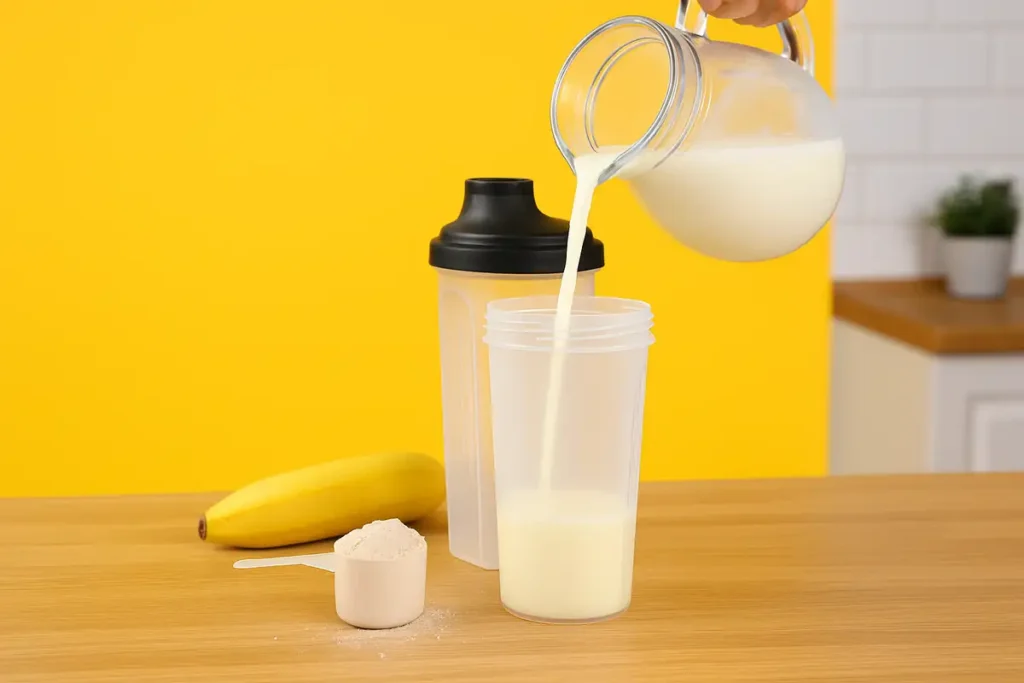
Getting the mixing step right is more important than most people think. A smooth, clump-free shake is easier to drink daily and ensures you’re getting every gram of nutrition you paid for.
fter years of making these shakes myself and for clients, I’ve nailed down a simple method that works every time.
Here’s my straightforward, step-by-step guide to mixing the perfect mass gainer shake, whether you choose milk or water:
- Choose your liquid based on your goal.
- Measure liquid (300–400ml milk / 400–500ml water).
- Add 1 scoop of mass gainer.
- Shake or blend for 20–30 seconds.
- Optional: Add banana, peanut butter, or oats.
Step 1: Choose Your Liquid Based on Your Goal
This is the most important decision. Don’t just pour randomly.
- Choose Milk if: You’re bulking, have a fast metabolism, or want the creamiest texture.
- Choose Water if: You’re cutting, want leaner gains, have a sensitive stomach, or need faster digestion.
Step 2: Measure Your Liquid First
Always add your liquid to the shaker or blender before the powder. This prevents dry clumps at the bottom.
- With Milk: Use 300–400 ml (about 1.5 cups) of milk per scoop.
- With Water: Use 400–500 ml (about 2 cups) of water per scoop.
Why more water? Powder tends to thicken more with water, so the extra liquid ensures a drinkable consistency.
Step 3: Add One Scoop of Mass Gainer
Use the scoop that came with your product. Level it off—don’t pack it heaping. One standard scoop is designed to mix properly with the liquid amounts above.
Step 4: Seal and Shake (or Blend) Vigorously
If using a shaker bottle:
- Ensure the lid is sealed tightly.
- Shake vertically and horizontally for 25–30 seconds. Don’t just wiggle it; put some shoulder into it.
If using a blender:
- Blend on medium for 20–30 seconds until completely smooth.
Step 5: Check Consistency and Drink Immediately
After shaking, open and check. If it’s too thick, add another splash of liquid and shake for 5 more seconds. For the best texture and nutrient quality, drink your shake within 10-15 minutes of mixing.
Pro Tips for the Best Shake Every Time:
- Use Room-Temperature Liquid: Cold milk or water can make some powders clump. Room temp or slightly cool liquid blends the easiest.
- Invest in a Good Shaker: A shaker with a metal whisk ball or a blender is non-negotiable for a smooth shake. It’s a small investment that makes a huge difference.
- Customize for Your Needs (Optional): Want more from your shake? Blend in these extras:
- For More Calories & Carbs: Add 1/2 a banana or a handful of oats.
- For Healthy Fats & Flavor: Add 1 tablespoon of peanut butter or almond butter.
- For Extra Hydration & Volume: Add a handful of ice cubes before blending.
😋 My Personal Favorite Mix: One scoop of chocolate mass gainer + 300 ml of milk + half a banana + a spoon of peanut butter. It tastes like a dessert, delivers 600-700 quality calories, and is perfect for a lean bulking day.
Mixing it right turns your mass gainer from a chalky chore into a tasty, effective tool for your goals.
🚀 If you’re training at high intensity or trying to boost calorie intake further, check the high-calorie mass gainer guide for expert-level stacking ideas.
Common Mistakes to Avoid
- Overusing gainer with milk: Too much can lead to unwanted fat gain and digestive issues.
- Skipping real meals: Gainers should complement your meals, not replace them.
- Using cold milk: This can cause clumping — use room temperature or slightly warm milk for smoother blending.
- Ignoring total calories: Even the best gainer won’t help if your daily calorie intake isn’t balanced.
I once had a client, Marco from Italy, who added oats and peanut butter to his milk-based gainer but ignored his total calorie count. He gained 6 kg in two months — but about half was fat. After switching to water and tracking calories more carefully, he started gaining lean muscle instead.
Still Unsure? FAQs on Mass Gainer With Milk vs Water
Yes, you can mix mass gainer with warm or hot milk, but avoid using boiling milk. Boiling can damage heat-sensitive nutrients and cause clumping. Warm milk is fine and can be more comfortable to drink in cold weather.
Cold or room-temperature milk is generally better for mixing mass gainer because it blends more smoothly and helps preserve the stability of vitamins and proteins in the powder.
Yes, you can absolutely take mass gainer with water. Mixing with water creates a lighter shake that is easier to digest, lower in calories, and ideal for lean muscle gains or during cutting phases.
For most people looking to bulk up quickly, milk is the better choice because it adds extra calories, protein, and healthy fats. This helps create the calorie surplus needed for weight and muscle gain.
For best results, use 300–400 ml of milk or 400–500 ml of water per scoop of mass gainer. Adjust the amount slightly based on your preferred consistency.
Yes, mixing half milk and half water is a great option. It provides some of the creaminess and extra calories from milk while keeping the shake lighter and easier to digest.
Yes, warm milk is okay as long as it’s not too hot. Slightly warm milk can help the powder dissolve better and prevent clumping, especially in cooler environments.
No, water does not make mass gainer less effective. All the nutrients in the powder remain the same. The only difference is that water adds no extra calories, which can be beneficial for lean gains.
Yes, lactose-intolerant users can use milk alternatives like almond milk, soy milk, or oat milk. These options are easier to digest and still add flavor and some calories to the shake.
Start with one serving per day, ideally after your workout. If you need more calories to meet your goals, you can add a second serving before bed to support overnight recovery.
The best times to drink mass gainer with milk are after your workout to support recovery and before bed to provide slow-digesting protein overnight, which aids muscle repair and growth.
Yes, you can take mass gainer with water even if your goal is weight gain. If you’re already consuming enough calories from solid foods, a water-based shake can help you gain lean muscle without excess fat.
You can add ingredients like half a banana, a tablespoon of peanut butter, a dash of cinnamon, vanilla extract, or a handful of berries to enhance the flavor and nutritional value of a water-based shake.
Milk is typically better for post-workout recovery because it provides both fast- and slow-digesting proteins along with carbohydrates. However, water is a good alternative if you prefer easier digestion or are lactose intolerant.
Yes, drinking a water-based mass gainer shake 30–60 minutes before a workout can provide energy without causing stomach discomfort. Avoid milk before training if you are sensitive to dairy.
No, mixing with water does not reduce protein absorption. The protein in the mass gainer is fully available regardless of whether you use water or milk. Digestion may be slightly faster with water.
Some individuals find that dairy can worsen acne or skin issues. If you are concerned, you may want to try using water or a non-dairy milk alternative and observe how your skin responds.
Final Thoughts
Whether you mix your mass gainer with milk or water depends entirely on your goals, metabolism, and comfort level.
If you’re aiming for fast muscle gain and fuller size, go with milk for the added protein and calories. If you’re focused on lean gains, digestion, or metabolic control, water is the smarter choice.
As someone who’s coached hundreds of clients across all body types, I can confidently say: both work — as long as your total nutrition plan is right.
Stay consistent, listen to your body, and tailor your shakes to your needs. That’s how you turn your gainer from a simple powder into a powerful tool for muscle growth and recovery.
Leave a Reply