


Can combining creatine and nitric oxide boosters really take your training to the next level? The answer — backed by science — is a strong yes.
This dynamic duo fuels your workouts from two angles: creatine boosts your strength and energy, while nitric oxide enhances blood flow and endurance. Together, they create the ultimate synergy for muscle growth, pump, and recovery.
Athletes worldwide — from lifters to CrossFit competitors — rely on this combo to train harder and recover faster. The results are real: more reps, stronger lifts, and lasting muscle fullness.
In this guide, you’ll discover how these two supplements work, how to stack them safely, and how to get the most from every dose — all backed by research and real coaching experience.
Table of contents
Introduction: The Quick Answer

If you’ve ever wondered whether combining creatine and nitric oxide (NO) boosters really works — the short answer is yes, absolutely. These two supplements complement each other and have strong scientific support behind their effectiveness.
Creatine helps your muscles produce more energy, allowing you to push through high-intensity sets with power and consistency. Nitric oxide boosters increase blood flow and nutrient delivery, giving you that fuller, pumped feeling and helping delay fatigue.
According to a PubMed study on creatine supplementation, creatine enhances phosphocreatine stores in the muscles, which boosts ATP regeneration — your body’s main source of quick energy. This often means more reps, stronger lifts, and better recovery between sets.
When I first combined the two, I noticed a big difference in how I performed and how my muscles felt post-workout. That tight, “pumped” sensation lasted for hours, and I could maintain training intensity much longer.
Over time, I refined this combo — not only for myself but also for my coaching clients — and the results were consistently impressive.
1. How Creatine Works

Creatine is one of the most researched and reliable supplements for improving strength, muscle mass, and overall performance. As shown in a 2024 meta-analysis published in Cureus, creatine consistently enhances muscle performance and metabolic function across varied training styles.
When you consume creatine, it replenishes phosphocreatine stores in your muscles. This allows faster regeneration of ATP (adenosine triphosphate) — your most immediate energy source during explosive efforts like lifting, sprinting, or jumping.
With higher ATP availability, your muscles perform stronger, last longer, and recover faster. If you want the complete science, including optimal loading and cycling strategies, see the Creatine Ultimate Guide.
Over my years of coaching, I’ve seen creatine transform the progress of both beginners and advanced athletes. One client, James, struggled to add strength to his squat despite perfect form and effort.
After adding 5 grams daily, his performance improved within three weeks — he added 15 kg to his squat and noticed less fatigue between sets. For how creatine influences both maximal and submaximal lifting, read Creatine for Max vs. Submax Lifts.
For athletes training multiple times per week, Creatine for High-Frequency Training explains how to manage recovery and maintain output in demanding schedules.
2. How Nitric Oxide Boosters Work

Nitric oxide (NO) boosters work differently but complement creatine perfectly. They increase vasodilation, widening blood vessels to improve blood flow, oxygen delivery, and nutrient transport.
This helps you perform at higher intensity and recover faster while also giving you that satisfying muscle pump. The key ingredients behind these effects include L-citrulline malate and arginine.
L-citrulline malate, in particular, tends to produce a smoother and longer-lasting pump than arginine-based products like AAKG. When I take it 20–30 minutes before training, I can push through the final sets of compound movements with more focus and less fatigue.
Dosage and timing matter. A client, Daniel, felt mild nausea after taking a high dose on an empty stomach. We fixed it by splitting the intake and pairing it with a light snack — his performance improved immediately.
3. Why the Combo Works Better
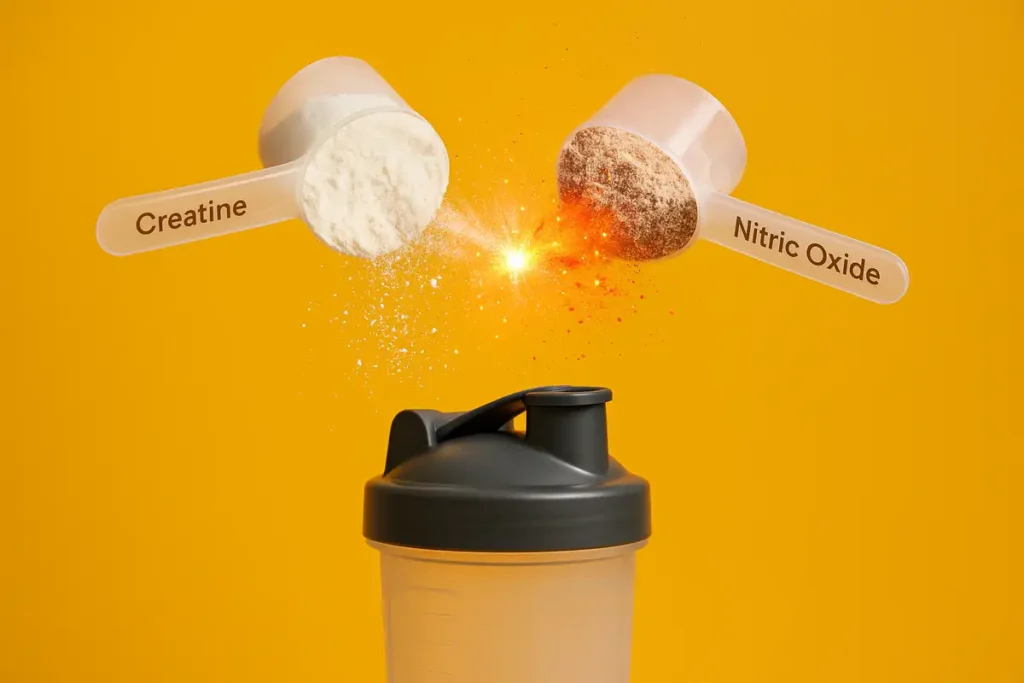
The synergy between creatine and nitric oxide is where real progress happens. Creatine amplifies muscle energy and power, while nitric oxide improves blood flow and nutrient delivery.
A systematic review and meta-analysis in Nutrients (2024) confirmed that creatine, combined with resistance training, significantly increases both lean mass and strength. When you pair this with NO boosters that enhance circulation, your muscles receive nutrients more efficiently and recover faster.
Think of it as a performance loop — creatine powers the engine, nitric oxide opens the fuel lines, and together they elevate endurance and recovery.
Here’s what most people notice when stacking the two:
- Increased workout volume and stamina
- Improved hydration and nutrient uptake
- Faster recovery between sets
- Greater fullness, vascularity, and visible muscle definition
When I coached Luca, a CrossFit athlete, we introduced this stack during competition prep. His endurance skyrocketed, and he sustained output during long WODs without his usual mid-session fade.
Mateo, a physique athlete, saw better vascularity and muscle density in the final week before a show — exactly what competitors want when refining their stage look. To understand how creatine interacts with energy systems, see Creatine vs. Phosphocreatine Differences.
4. How to Stack Them Effectively

Timing and consistency are crucial. Here’s the approach I’ve found most effective:
- Citrulline Malate (6–8 g): Take it 20–30 minutes before your workout. Mix with water or a light pre-workout drink.
- Creatine Monohydrate (3–5 g): Take it daily, pre- or post-workout. I prefer it post-workout with whey protein and a banana — the carbs help drive creatine into the muscle.
If you’re curious about mixing methods, here’s the breakdown: Creatine with Milk vs. Water – Absorption Rate. Hydration is another key factor — both supplements depend on proper water balance.
If you’re in a deload phase, don’t stop using creatine. Read Creatine During Deload Weeks to maintain muscle saturation even when you reduce training intensity.
5. Potential Side Effects and Tips
Both supplements are safe when used properly, but details matter. Start small and increase gradually to allow your body to adapt.
Avoid combining too many stimulants (like caffeine-heavy pre-workouts) alongside nitric oxide boosters. Hydration is non-negotiable; without enough water, creatine’s cell-volumizing effect drops and nitric oxide’s benefits may fade.
Choose high-quality, third-party-tested products with clear labels and no proprietary blends. From my experience, the rare clients who felt bloated or heavy were either under-hydrated or overdosing.
One client used 10 grams of creatine daily and felt sluggish in sessions. We reduced it to 5 grams, and his training felt lighter and stronger within days. For timing finesse, see Creatine and Antioxidants: Timing Guide.
Conclusion
Combining creatine and nitric oxide boosters isn’t a gimmick — it’s a well-supported strategy for athletes aiming to improve strength, endurance, and recovery simultaneously.
Current evidence shows consistent creatine use enhances muscle function and performance, and in practice the addition of NO boosters often magnifies these benefits. From years of coaching, I’ve seen how powerful this combo becomes when paired with solid training, nutrition, and sleep.
Stay consistent, track your lifts, and within weeks you’ll feel stronger, look fuller, and train with more confidence than ever.
FAQ
Yes. Take creatine daily to maintain muscle saturation. Nitric oxide boosters aren’t essential on rest days but can still support circulation and recovery.
You can take both together before training for simplicity. Personally, I prefer creatine post-workout for better absorption — especially with carbs or protein.
Yes, both are considered safe for healthy adults at proper dosages. Hydrate well and avoid overuse.
L-citrulline malate is the top choice for sustained blood flow, improved endurance, and better performance during intense sessions.

Leave a Reply