


If you’ve been training for a while, you’ve probably heard people talk about EAAs — Essential Amino Acids — as if they’re the secret weapon for muscle recovery and energy.
But what exactly are they? Are they better than BCAAs? And do you really need them if you’re already getting enough protein?
As a fitness coach who has trained hundreds of athletes and everyday lifters, I’ve tested EAAs through every kind of training block — bulking, cutting, fasting, even two-a-day sessions. The difference they can make is real.
In this article, I’ll break down how EAAs work, when to take them, what science says, and how to use them in real life to get the most out of your workouts.
Table of contents
- What Are EAAs and Why They Matter
- How EAAs Work in the Body
- Key Benefits of EAAs for Athletes and Lifters
- Best Times to Take EAAs
- How to Choose a Quality EAA Supplement
- EAAs vs. Whey Protein — Which Is Better?
- Recommended Dosage and Safety Tips
- Advanced Use: EAAs for Specialized Goals
- Final Takeaway
- FAQs
- Coach’s Note
What Are EAAs and Why They Matter

EAAs are the nine amino acids your body can’t produce on its own — leucine, isoleucine, valine, lysine, methionine, threonine, tryptophan, phenylalanine, and histidine. These are the building blocks of muscle tissue and recovery.
When you eat protein (from chicken, eggs, or whey), your body breaks it down into these amino acids. But when you drink EAAs directly, you skip the digestion phase — giving your muscles rapid access to what they need to grow and repair.
EAAs are different from BCAAs. BCAAs (leucine, isoleucine, valine) cover only part of the puzzle. EAAs complete it. A 2017 study in the Journal of the International Society of Sports Nutrition found that BCAAs alone cannot fully stimulate muscle protein synthesis without the rest of the essential amino acids. That’s why a full EAA blend performs much better than BCAAs alone.
If you want a deeper breakdown, check out EAA vs. BCAA Differences.
My First Experience with EAAs
Back in 2018, I was cutting for summer photoshoots. I trained fasted at 6 a.m., and protein shakes felt too heavy before cardio and weights. That’s when I discovered EAAs.
Within the first week, I noticed something subtle but powerful — less soreness, faster recovery, and zero “flat” feeling in my muscles. I stayed leaner and stronger than in any previous cut.

Tell us your goal & discover your perfect stack — backed by science, no BS.
Free. Takes 2 Min | No sign-up needed
Since then, I’ve used EAAs regularly with my clients who train early or under calorie restriction. They consistently report the same thing: improved stamina, less fatigue, and better muscle retention. (Learn more about EAAs for Early-Morning Training).
How EAAs Work in the Body

When you train hard, you create micro-tears in your muscles. That’s normal — it’s what triggers muscle growth. EAAs provide the building materials your body uses to repair and rebuild those fibers stronger than before.
Leucine, in particular, acts as the key that starts this whole rebuilding process. It activates the mTOR pathway, the cellular switch that triggers new muscle protein synthesis. A 2024 study in the International Journal of Molecular Sciences confirmed that leucine directly stimulates mTOR, making it a cornerstone of muscle growth.
But leucine can’t do it alone. A 2020 paper in Nutrients demonstrated that all nine EAAs together accelerate both muscle repair and whole-body protein turnover far more effectively than partial blends.
So if you’re serious about recovery, EAAs are like a “fast-lane refuel” for your muscles — especially during workouts longer than 60 minutes or endurance sessions focused on VO₂ max.
Real-World Example
One of my clients, Jonas, trained after 10-hour workdays. His energy crashed halfway through sessions. When we added EAAs to his intra-workout routine, he said it felt like “turning the lights back on.” Within two weeks, his lifts went up and his soreness went down.
This isn’t just placebo — it’s how amino availability influences performance. When your muscles have a steady supply of EAAs, they stay in a positive nitrogen balance and avoid breaking down existing muscle tissue for fuel.
Key Benefits of EAAs for Athletes and Lifters

EAAs offer more than just faster recovery. Here are the real-world advantages backed by research and experience.
1. Faster Muscle Recovery
After tough sessions, your body demands amino acids fast. EAAs replenish them almost instantly. A 2020 trial in Applied Physiology, Nutrition, and Metabolism found that leucine-enriched EAAs improved recovery and reduced soreness after heavy resistance exercise.
For my clients who train six days a week, I always include EAAs in their post-workout recovery shakes. It helps them bounce back for the next session instead of dragging through it.
2. Improved Training Endurance
EAAs help sustain both muscular and mental endurance. A 2018 study in Frontiers in Physiology showed that EAA supplementation reduced neuromuscular fatigue during long resistance workouts.
This is why EAAs are often used by athletes in fat-adapted endurance programs or long-distance training blocks — they protect muscle and delay fatigue even when glycogen runs low.
Coach tip: Mix your EAAs with electrolytes during long sessions. It improves hydration and keeps the central nervous system sharp. (EAAs with Electrolytes for Hydration).
3. Prevents Muscle Breakdown During Cuts
When calories drop, the body sometimes breaks down muscle tissue for energy. EAAs help block that. A 2021 trial in Clinical Nutrition showed that higher EAA intake preserved muscle protein synthesis even in energy deficits.
If you’re cutting, this is critical. EAAs protect the lean muscle you’ve worked for while still allowing fat loss. That’s why I use them in nearly every weight-loss strength program I design.
4. Better Hydration, Focus, and Recovery
Many EAA products now include electrolytes. This combination not only prevents dehydration but also keeps energy levels and focus stable throughout training.
When you sweat heavily, you lose sodium, potassium, and magnesium — all essential for muscle function. EAAs with electrolytes replace these faster than water alone, helping prevent cramps and fatigue.
To learn more about how this synergy works, read EAAs with Electrolytes for Hydration.
5. Support During Fasting or Low-Carb Training
EAAs are ideal during fasting or carb-restricted diets because they deliver amino fuel without breaking your fast significantly. A 2023 review in Nutrients confirmed that EAA supplementation supports muscle and metabolic health even with limited energy intake.
I’ve seen this work firsthand with Karim, a client from Dubai who trained during Ramadan. We kept him on EAAs with electrolytes before sunset, and his muscle mass held steady despite fasting for over 14 hours a day.

Take this 2-minute assessment & get a science-backed training, nutrition & supplement roadmap built for YOUR body.
🔬 12,000+ personalized roadmaps generated
For similar protocols, see my full EAAs During Workout Guide.
6. Stronger Immunity for Active Athletes
Heavy training weakens immune response temporarily. EAAs can help reduce that dip by providing building blocks for immune cells and tissue repair. They support glutamine production, which fuels immune cells.
You can explore this topic further in EAAs and the Immune System for Athletes. It’s an under-discussed but important benefit, especially for those training multiple times per day or in competition season.
Best Times to Take EAAs

Timing matters — and it depends on your training schedule and goals.
Pre-workout (15–30 minutes before): Taking EAAs before training reduces early fatigue and primes your muscles for performance.
Intra-workout: Sipping EAAs during training keeps amino levels stable, improves hydration, and supports endurance.
Post-workout: EAAs right after training jump-start recovery when your body is most anabolic.
I often recommend splitting your dose: half before, half during. It keeps the muscle environment anabolic from start to finish.
For a deep breakdown, read Best Time to Take EAAs and how it supports recovery between competition heats.
If you’re training early mornings or fasted, pre-workout EAAs are especially effective. (EAAs for Early-Morning Training)
How to Choose a Quality EAA Supplement
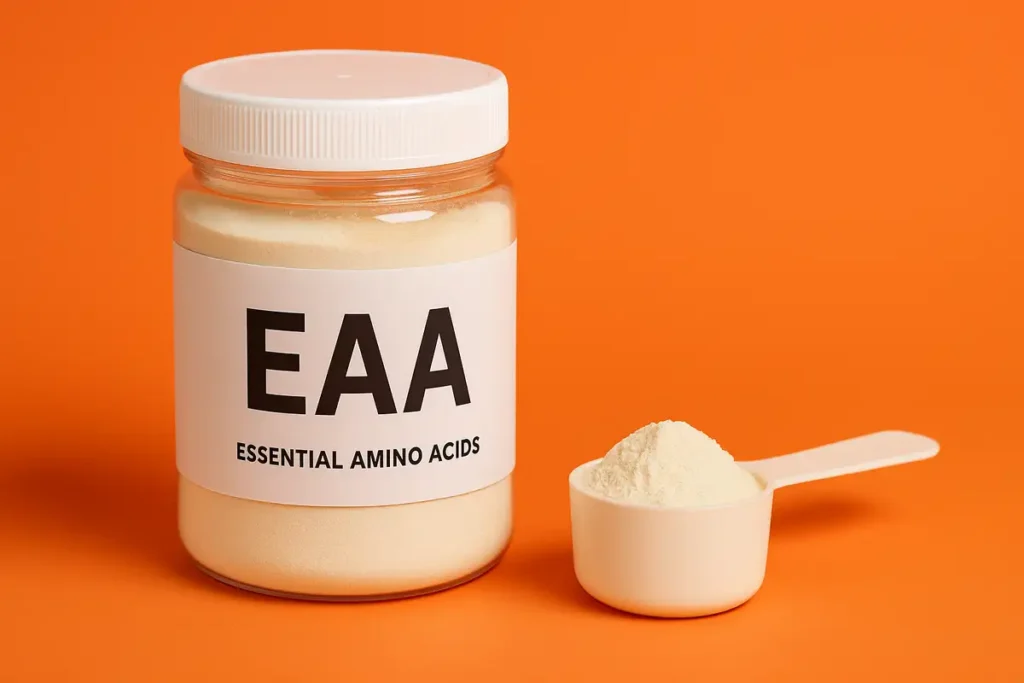
When shopping for EAAs, a few factors matter more than branding or flavor:
- Complete profile: All nine EAAs listed clearly on the label.
- Leucine-dominant ratio (around 2:1:1): A 2018 review in The Journal of Nutritional Biochemistry highlighted leucine’s primary role in triggering protein synthesis, which is why this ratio remains industry standard.
- Hydration support: Added electrolytes or coconut water powder enhance absorption.
- No excess sweeteners: Artificial ingredients can cause bloating or GI distress.
If you’re after performance pumps, look at specialized blends like EAAs for Muscle Pump.
Personally, I recommend sticking with transparent labels and science-backed dosages. Optimum Nutrition and Xtend EAAs are solid choices.
EAAs vs. Whey Protein — Which Is Better?

Think of whey protein and EAAs as teammates. Whey provides a complete nutrient profile with calories and sustained digestion. EAAs deliver rapid amino uptake with zero heaviness.
If you train multiple times a day or can’t eat immediately post-workout, EAAs bridge that gap. They’re especially helpful for athletes training twice daily.
Anecdote: When Laura, one of my long-term clients, replaced BCAAs with EAAs for morning cardio, she said, “I don’t crash anymore.” Her sessions became stronger and her recovery faster.
Use EAAs before and during training for performance, then a protein meal or shake afterward for full recovery. This combo covers both immediate repair and long-term muscle building.
Recommended Dosage and Safety Tips
For most lifters, 10 g of EAAs daily is ideal. Research in the American Journal of Clinical Nutrition found that this amount effectively triggers anabolic signaling.
Some advanced lifters go up to 15 g on double-training days, but more isn’t always better. Start small and adjust based on how your body responds.
EAAs are safe for daily use and easy to combine with creatine, beta-alanine, or caffeine. For a complete breakdown, check EAA Dosage for Lifters.
If you’re training fasted or in a calorie deficit, EAAs will also support metabolic stability while minimizing muscle loss.
Advanced Use: EAAs for Specialized Goals

EAAs are flexible. Here’s how you can tailor them:
- For weight loss and strength maintenance: 5 g pre-workout and 5 g intra-workout maintains lean mass while cutting. (EAAs for Weight Loss & Strength)
- For endurance athletes: 10–12 g spread across long sessions improves fatigue resistance and recovery.
- For VO₂ max and competition prep: Combine EAAs with electrolytes and simple carbs to maintain energy. (EAAs for VO₂ Max Endurance Athletes)
- For post-injury recovery: EAAs accelerate tissue rebuilding when appetite or protein intake is low.
As a coach, I adjust dosage and timing based on training phase. During cutting cycles, EAAs help clients maintain definition and strength without over-relying on protein shakes.
Final Takeaway
Even without food, EAAs can trigger muscle growth. A classic study in the American Journal of Clinical Nutrition found that essential amino acids alone were responsible for the anabolic response after amino intake.
That’s why EAAs remain one of the few supplements I consistently use and recommend. They digest fast, enhance focus, support hydration, and protect your hard-earned muscle across every phase — bulking, cutting, or maintenance.
My personal go-to: 5 g before training + 5 g during, mixed with water and a squeeze of lemon or electrolytes. Simple, affordable, and effective.
If you want to refine your plan, explore:
- EAAs During Workout Guide
- EAAs for Recovery Between Competition Heats
- EAAs Post-Workout Recovery Shakes
FAQs

Yes. EAAs directly activate muscle protein synthesis even without food, as proven by multiple human studies.
Absolutely. They’re natural nutrients, not stimulants. Daily use supports ongoing recovery, especially in athletes training five or more days per week.
Technically, yes — they contain a few calories — but they maintain muscle integrity and metabolism during fasting. Many athletes use them successfully during intermittent fasting windows.
Yes. BCAAs are incomplete. EAAs contain all nine essential amino acids needed for full muscle repair and growth. (EAA vs. BCAA Differences)
Yes. Most EAA supplements today use plant-based sources derived from corn or beet.
Coach’s Note
After more than a decade in bodybuilding and coaching, I’ve watched supplement trends come and go. EAAs are here to stay because they’re backed by both science and real results.
They won’t replace hard training or clean eating — but they’ll help you recover faster, train harder, and protect every bit of muscle you’ve built.
Train smart. Stay consistent. And let EAAs be your silent partner in progress.

Leave a Reply