


If you’ve ever Googled when to take BCAAs or best time to take BCAAs for muscle growth, you already know the advice is all over the place.
Some say pre-workout, some say intra, and others swear by post.
The truth? The right timing depends on your goal – but one timing window consistently outperforms the rest for recovery, performance, and preserving muscle.
Whether you train fasted, cut calories, hit back-to-back sessions, or just want to wake up less wrecked after leg day, BCAAs can be the edge you’re missing. But only if you time them with purpose, not guesswork.
As a certified fitness coach who’s personally tested BCAA timing across hundreds of athletes and clients, I’ve seen what actually works in the trenches.
✅ Below is the cheat sheet I use with my own athletes – a simple, actionable roadmap for when to take BCAAs based on your primary goal.
BCAA Timing Cheat Sheet: Exactly When to Take Them
Your Goal | Best Time to Take BCAAs | Dosage | Quick Why |
|---|---|---|---|
General Recovery & Soreness | 10–15 min pre-workout or sip during training | 5–10 g (2:1:1) | Protects muscle during stress, reduces DOMS. |
Fasted Training / Cutting | 10–15 min before fasted sessions | 5–10 g (2:1:1) | Guards against muscle breakdown when calories are low. |
Muscle Growth | Pre-workout or intra-workout (first half of session) | 7–10 g (2:1:1) | Keeps muscle in an anabolic-protective state for harder, more frequent training. |
Weight Loss (muscle sparing) | Pre fasted cardio or pre-workout | 5–10 g (2:1:1) | Signals the body to spare muscle while burning fat. |
Rest Days | Only if under-recovering or severe calorie deficit | 5 g morning | Not essential if protein intake is solid; optional insurance. |
Long/Hot Training Sessions | Sip throughout (intra-workout) with water + electrolytes | 5–10 g (2:1:1) | Hydration + amino acid delivery for endurance and less fatigue. |
Coach’s Golden Rule: Pre-workout or intra-workout beats post-workout almost every time, and consistency matters far more than megadosing.
🏋️ Now, let me walk you through the details—not just the textbook theory, but what’s worked for real clients in real training sessions.
You’ll see exactly why timing can make or break your results, and how to tailor it to your body, your schedule, and your goals.
Table of contents
- Why Timing Matters for BCAAs
- When Should You Take BCAAs? Pre, Intra, or Post-Workout?
- BCAAs for Muscle Growth: Best Time to Take Them
- BCAAs for Weight Loss: Best Time to Take Them (Preserve Muscle While Cutting)
- How Much BCAA Should You Take?
- Who Actually Benefits from BCAAs?
- Should You Take BCAAs on Rest Days?
- BCAA Myths I See Too Often
- My Recommended BCAA Brands (Tried & Trusted)
- When to Take BCAAs: Frequently Asked Questions
- Final Word: Best Time to Take BCAAs for Your Goal
Why Timing Matters for BCAAs
BCAAs—leucine, isoleucine, and valine—aren’t just another supplement. Think of them as fast-acting muscle support that goes to work almost immediately.
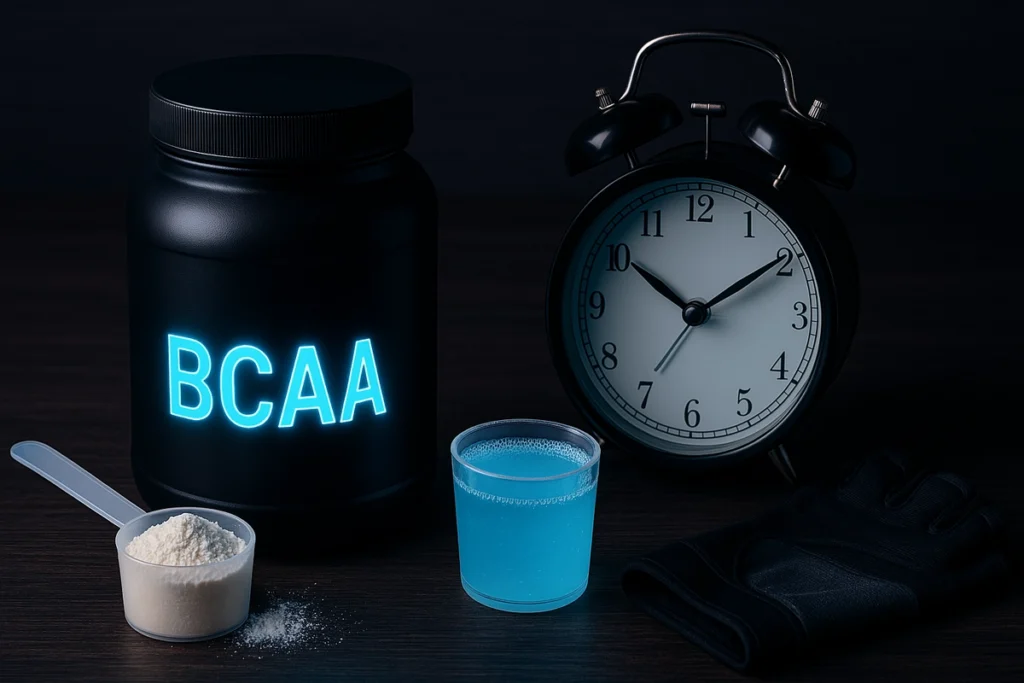
Because they skip liver breakdown and hit your bloodstream rapidly, they’re uniquely suited for very specific windows.
⌚ When timed right, BCAAs help you:
- Curb muscle protein breakdown during stressful sessions
- Reduce delayed onset muscle soreness (DOMS) so you can train more often
- Sustain performance and focus, especially when energy dips late in a workout
- Speed up the start of recovery while you’re still breathing hard
Here’s the crucial part: BCAAs have a short window of peak availability. You want those amino acids already circulating while your muscles are under stress—not arriving hours later after the damage has already set in.
That’s why a little planning before and during your session goes further than randomly sipping them afterwards.
💡 Real Talk: A client of mine, Andre from Brazil, was struggling to recover during a lean bulk. We added just 7g of BCAAs 15 minutes before his training.
A week later he said, “Man, I don’t feel wrecked anymore the next day. I can actually hit legs twice a week now.” That kind of consistency edge is exactly what good timing unlocks.
When Should You Take BCAAs? Pre, Intra, or Post-Workout?

Timing your BCAAs around training gives you the biggest return. Here’s how to match your intake to your workout style.
Pre‑Workout (My Personal Favourite)
Taking BCAAs 10–15 minutes before you train primes your muscles and signals your body to hold onto protein. I rely on this every single morning because I train fasted, and it makes a noticeable difference.
The biggest benefit? I wake up the next day far less sore, even after heavy squats or deadlifts. For example, during a summer shred phase I trained early on an empty stomach. Sipping 7g of BCAAs 15 minutes beforehand stopped me from crashing mid-session and helped me preserve muscle even while I was shedding body fat.
If you train fasted, are cutting calories, or simply want to feel fresher through the week, pre‑workout is your best bet.
Intra‑Workout: The Best Time to Drink BCAAs
If your sessions run long or you’re dragging by the middle of the workout, sipping BCAAs throughout training can be a game‑changer. The best time to drink BCAAs is during these extended or high‑volume blocks—you get a steady trickle of leucine, which fights fatigue and blunts muscle breakdown in real time.
Client Story: Aya, a bikini competitor I coached in Japan, used to train after draining workdays and would fade halfway through. We added an intra‑workout BCAA drink (5g in 750ml water, sipped from the first set to the last). Within two weeks she said she felt stronger into her final sets and needed less recovery between sessions. That hydration‑plus‑aminos combo kept her output high without adding calories.
If you’re doing two‑a‑days, endurance work, or punishing leg sessions, go intra.
Post-Workout
Post‑workout isn’t a bad time, but if you’ve already taken BCAAs before or during your session, adding more afterwards is often redundant—especially if you’re having a proper post‑workout shake or meal with high‑quality protein.
Think of post‑training BCAAs as bonus recovery, not the main event. They can still help on days when you forget your pre‑workout dose or train in a rush, but they won’t deliver the same protective edge as having amino acids circulating while your muscles are under stress.
The priority order stays simple: pre or intra first. Then whole-food protein after.
BCAAs for Muscle Growth: Best Time to Take Them
BCAAs don’t build muscle on their own—you need full‑spectrum protein for that. But what they do is protect the muscle you already have.
By reducing muscle protein breakdown during training, BCAAs help shift your body into a more anabolic, growth‑friendly state.
So, when’s the best time to take BCAAs for muscle growth?
The same window as recovery: pre‑workout or intra‑workout.


✅ Here’s the simple protocol I use with clients:
- Dose: 5–10 g in the classic 2:1:1 leucine‑forward ratio
- Timing: 10–15 minutes before you lift, or sipped throughout longer sessions
Why it works: Less muscle breakdown during hard training means less soreness, faster turnaround, and the ability to train harder, more often. Over weeks and months, that consistency adds up to visible size gains.
Real‑world result:
A powerlifter I coached trained fasted at 6 a.m. and was stalling on deadlifts. We added 8 g of BCAAs pre‑workout. Within three weeks, he broke through his rep plateau. After 12 weeks, he’d packed noticeable thickness onto his back and quads—not from the BCAAs alone, but from being able to train heavier and more frequently without burning out.
One non‑negotiable:
BCAAs are only the safety net. Muscle growth still depends on total daily protein (1.6–2.2 g per kg of bodyweight) and a calorie surplus or maintenance with adequate stimulus. Think of BCAAs as cheap insurance for the workout window—not a replacement for real meals. Use them when eating around training isn’t practical, and let your whole diet handle the heavy lifting.
BCAAs for Weight Loss: Best Time to Take Them (Preserve Muscle While Cutting)
When you cut calories, your body doesn’t just burn fat — it can raid your muscle for fuel. That’s the last thing you want after all that hard training. The right BCAA timing tells your body to prioritise fat as energy while sparing lean tissue, especially when your muscles are most vulnerable.
Why timing becomes critical on a cut
- Calorie deficits raise cortisol and muscle breakdown.
- Fasted training or morning cardio amplifies the risk of losing muscle.
- BCAAs pre‑workout shift your body towards fat oxidation while guarding protein stores.
The sweet spot: when to take them to protect muscle
- Pre‑workout (fasted or fed): 5–10 g around 15 minutes before lifting, HIIT, or any demanding session. This floods your bloodstream with leucine right when breakdown signals peak.
- Fasted cardio: 5 g immediately before stepping onto the treadmill or bike. Zero calories, no insulin spike — just a direct amino acid shield.
- During intermittent fasting windows: If you train deep into a fast, BCAAs bridge the gap, keeping your muscles safe until your first real meal.
Client story: How Zayd kept his muscle during Ramadan
Zayd, a client in Dubai, was in a steep deficit while fasting from sunrise to sunset. By the time his post‑sunset workout arrived, his body had gone over 12 hours without protein — a prime environment for muscle loss.
We added 7 g of BCAAs 15 minutes before training. Despite the severe restriction, Zayd held onto his muscle mass, felt noticeably less drained, and even got comments that he looked fuller. “I thought I’d shrink,” he admitted, “but I actually kept my shape.” That’s strategic supplementation doing exactly what it’s meant to do.
Quick dosage cheat sheet
Situation | BCAA dose | Timing |
|---|---|---|
Pre‑workout (weights/HIIT) | 5–10 g | 10–15 min before |
Fasted cardio | 5 g | Right before starting |
Rest days on a cut | Optional | Only if protein intake is very low; otherwise rely on whole food |
Pro tip: Stick to a clean 2:1:1 ratio with no added sugars. The goal is muscle preservation, not a glucose spike that could switch off fat burning. This is the best time to take BCAAs for weight loss — right when your body needs a signal to burn fat and protect hard‑earned muscle.
How Much BCAA Should You Take?
For almost everyone, 5–10g of BCAAs per training session is the proven range. I personally use 7–10g on heavy leg or back days and closer to 5g on lighter sessions or rest days when I choose to supplement.
The magic isn’t in taking more — it’s in hitting the minimum effective dose and being consistent.
Why 5–10 g?
The key is leucine, the amino acid that flips the switch on muscle protein synthesis. Research suggests you need roughly 2–3 g of leucine in a serving to get that protective signal. A standard 5g scoop of a 2:1:1 BCAA powder provides about 2.5 g of leucine — right in the sweet spot. A 10g serving pushes you toward the top of the range, which is why harder training days may benefit from a little extra.
What about the 2:1:1 ratio?
Always look for a 2:1:1 ratio (Leucine : Isoleucine : Valine). That’s the formulation with the most research behind it. Leucine drives muscle preservation, isoleucine supports glucose uptake into cells, and valine helps with energy production and repair. Together they work synergistically, and the 2:1:1 split delivers them in the proportions your muscles actually use.
Does the form matter?
Whether you use BCAA powder, capsules, or tablets, the dosage is the same — just take 5–10 g total. Powders are usually the easiest and most cost-effective way to get the full dose without swallowing a handful of pills, but choose whatever fits your routine.
Pro Tip:
Don’t megadose. More than 10–12 g in one sitting doesn’t speed up recovery — it mostly ends up as expensive urine, and it can even cause stomach upset. Consistency, timing, and pairing BCAAs with a good diet will take you much further than overdosing ever could.
One client I coached, Andre, saw better recovery when we dropped his BCAA dose from a random 15g “heaping scoop” back to a measured 7g before training. His soreness didn’t change, but his stomach felt better and his wallet thanked him.
Who Actually Benefits from BCAAs?

BCAAs make the biggest difference for these four groups:
- Fasted training: 5–10g taken 15 minutes before a workout shields muscle without breaking a fast.
- Cutting or calorie deficit: Pre- or intra-workout BCAAs signal your body to preserve lean mass while you lean out.
- Back-to-back training days: A consistent pre/intra dose cuts next-day soreness enough to keep performance high.
- Low-protein or plant-based diets: They fill the leucine gap around your workout when whole-food protein falls short.
If you’re already eating enough high-quality protein and recovering well, you can safely save your money.
Should You Take BCAAs on Rest Days?
For most people eating enough protein, the short answer is no—you don’t need BCAAs on rest days. But there are a few specific situations where a small dose actually helps.
✅ When to take BCAAs on rest days:
- You’re in a deep calorie deficit or cutting – A 5g serving in the morning or between meals helps protect muscle when your body might otherwise break it down for fuel.
- You train hard on back-to-back days – If today is a rest day but you trained yesterday and will train again tomorrow, BCAAs can support ongoing recovery and reduce lingering soreness.
- You struggle to hit daily protein targets – On a low-protein or plant-based diet, a rest-day dose bridges the leucine gap to keep muscle repair humming.
❌ When to skip them:
- Your diet is already high in protein and you’re recovering well.
- You’re in a maintenance or surplus phase without intense training frequency.
- You’d rather spend your supplement budget on quality whole food or a complete protein powder.
How much on rest days?
Stick to a smaller serving—5g of BCAAs in a 2:1:1 ratio, taken in the morning or between meals. There’s no need for a full 10g dose when you aren’t breaking down muscle through training.
What I tell my clients:
Save your BCAAs mainly for training days, especially before fasted or grueling sessions. If you tick the boxes above, a rest-day scoop is a smart insurance policy—otherwise, give your body (and your wallet) a break.
BCAA Myths I See Too Often

Myth 1: BCAAs replace protein.
Nope. They’re only 3 of the 9 essential amino acids. You still need full protein (via food or shakes) to build and repair muscle fully.
Example: Elena thought she could sip BCAAs instead of eating. Once we corrected that and added real meals, her strength, mood, and body composition improved fast.
Myth 2: More BCAAs = more muscle.
Nope again. This isn’t pre-workout. Stick to the dose, time it well, and let your training and diet do the heavy lifting.
My Recommended BCAA Brands (Tried & Trusted)
Not all BCAA supplements are equal. I’ve tested dozens—some work, some are sugar bombs in disguise.
Here are my top picks:
- Xtend BCAAs by Scivation – includes electrolytes, amazing taste, ideal for long sessions or hot climates.
- Optimum Nutrition BCAA 5000 – clean, simple, affordable. No gimmicks, just what works.
Real Talk: When coaching Elena from Italy, a first-time bikini competitor, we used Xtend BCAAs to help her stay energized while cutting. She crushed her prep and came in lean and recovered.
When to Take BCAAs: Frequently Asked Questions
The ideal time is 15 minutes before your workout or sipped during training. Pre‑workout primes your muscles against breakdown, while intra‑workout keeps amino acid levels steady during long sessions. If you train fasted, pre‑workout becomes even more important to protect lean mass.
For muscle growth, take BCAAs pre‑ or intra‑workout. They don’t directly build muscle, but they reduce breakdown during training so your body stays in a net‑positive protein state. That means better recovery, harder sessions, and more muscle over time—especially when you train 3‑5 times a week.
Take BCAAs 15 minutes before fasted cardio or pre‑workout during a calorie deficit. This signals your body to spare muscle and favour fat as fuel. 5–10 g before a fasted morning walk or lifting session helps preserve lean tissue without breaking your fast.
Only if your daily protein intake is very low or you’re cutting aggressively. For most people, a high‑protein diet covers recovery on rest days. If you do use them, a small dose (5 g) in the morning can help curb muscle breakdown between training days, but it’s usually unnecessary.
Yes, but it’s often redundant. A quality protein shake already contains BCAAs. Mixing them together is fine and won’t hurt, but you’d get the same muscle‑sparing benefits from the shake alone. Save the standalone BCAA drink for fasted training or sipping during your workout when you don’t want a full shake.
Final Word: Best Time to Take BCAAs for Your Goal
If you’re training hard and want to stay consistent, BCAAs can be your recovery insurance policy – but only when you time them right.
💪 After years of coaching, here’s what I know works for real people with real goals.
- For muscle recovery and less soreness: Take 5–10g of BCAAs 10–15 minutes before your workout. If your session runs long or you train fasted, sip them during training too.
- For muscle growth: Timing matters most around your workout. Get BCAAs (and your overall protein) in pre- or intra-workout to protect the muscle you’re building. Combine this with a full protein source post-workout.
- For weight loss and cutting: Use BCAAs before fasted training or when calories are low. This helps preserve lean mass while your body taps into fat for fuel.
- On rest days? Not necessary for most people eating enough protein. But if you’re severely cutting, training back-to-back, or struggling to hit protein targets, a small 5g dose in the morning can help prevent muscle breakdown.
Quick reference: BCAA timing at a glance
Goal | Best Time | Dose & Ratio |
|---|---|---|
General recovery & soreness | Pre-workout (10–15 min before) | 5–10g, 2:1:1 |
Muscle growth | Pre- or intra-workout | 5–10g, 2:1:1 |
Weight loss / fasted training | Pre-workout (especially a.m. fasted) | 5–10g, 2:1:1 |
Rest days (if needed) | Morning | 5g, 2:1:1 |
Train smart. Recover harder. Respect the grind.
Stay consistent,
– Hossein, Fitness Coach @ MuscleZeus
💬 Still unsure which BCAA fits your goals? Drop a comment below.
Leave a Reply