


Struggling to hold onto muscle while fasting? You’re not alone.
Many lifters fear losing strength and muscle gains during intermittent fasting. That’s where EAAs (Essential Amino Acids) come in.
✅ Quick answer: No, EAAs do not break your fast. They help preserve muscle without disrupting fat loss or autophagy.
⚠️ Ramadan clarification: For Islamic fasting (dawn to sunset), do not take EAAs during daylight hours. Take them only after Iftar or before Suhoor.
In this article, I’ll break down the science and real-world coaching experience so you can decide if EAAs belong in your fasting routine.
Table of contents
What Are EAAs and Why Do They Matter During a Fast?
EAAs are the nine essential amino acids your body can’t produce on its own.

They’re crucial for muscle protein synthesis, especially when you’re not eating for extended periods.
During intermittent fasting, your body may start breaking down muscle tissue for amino acids.
Supplementing with EAAs gives your body what it needs—without triggering a full-blown metabolic response that breaks your fast.
📌 For a detailed comparison between EAAs, BCAAs, and protein powder, check out this comprehensive guide.
Want to know the ideal dosage for lifters? Here’s a helpful breakdown: EAA Dosage for Lifters.
⚡ Your EAAs could be doing nothing right now
Bad timing and wrong dose = expensive urine. Here's how to actually absorb them.
Maximize My EAAs FreeEAAs vs BCAAs During a Fast
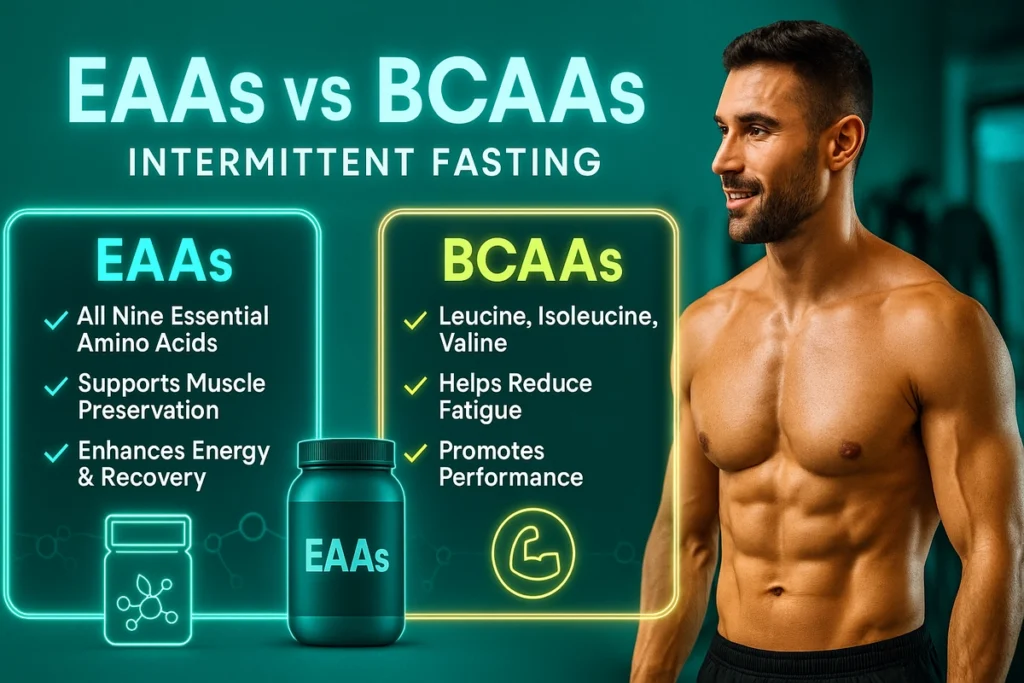
Many people confuse EAAs with BCAAs.
The difference? BCAAs contain just three amino acids (leucine, isoleucine, valine), while EAAs provide all nine.
I’ve personally tested both during fasted training. EAAs consistently outperformed BCAAs—less fatigue, better recovery, and better results.
A client of mine, Daniel, was using BCAAs during his mini-cut but kept feeling drained.
After switching to EAAs, his energy bounced back, and his strength didn’t dip.
For more insights on this topic, check out:
EAAs vs BCAAs During Workout and
EAAs vs Protein Powder.
Do EAAs Affect Insulin or Autophagy?
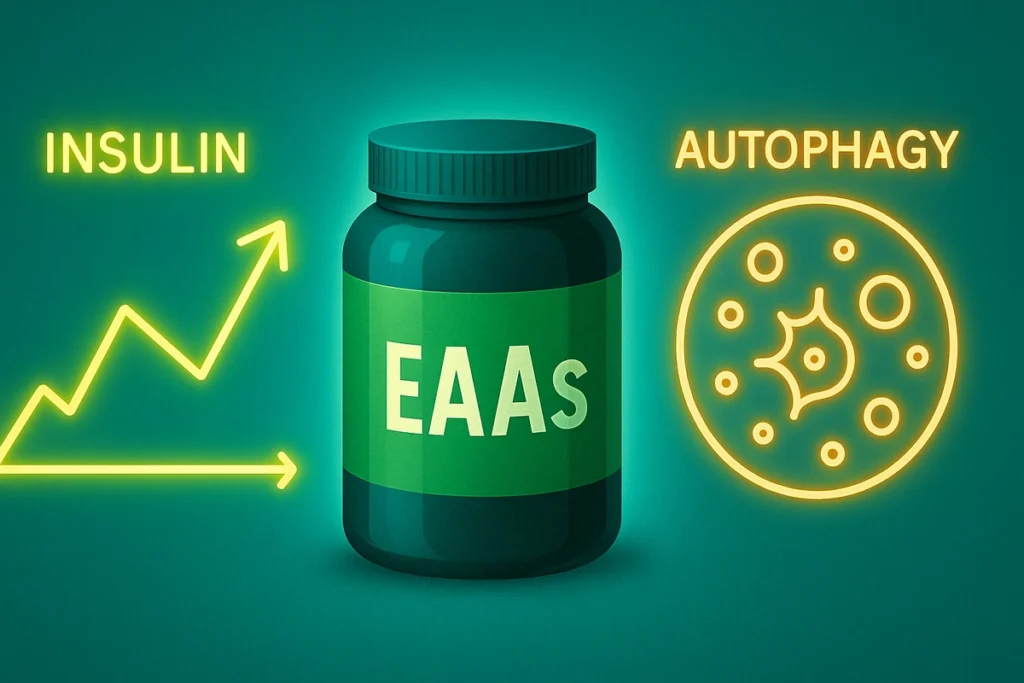
This is one of the most common concerns.
While EAAs may cause a mild insulin response, it’s not enough to kick you out of a fasted state or interfere with fat loss or autophagy in any meaningful way.
In fact, I’ve coached clients through Ramadan (like Luca, who trained early mornings) using EAAs with great results.
They powered through fasted workouts without breaking the fast or losing muscle mass.
To understand how EAAs help with body composition goals, read:
EAAs for Fat Loss and Muscle Retention.
You just read everything about EAAs. Now let’s make it work for YOUR body.
I’ll design your personalized supplement protocol — exact timing, dosage, and stacking for your specific goal. No templates. No bots. A real coach who reads your answers.
Pay what you want after you receive it. No risk. No pressure.
When and How to Take EAAs While Fasting
Timing matters. The best time to take EAAs is before or during your fasted workouts.
I usually sip mine 10–15 minutes before lifting. That’s when you need muscle protection the most.
This was especially helpful for one of my clients, Michelle, who trained fasted during her fat loss phase.
She dropped over 5 kg in 8 weeks and kept her muscle tone, all thanks to solid programming and smart EAA use.
Learn more in this practical guide: Best Time to Take EAAs.
Also, check this in-depth article for active women: EAAs for Women in Strength Training.
Many fasting clients use EAAs during training windows to reduce muscle loss and maintain strength. This EAAs fasting guide explains how they fit into IF safely.
Taking EAAs in the Morning While Fasted (With No Exercise)
If you wake up fasted and don’t plan to train until later—or at all—you might still benefit from EAAs.
- Does it break your fast? No. A single 5g serving contains minimal calories (≈10–20 kcal) and won’t disrupt fat loss or metabolic fasting.
- Does it help without exercise? Mildly. EAAs stimulate muscle protein synthesis (MPS) even at rest, helping preserve lean mass during extended fasting periods. However, the effect is smaller than when combined with training.
Best protocol:
Scenario | Recommendation |
|---|---|
Morning fasted, training later | 5–10g EAAs upon waking |
Morning fasted, no training | 5g EAAs (optional) |
Strict autophagy fast | Skip EAAs |
Who Should Consider EAAs During a Fast?
If you’re lifting weights or doing intense cardio during your fasting window, EAAs can make a big difference.

I recommend them to:
- Lifters on a cut
- Athletes training early mornings
- People aiming to preserve lean muscle while losing fat
For beginners, EAAs aren’t essential, but they can help if you’re struggling with energy or soreness.
For leaner, more advanced lifters, they can be a game-changer.
Need more context for how to use EAAs during your session?
Here’s a full EAA During Workout Guide.
Frequently Asked Questions
No. EAAs contain very few calories (about 10–25 per serving). They do not provide enough energy to end a fasted state for fat loss or muscle retention.
No. One serving of EAAs has the same effect as black coffee or tea. It will not stop fat burning or kick you out of a fast.
No. Clean, unflavored EAA supplements with no added sugar or carbs are safe to use during a fasting window.
No, but it depends on your goal.
For fat loss and muscle preservation → safe to take.
For strict autophagy (cellular cleanup) → skip it and stick to water only.
Yes, but the benefit is small. Without exercise, EAAs still help maintain your body’s nitrogen balance, but they won’t stimulate much muscle growth. Take them only if you feel weak or very hungry.
Multiple small doses are slightly better for muscle protein synthesis, but one dose is more practical. One dose of 5 to 10 grams is easier and works well for most people. Two or three smaller doses of 3 grams every 2 to 3 hours gives slightly better muscle support, but it is less convenient.
Yes, but very mildly. The insulin rise from EAAs is similar to drinking black coffee or green tea. It is not strong enough to break your fast for weight loss or muscle retention purposes.
Not in a meaningful way for most people. A small serving of EAAs may temporarily lower autophagy slightly, but it does not shut it off completely. For deep autophagy (e.g., for longevity or cell repair), water-only fasting is still best.
Take them 10–15 minutes before a fasted workout. That is when your muscles need protection the most. You can also sip them during training.
5 to 10 grams per serving. Start with 5g if you are new. Go up to 10g if you train hard or are an advanced lifter.
Yes. EAAs are safe for daily use during your fasting window. Just choose a clean formula with no added sugar, artificial flavors, or fillers.
Strict autophagy purists and people doing medical fasts. If your only goal is maximum cellular cleanup for 24+ hours, stick to water only. Everyone else can benefit from EAAs.
Are EAAs Worth It for Intermittent Fasting?
Yes—if you train fasted and want to protect muscle.
EAAs aren’t magic, but they solve a real problem: muscle breakdown during long fasting windows.
Who gets the most value?
Type | Worth it? |
|---|---|
Fasted lifters (standard IF) | ✅ Yes |
Early morning trainers | ✅ Yes |
Cutting phases | ✅ Yes |
Strict autophagy purists | ❌ Skip |
Beginners (easy muscle gain) | ⚠️ Optional |
Important reminder: Ramadan & Islamic fasting
⚠️ If you are fasting for religious reasons (Ramadan, dawn to sunset):
- Do NOT take EAAs during daylight hours — even unflavored or zero-calorie
- Take EAAs only after Iftar (breaking the fast) or before Suhoor (pre-dawn meal)
- Metabolic fasting ≠ religious fasting. Respect the rules of your fast.
Final verdict
- Do EAAs break a metabolic fast? No.
- Do they preserve muscle? Yes.
- Do you need them? Only if you train fasted and struggle with energy or soreness.
- Can you take them during Ramadan daylight? No.
What to buy
Choose unflavored or naturally sweetened EAAs with minimal additives. Avoid maltodextrin, artificial colors, or hidden calories.
EAAs won’t break your metabolic fast—but they can break the cycle of muscle loss, fatigue, and poor recovery. For religious fasting, save them for your eating window.
Leave a Reply