
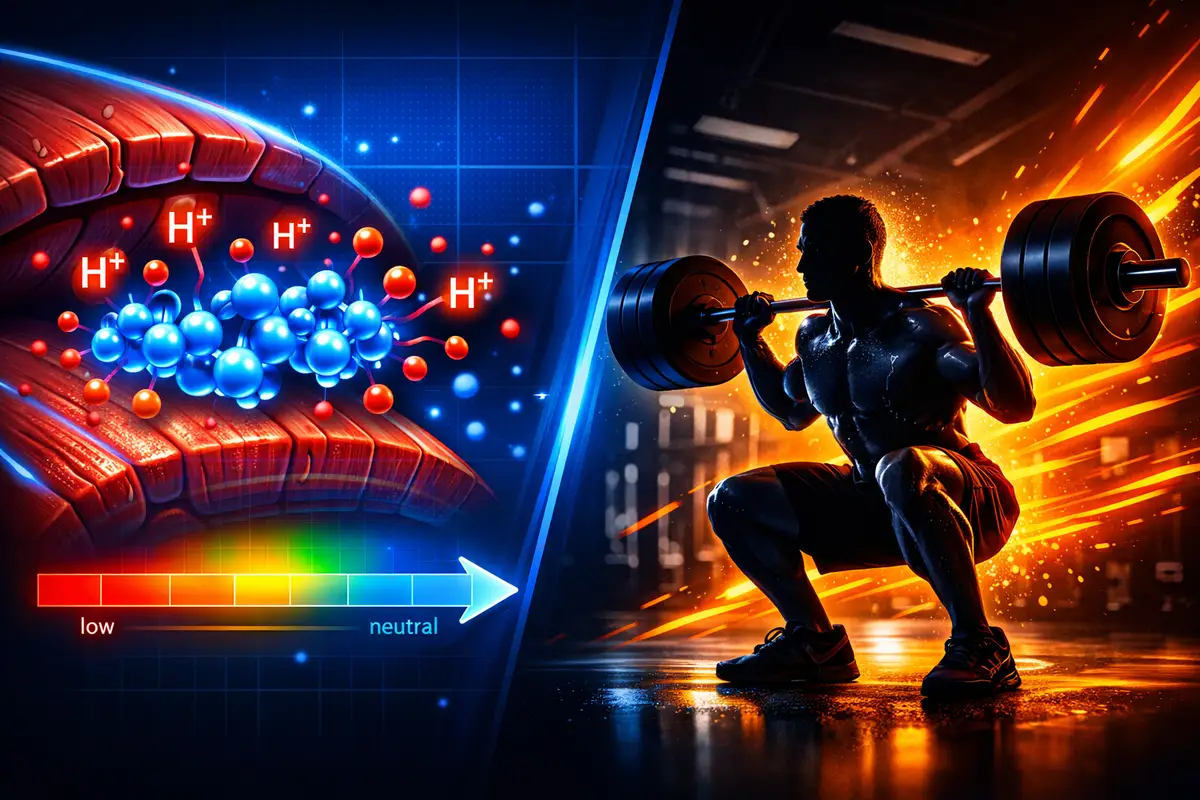

You know that moment mid-set when your muscles feel like they’re filling with wet cement? That burning, searing sensation that screams at your brain to drop the dumbbell and walk away?
That’s not weakness leaving the body. That’s hydrogen ions crashing the party. And Beta-Alanine? It’s the bouncer you need at the door.
I’m Hossein Mardali. I’ve spent over a decade in the trenches of bodybuilding and the last seven years coaching everyone from physique athletes to combat sports fighters.
If there’s one supplement that people feel but rarely understand, it’s Beta-Alanine.
Let me explain exactly what it does, why the tingles don’t matter, and how to use it like a pro.
Table of contents
- What Does Beta-Alanine Actually Do? (The Direct Answer)
- Why Does Buffering Hydrogen Ions Matter for Performance?
- How to Use Beta-Alanine for Optimal Buffering (Coach’s Protocol)
- Beta-Alanine vs. Sodium Bicarbonate: Different Buffering Systems
- Managing the Tingles (Paresthesia)
- Frequently Asked Questions (FAQ)
What Does Beta-Alanine Actually Do? (The Direct Answer)
Let’s cut through the bro-science and get straight to the cellular level. When you push a heavy set of squats or sprint a 400m repeat, your body burns glucose for fuel without oxygen.
The byproduct of this process is not just “lactic acid.” That’s an outdated term we need to retire.
Here’s the real chain reaction:
Glucose breaks down and produces Pyruvate, which then converts to Lactate AND a positively charged Hydrogen Ion (H+).
Lactate is actually a fuel source your body can reuse. The villain here is the Hydrogen Ion. H+ accumulation drops the pH inside your muscle cell, making the environment more acidic.
When the inside of your muscle cell becomes too acidic, two critical failures happen.
- First, the enzymes responsible for breaking down ATP (your immediate energy currency) stop working efficiently.
- Second, calcium sensitivity decreases, meaning your muscle fibers literally cannot slide past each other as forcefully.
The Direct Answer: Beta-Alanine’s job is to bind with the amino acid Histidine already present in your muscle. Together, they form a dipeptide called Carnosine. Carnosine acts as an intracellular pH buffer.
Think of it as a sponge inside your muscle cell that soaks up those pesky Hydrogen Ions. By mopping up H+, Carnosine delays the drop in pH, allowing you to maintain power output for 1 to 4 more reps in the gym or shave seconds off your track time.
For a complete breakdown of dosing protocols and the full mechanism of action, check out the Beta-Alanine Ultimate Guide.

Is Beta-Alanine Really the Best Choice for YOU?
Analyze your body, training and goals to discover which supplements will actually benefit you—not just creatine.
No signup required · Results instantly
Why Does Buffering Hydrogen Ions Matter for Performance?
I’ve had countless clients walk into my coaching practice saying, “I need to work on my lactic acid tolerance.” I gently correct them every time. You don’t need to tolerate the acid. You need to neutralize it.
The “Burn” Myth Debunked
The burn you feel in the last grueling reps of a leg extension isn’t lactic acid melting your quads. It’s the Hydrogen Ion (H+) accumulation stimulating pain receptors.
By increasing muscle Carnosine stores via Beta-Alanine supplementation, you are essentially raising the “acid ceiling” before that pain signal becomes overwhelming.
The Performance Window: Where Beta-Alanine Shines
This is where many recreational lifters get lost. Beta-Alanine is not a Swiss Army knife for all fitness goals. Its effectiveness is tied directly to the duration of the effort and the energy system used.
Type of Activity | Duration | Energy System | Beta-Alanine Impact |
|---|---|---|---|
1-Rep Max Deadlift | 3-5 Seconds | ATP-PCr (Phosphocreatine) | Minimal to None |
100m Sprint | 10-12 Seconds | ATP-PCr / Fast Glycolysis | Low |
400m Run / HIIT Intervals | 60 – 180 Seconds | Fast Glycolysis | HIGHEST IMPACT |
High-Rep Squats (12-20 Reps) | 45 – 90 Seconds | Fast Glycolysis | HIGH IMPACT |
5k Jog / Marathon Pace | 20+ Minutes | Aerobic / Fat Oxidation | Low to Moderate |
If your goal is to be explosive for under 10 seconds, stick to Creatine. If your goal is to sustain high-intensity output for over a minute without your muscles seizing up, Beta-Alanine is non-negotiable.
This performance window also explains why athletes in sports with repeated high-intensity bursts see such profound benefits. If you compete in soccer, basketball, or combat sports, you’ll want to read about Beta-Alanine for Mixed Sports Performance.
How to Use Beta-Alanine for Optimal Buffering (Coach’s Protocol)
This is the section where 90% of gym-goers get it wrong. They think Beta-Alanine is like Caffeine. Pop a scoop 30 minutes before the gym and you’re superhuman. That is not how this compound works.
The Saturation Loading Phase
Beta-Alanine is a chronic loading supplement, not an acute pre-workout stimulant. You are building a reservoir of Carnosine in your muscle tissue, and that takes time and consistency.
The key numbers you need to know:
- Daily Intake: Aim for 3.2g to 6.4g total per day.
- Duration: Minimum 4 weeks to see meaningful performance shifts.
- Peak Saturation: Muscle Carnosine levels hit their ceiling around 8-12 weeks of consistent daily use.
- Consistency is King: Take it on rest days. Take it on active recovery days. The muscles don’t load Carnosine just because you’re sweating. They load it because the substrate is in the blood.
Coach’s Real-World Example
I had a client named Marco, a competitive CrossFit athlete. He was a beast on the rig but his engine on the Assault Bike during max-calorie intervals would fade fast.
We implemented a strict 1.6g dose with breakfast and 1.6g with dinner protocol. After 5 weeks, his 60-second max calorie output on the Bike Erg increased by 8 calories.
Here’s the kicker. Two months later, we ran out of his supply and I didn’t tell him we were switching to a placebo for two weeks. This was strictly for data tracking.
His output dropped almost exactly back to baseline. He texted me: “I don’t know why, but my legs are blowing up way too early.”
That’s the proof right there. It wasn’t the placebo effect of the tingles. It was the depletion of the Carnosine buffer.
Synergy Stacking
While Beta-Alanine handles the intracellular buffering, it plays very nicely with others:
- Creatine Monohydrate: Handles the first 10 seconds of the set (ATP).
- Beta-Alanine: Handles reps 10 through 20 (pH Buffer).
- Sodium Bicarbonate: Handles acid outside the cell. More on this advanced tactic later.
For rowers specifically, this buffering capacity translates directly to maintaining stroke power in the final 500 meters. I’ve detailed this application in Beta-Alanine for Rowing: Unlock Explosive Power.

🔍 Not Seeing The Results You Expected?
Answer a few quick questions and our smart system will analyze your routine, diet, and recovery to pinpoint exactly what’s holding you back.
No signup required · Results instantly
Beta-Alanine vs. Sodium Bicarbonate: Different Buffering Systems
Since you’re reading this, you’re likely the kind of person who wants the edge. Let’s talk about the difference between buffering inside the muscle and outside the muscle.
Feature | Beta-Alanine (Carnosine) | Sodium Bicarbonate (Baking Soda) |
|---|---|---|
Location of Action | Intracellular (Inside Muscle Fiber) | Extracellular (Bloodstream) |
Mechanism | Directly binds and neutralizes H+ | Increases blood bicarbonate to mop up H+ exported from muscle |
Timing | Chronic Loading (Weeks/Months) | Acute Dose (60-90 Mins Pre-Event) |
Side Effects | Paresthesia (Tingling – Harmless) | GI Distress, Bloating, Urgent Diarrhea |
Best For | Daily Training Consistency | Competition Day / Testing Day |
Practical Application: For a general physique client doing leg day, I stick exclusively to Beta-Alanine. The risk of ruining a workout with stomach cramps from Sodium Bicarbonate isn’t worth it.
However, for my combat athletes—like my fighter Dmitri—we use a specific enteric-coated sodium bicarb capsule 90 minutes before a fight simulation. This goes on top of fully saturated Beta-Alanine stores.
He describes the difference as “throwing volume in round three that I used to only have in round one.”
If you’re curious about how this buffering system affects maximal strength output specifically, I cover that in depth in Beta-Alanine for Powerlifting: Boost Strength & Endurance.
Managing the Tingles (Paresthesia)
Let’s address the elephant in the room: The face-scratching, ear-tingling sensation known as Paresthesia.
What It Is
Beta-Alanine binds to nerve receptors under the skin. These are called Mas-related G-protein coupled receptors. It’s a harmless neurological signal, not an allergic reaction.
The Mistake Most People Make
People take a 6g scoop of pre-workout powder on an empty stomach 10 minutes before deadlifts. They spend the next 20 minutes looking like they have ants crawling under their gym hoodie. Then they swear off Beta-Alanine forever.
This is completely avoidable.
The Solution
- Split Your Dose: Instead of a 3.2g bomb, take 1.6g (or even 800mg) at a time.
- Take With Food: A meal slows gastric emptying and drastically reduces the intensity of the tingle.
- Sustained-Release Formulas: I have a client named Priya who is a software engineer and absolutely hates the sensation. It distracts her during her lunch lifts.
We switched her to a Sustained-Release Beta-Alanine capsule. Zero tingles. It takes about an extra week to fully saturate the muscle, but she stays compliant.
Compliance beats perfection every single time.
Frequently Asked Questions (FAQ)
You will notice small improvements within 2 to 3 weeks. Full muscle saturation and peak performance take 8 to 12 weeks of daily use.
No. Beta-Alanine needs to build up in your muscles over time. Taking it only on workout days does not work. You must take it daily, including rest days.
It helps with both but only at high intensity. It works great for 400m repeats, hill sprints, and fast finishes. It does very little for slow, steady jogging.
No. The tingling is harmless. It happens because Beta-Alanine touches nerve receptors under your skin. It is not an allergy or a health risk.
You do not need to cycle it. Muscle carnosine levels drop very slowly. Some coaches suggest a 2 to 4 week break every 6 months just to reset tolerance.
Take 3.2 to 6.4 grams total per day. Split it into smaller doses of 1.6 grams to avoid strong tingling.
Yes. They work through different systems. Creatine helps with short bursts of power. Beta-Alanine helps you push through longer, burning sets. They pair perfectly.
Not directly. It does not burn fat. It helps you train harder and longer. That extra training volume can support fat loss over time.
No. Beta-Alanine does not help with maximal strength or one-rep max attempts. Those efforts are too short for hydrogen ions to build up.
Yes. Taking it with a meal reduces the tingling sensation and makes it easier on your stomach.
Leave a Reply